Monthly Archives: September 2016

The Dice Lab, Sum of Cubes, and Double Polyhedra

Welcome to this week’s Math Munch!

It’s the final Thursday of September, so it’s time again for a recap of the month’s best from our Facebook page. This month we have a new sort of dice, a beautiful illustration of a numerical fact, and some wonderful new sculpture work from Rinus Roelofs. Let’s dig in.

First, check out this wonderful image. Meditate on it, and see if you can figure out what’s going on, even if you can’t understand the notation.
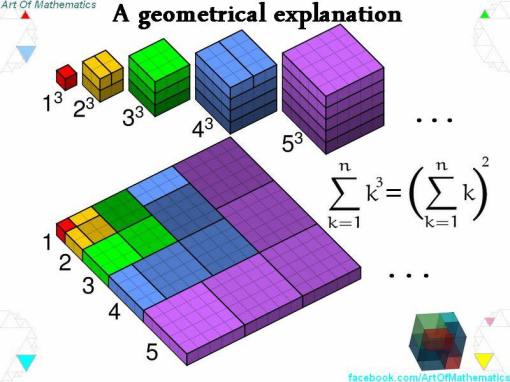
sum-of-cubes

It’s showing us a simple way to compute a sum of cubes. They can be broken down and reconstructed as a square! Consider the sum of the first 3 cube numbers, for example: 1+8+27=36, and 36 is the square of 6. One step further, 6 is the sum of the first 3 numbers.

So in the picture above, the sum of the first 5 cubes is equal to the square whose side length is the sum of 1 through 5.  AMAZING, and a beautiful illustration. Can you see why it always works, not just for 1 through 5? That’s key! And now test your understanding: What is the sum of the first 100 cube numbers?
dicelablogoUp next, we’ve met Henry Segerman plenty of times on Math Munch, including a look at the project he shares with Robert Fathauer, called The Dice Lab. They make mathematically interesting dice that have, in most cases, never been produced before. There newest creation (also last? see the video to see what I mean) is a 48-sided dice. Very cool. Can you think of a use for a 48-sided die?  It sure looks cool. Reminds me of a rhombic dodecahedron. Do you see the connection?

Finally, another familiar face – the incredible mathematical artist, Rinus Roelofs – has been making incredible things. We met Roelofs in July, but his facebook page has been full of activity since then. His recent work has focused on double-covered polyhedra.  You’ll have to click over and browse to see what I mean. Recently he posted a project I might want to take on. These are fold-up models for his creations. Check out the gallery below.
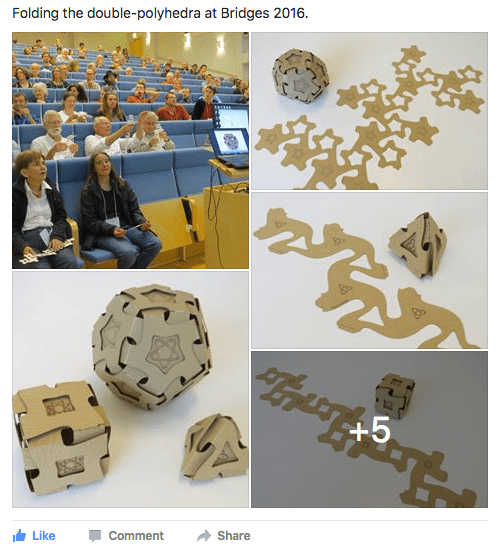
screen-shot-2016-09-29-at-10-56-47-am

I’m not 100% sure how that cube one works, but I think I can figure it out, and I bet some of you can too. Of course, I’m sure we’ll make mistakes, but if we keep on learning, I bet we can get this figured out. If anyone ends up making a template of their own, email it to us and we’ll share it on the site.

Until next time, bon appetit!


Demonstrations, a Number Tree, and Brainfilling Curves

This month of September has five Thursdays in it, so enjoy this bonus blast from the past. We hope it will “fill your brain”!

Justin Lanier's avatarMath Munch

Welcome to this week’s Math Munch!

Maybe you’re headed back to school this week. (We are!) Or maybe you’ve been back for a few weeks now. Or maybe you’ve been out of school for years. No matter which one it is, we hope that this new school year will bring many new mathematical delights your way!

A website that’s worth returning to again and again is the Wolfram Demonstrations Project (WDP). Since it was founded in 2007, users of the software package Mathematica have been uploading “demonstrations” to this website—amazing illuminations of some of the gems of mathematics and the sciences.

Each demonstration is an interactive applet. Some are very simple, like one that will factor any number up to 10000 for you. Others are complex, like this one that “plots orbits of the Hopalong map.”

Some demonstrations are great for visualizing facts about math, like these:

Any Quadrilateral Can…

View original post 415 more words

Functionized Photos, Projective Games, and Traffic

Welcome to this week’s Math Munch!

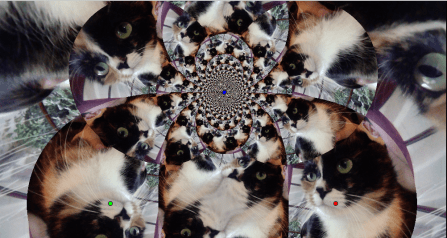
Have you ever looked in a distorted mirror– one that stretched and squeezed your face so that you looked very, very silly? If you like that, check out this program called the Function Explorer that distorts your picture according to different functions!

Crazy Mikos

My cat under the “fraction” function

To use the program, you’ll have to turn on your webcam. Then, select one of the functions listed– maybe similarity, log, or fraction. Then, watch as the image in front of your webcam twists, expands, and repeats as the function distorts the picture!

What’s going on here? The program treats your picture like it’s on something called the complex plane— which is kind of like the regular two-dimensional plane we’re used to, except that some of the numbers multiply strangely. One of the dimensions on the complex plane is made of regular, normal numbers– which, in this situation, are called the “real numbers”– while the other dimension is made of different numbers, called “imaginary numbers.” These are the numbers that do weird things when you multiply them together. Maybe you’ve heard that you can’t take the square-root of a negative number. Well, on the complex plane you can. And when you do, you get an imaginary number!

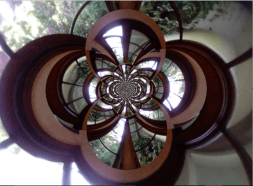
Windows

Windows, under 1/z

If you’re curious about these crazy creatures called imaginary numbers and how they work to make images go wild on the complex plane, I recommend you check out this site. It gives a great interactive explanation of imaginary numbers (and teaches you about fractals, too!). But I also wouldn’t blame you if you wanted to spend a few hours holding things in front of your webcam and seeing what happens to them under different function transformations!

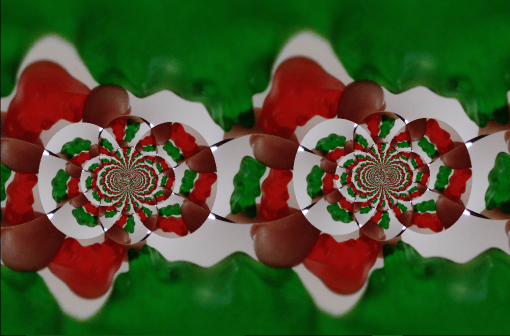
Gummy bears

Gummy bears! Which function did this?

screen-shot-2016-09-14-at-9-58-52-pm

Meet Donna

Next up, I’d like to share a fun collection of games with you. They’re all made by mathematician Donna Dietz, and they all have to do with a particular kind of math that I find very interesting– projective geometry! You can still enjoy the games even if you know nothing about projective geometry (and you might learn something at the same time).

screen-shot-2016-09-14-at-9-19-29-pmThe rules are pretty simple: Donna gives you a bunch of cards with symbols on them. For example, in the version shown here, you get 13 cards with 4 symbols on them each. There are a bunch of different symbols. Your task is to pick four cards to discard and arrange the remaining nine so that the cards in each row, column, and diagonal share exactly one symbol.

Donna’s projective geometry games page has links to lots more games (if you think the game with cards in three rows and columns is too easy, try one with five) and information about them.

“What does this have to do with geometry?” you might be wondering. These games show a very important property of points and lines in projective geometry. In regular geometry (which you could also call Euclidean geometry), you can have two lines that don’t share any points– meaning that they’d be parallel. But this isn’t possible in projective geometry. All pairs of lines share exactly one point. How is this related to Donna’s games? If lines are rows, columns, and diagonals of cards, and points the symbols on them…

If you’d like to learn more about how and why Donna developed these games, check out this page!

Finally, I’ve been driving a lot lately. I live in the Bay Area, and there is SO MUCH TRAFFIC AAAAAAAA!!! I went searching for solutions, and I came across this great video by our friend CGP Grey (who also made these great videos about voting theory). There’s a lot of math going on here, even if it isn’t immediately apparent. Can you find the math? (Oh, and can you stop causing traffic jams? Thanks.)

Don’t Math Munch and drive, and bon appetit!