Author Archives: Anna Weltman

Mathy Clocks, Spirolaterals, and Mandalas

Welcome to this week’s Math Munch!
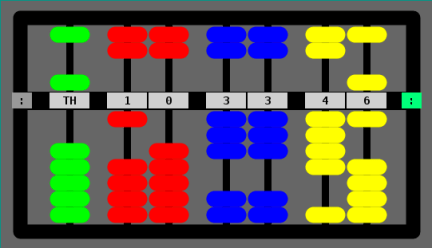
Screen Shot 2016-03-31 at 10.33.37 AM

Hermann’s Abacus Clock. What time was I working on this post?

A few months ago, the Math Munch team got an email from retired mathematician Hermann Hoch with a lead to his amazing website full of (among other things)… clocks! One of the things Hermann does with his spare time in retirement is make creative math-y clocks using html. He calls them “html5 experiments”– and they really do take math art to the next level!

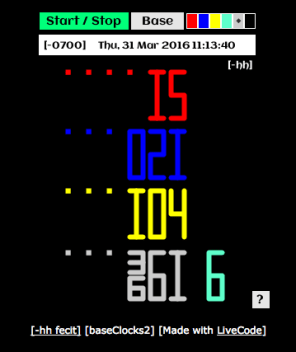
There are many fascinating clocks on Hermann’s site. (Be careful, or you might spend too much time watching the seconds go by!) One of my favorites is a clock he calls the Mondriaan Clock. The display is inspired by the art of Dutch painter Piet Mondriaan, who was known for his paintings of overlapping squares and rectangles in primary colors. The clock also comes with the exciting prompt– “wait until time creates golden ratios for us”! At what time will one of the rectangles in the image have dimensions that approximate the Golden Ratio? Hermann says that this question isn’t easy– he hasn’t even found all of the times himself! (And I’m sure he’d love to know– post your ideas in the comments below.)

Next up, I’ve been obsessed with Spirolaterals lately. What’s a Spirolateral, you ask? It’s a shape made by drawing segments of different lengths (say, 2, 3, and 4) one after another in a cycle (say, right, up, left, and down) until the shape closes up (or doesn’t, and you know it never will). If you follow those instructions (drawing on grid paper helps), you make this flower-like shape:

Screen Shot 2016-03-31 at 10.55.24 AM


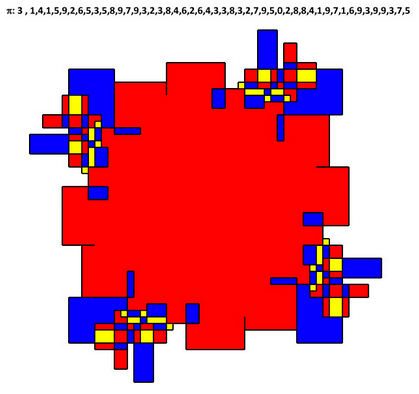
You can make Spirolaterals (or Loop-de-Loops, as they’re also called) with any numbers and using any turning angle. This Spirolateral uses three numbers and a turning angle of 90 degrees. (See the square corners?) But what if you use four numbers? Five numbers? Thirteen numbers? You can try drawing by hand- and then coloring them in, to make a beautiful mathematical creation. The Spirolateral below uses the first 50 digits of pi!
Screen Shot 2016-03-31 at 11.00.37 AM.png

But you also don’t have to draw them by hand. The two Spirolaterals shown here were both drawn using a computer program! My favorite program for drawing Spirolaterals with 90 degree turns is this one, made by Chris Lusto. He gives great instructions and allows you to use as many numbers as you like!

But what if you wanted to make a Spirolateral with a… 109 degree turn? Wouldn’t that be cool! Well, yes, it is cool–

Screen Shot 2016-03-31 at 11.04.41 AM.png

You can make this and other crazy Spirolaterals at this awesome website, brought to us by The Mathenaeum.

Finally, I leave you with this mesmerizing video of Dearing Wang drawing a Mandala. If you thought you’d never use your skills with a straight-edge and compass you worked so hard to develop in Geometry class– think twice. And for you straight-edge and compass nerds, keep an eye out for his pentagon construction! Is it perfect??

Bon appetit!
Screen Shot 2016-03-31 at 11.13.27 AM.png

How long did it take me to make this post? (Hint: This clock tells time in base 6!)

Fold and Cut, My Favorite Spaces, and Hook

Welcome to this week’s Math Munch!

Before you watch this video, think about this question: Do you think you could fold a piece paper so that you could cut a square out of it using exactly one straight cut? How about a triangle? Hexagon? Christmas tree shape??

Give it a try. Then watch this video:

Pattern for a very angular swan, by Erik Demaine

Surprised? As you may have seen in the video, using the “fold and cut” process you can make any shape with straight sides! Isn’t that crazy? I learned about this a few years ago, and now cutting weird shapes out of paper using just one cut is one of my favorite things to do.

The person who proved this amazing result is one of my favorite mathematicians, Erik Demaine. (You might remember him from our post a few years ago about origami mazes.) I think it’s really interesting that this idea that’s now a mathematical theorem appeared throughout history as a magic trick and a method for cutting out five-pointed stars to make American flags. Check out this website about the fold and cut problem to learn more about the history of the theorem, Demaine’s method for cutting out any straight-edged shape, and other related problems.

Evelyn wearing a Borromean ring cowl. Sweet!

I found out about this video from another favorite mathematician of mine, Evelyn Lamb. Evelyn writes a blog about math for Scientific American called Roots of Unity that’s really fun to read. Check it out if you get the chance!

She has a series of posts called “A Few of My Favorite Spaces” (cue Sound of Music song, “My Favorite Things”). Favorite spaces, you may ask? I’m not familiar with spaces plural. There’s more than just regular old 3D space? Yes, in fact there are! And if you read Evelyn’s blog you’ll learn about how mathematicians like to invent new spaces with bizarre properties– and sometime find out that what they thought was a completely new space actually resembles something very familiar.

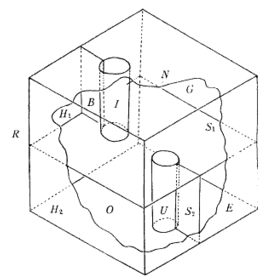
House with 2 roomsSuch as… The “house with two rooms.” As I understand it, this a box (“house”) with two floors and two tunnels in it– one punched from the top of the box and another from the bottom. The top tunnel lets you get from the roof of the house to the ground floor; the bottom tunnel lets you get from below the house to the second floor.

If you want to see someone making this crazy house in Minecraft and hear a much better explanation of what the house is like, here’s a video!

https://www.youtube.com/watch?v=_x_ZvTpx4dE

Ok, so what’s the point? Well, it turns out you can squish (just squish– no ripping or gluing) this house all the way down to a single point. This means that in topology (the type of math that involves a lot of squishing), the crazy tunnel house space is the same as the really boring space of just one point. I might want to live in a house with all these tunnels– but I definitely don’t want to live in a point. But in topology-world, they’re the same space. Huh.

To learn more about the house with two rooms (aka, point) and other crazy spaces, check out Evelyn’s blog!

Finally, speaking of squishing things down to a point, I want to show you a fun new game I found that involves a lot of squishing– Hook! Here’s a trailer video for the game:

You can find this game online at Kongregate. Enjoy!

Bon appetit!

HYPERNOM, Euclid the Game, and Math Quilts

Welcome to this week’s Math Munch! And, welcome to a new school year! Back to school means back to Math Munch– and we’re super excited to share some great new things that we found over the summer.  The first of which is…

… THIS.

(GIF hoisted from the amazing Aperiodical)

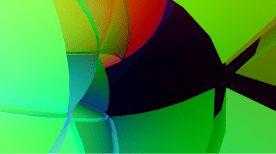
That’s an image from this crazy new game called HYPERNOM, invented by some of our favorite people– Vi Hart, Henry Segerman, and Andrea Hawksley!

Noming through tasty tasty tetrahedra. Mmmm!

Noming through tasty tasty tetrahedra.

In this game, you wiggle around in a projection of 4-dimensional space, eating (or, better put, NOMING– NOM NOM NOM) 4-dimensional objects. Such as the dodecahedra (polyhedron with faces made from regular pentagons) that come together to form the 4-dimensional shape (called a polytope) you’re moving around in.

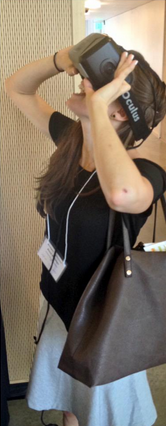
Playing hypernomThis game is MINDBLOWING. Really. You can play it on your computer– but I got to play it wearing a helmet that plunged me into the fourth dimension and left me feeling very dizzy.

The math behind HYPERNOM is kind of complicated but VERY interesting. If you’d like to learn more about the game and the 4-dimensional math it involves, check out this post from Aperiodical. Or, watch the talk that Vi, Henry, and Andrea gave about HYPERNOM at this year’s Bridges Mathematical Art conference!

Next up, the Math Munch team went back to school a few weeks ago, too– literally! And this member of the Math Munch team is taking a math class! My homework assignment last week was to play a new game called Euclid: The Game.

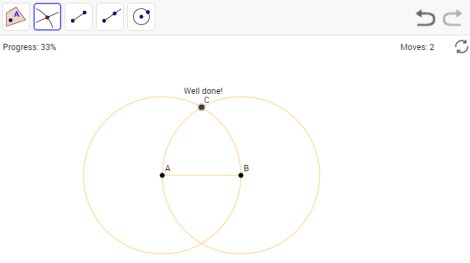
On my way to constructing an equilateral triangle. What should I do next?

On my way to constructing an equilateral triangle. What should I do next?

The game is pretty much exactly what it sounds like. You get to use just a straight-edge and compass (but a virtual straight-edge and compass, powered by Geogebra, because it’s a computer game!) to make Euclid’s constructions. For instance, the first challenge is to make an equilateral triangle– and all you can do is draw circles and lines! How would you do that?

I love this game for learning geometry because it lets you see how Euclid and his mathematicians peers thought about geometry– but you don’t have to use a real compass! The game saves your constructions so you can use them later– so if you ever want to make an equilateral triangle again, you don’t have to start from scratch. The game also gives you points if you make your construction with the least number of steps or without using any new tools. Give it a try!

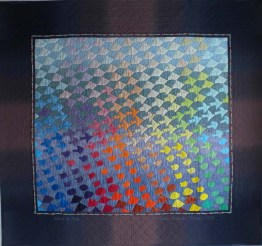
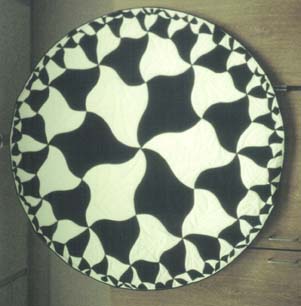
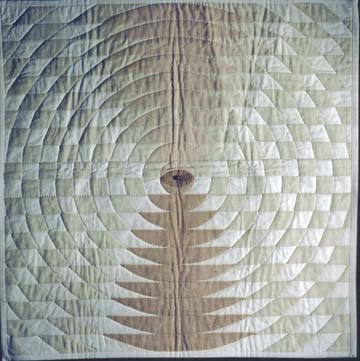
Ellison tessellation quiltFinally, I recently ran across the beautiful mathematical quilts of Elaine Ellison. Elaine is a former high school math teacher from Indiana who now creates and gives talks about making mathematical quilts. Her quilts explore some of the most interesting types of mathematics– from tessellations (like the Escher-inspired fish tessellation quilt to the left), to conic sections, to strange geometric spaces.

Ellison poincare quilt

“Poincare Plane”

Ellison parabola quilt

“Parabolas”

Elaine has a website and a YouTube channel devoted to her gorgeous quilts. Check them out! Here’s a taster:

We hope you’re enjoying your return to school! We definitely are. Bon appetit!