Author Archives: Paul Salomon

TED, Bridges, and Silk

Welcome to this week’s Math Munch!

TEDxNYED pic

The Math Munch team at TEDxNYED

Marjorie Rice

Marjorie Rice | click to watch her interview video

On Saturday, the Math Munch team gave a 16-minute presentation at TEDxNYED about Math Munch!  (Eventually there will be a video, and we’ll be sure to share it with you right away, but you’ll have to wait a month, maybe.)

We started with the story of Marjorie Rice, and in searching for a good picture of her, we came across this wonderful interview in a documentary about Martin Gardner.  It’s so neat to hear her speak about her discoveries.  You can see how proud she is and how much she truly loves math.  Feel free to watch the whole documentary if you like.  I haven’t gotten a chance yet, but I know it’s full of incredible stuff.

In the spirit of TED, I decided to share a few mathematical TED talks.  This one is absolutely fascinating.  In it, mathematician Ron Eglash describes how fractals underly the african designs.  You know how we love fractals.

If you’re hungry for another TED talk, here’s one about connections between music, mathematics, and sonar.

Up next, remember when we wrote about attending last year’s Bridges conference?  Well it happens every year, of course, and this year’s gallery of mathematical art is available online!  Click on one of those images and you get to more of the artists work.  I could easily spend hours staring at this art, trying to understand them, and reading the descriptions and artist statements.  Seriously, there is just way too much cool stuff there, so I’ve picked out a few of my favorites.  Also, I have great news to announce: Chloé Worthington (previously featured) had some of her art accepted to the exhibition!  Congratulations, Chloe!  If you look closely, you’ll see some of my art in there too.  🙂

Bjarne Jespersen

Bjarne Jespersen

Marc Chamberland

Marc Chamberland

Bob Rollings

Bob Rollings

Chloe Worthington

Chloé Worthington

Mehrdad Garousi

Mehrdad Garousi

By the way, if you ever create any mathematical art of your own, we’d love to see it!  Send us an email at mathmunchteam@gmail.com, and maybe we’ll feature your work in an upcoming Math Munch. (Only if you want us too, of course.)

Yuri Vishnevsky

Silk creator Yuri Vishnevsky

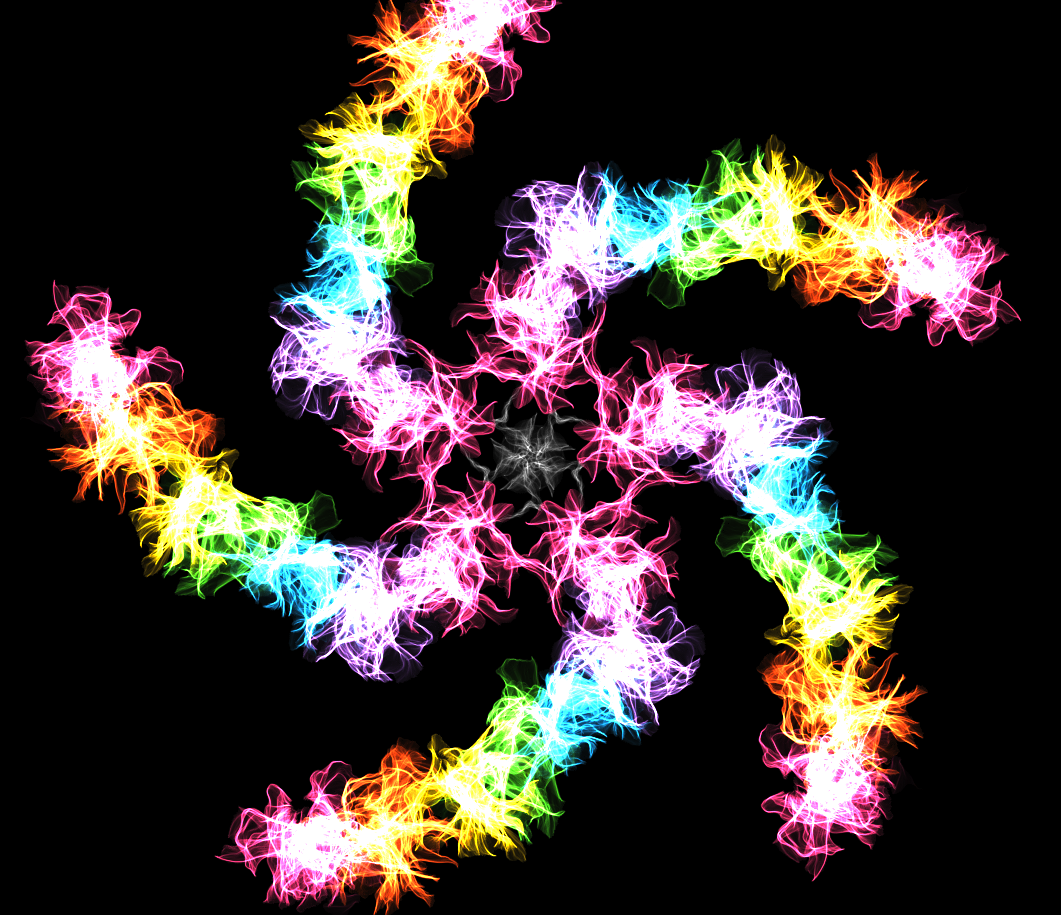
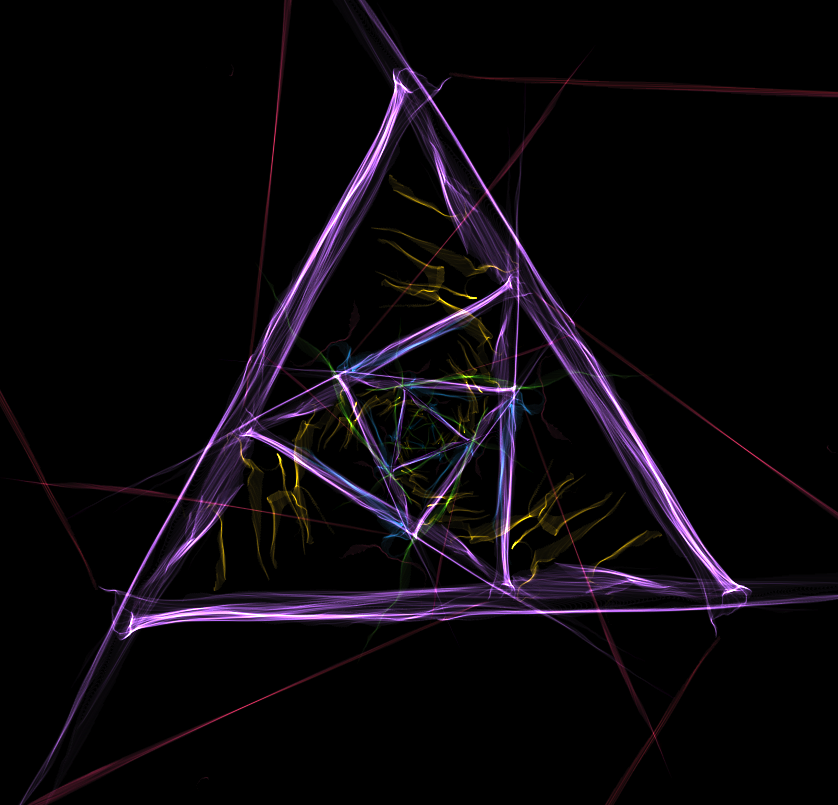
Finally, I know many of you like playing around with Symmetry Artist, which can be found on our page of Math Art Tools.  If you like that, then you’ll love Silk!  It’s much the same, but generates a certain kind of whispiness as you draw that looks really cool.  It also lets you spiral your designs toward the center, a feature which Symmetry Artist lacks.  You can download the Silk app for iPad or iPhone, if you like.  Silk was designed by Yuri Vishnevsky, with sound design by Mat Jarvis.  Yuri has agreed to do a Q&A for us, but we haven’t quite finished it just yet.  I’ll upload it as soon as possible, but for now, you can read an interview Mat and Yuri did with a website called Giant Fire Breathing Dragon.

Bon appetit!

Silk1 Silk4 Silk2


Sam Loyd, Weight Problems, and Exercises

Welcome to this week’s Math Munch!

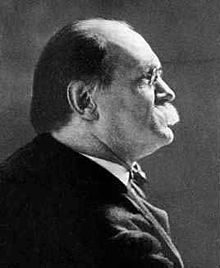
Chess master, puzzlist, and recreational mathematician Sam Loyd. GREAT mustache.

Chess composer, puzzlist, and recreational mathematician Sam Loyd. GREAT mustache.

First up, remember Sam Loyd?  (We’ve featured him twice before.)   He was an american chess player and recreational mathematician who lived from 1841-1911.  He was also a chess composer, someone who writes endgame strategies and chess puzzles.  In fact, he wrote all sorts of puzzles, which his son published in a book called Sam Loyd’s Cyclopedia of 5000 Puzzles, Tricks, and Conundrums.  (That link will take you to a scan of all 385 pages!)  By the way, those 5000 puzzles are only about half of the ones he wrote in his lifetime.  It’s no wonder Martin Gardner called him “America’s greatest puzzler.”  An interesting anecdote: Sam Loyd claimed until his death to have invented the 15 puzzle, but in fact he did not.  The actual inventor was Noyes Chapman, the Postmaster of Canastota, NY.

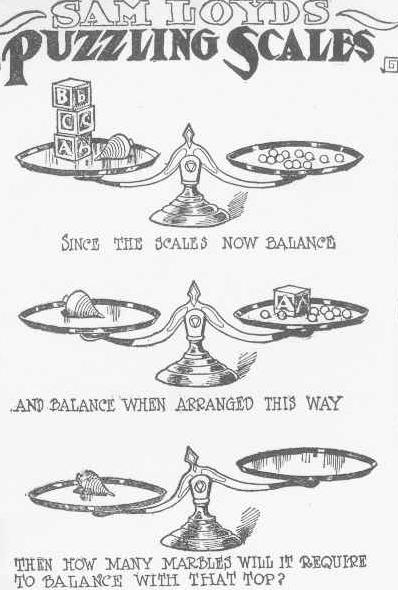
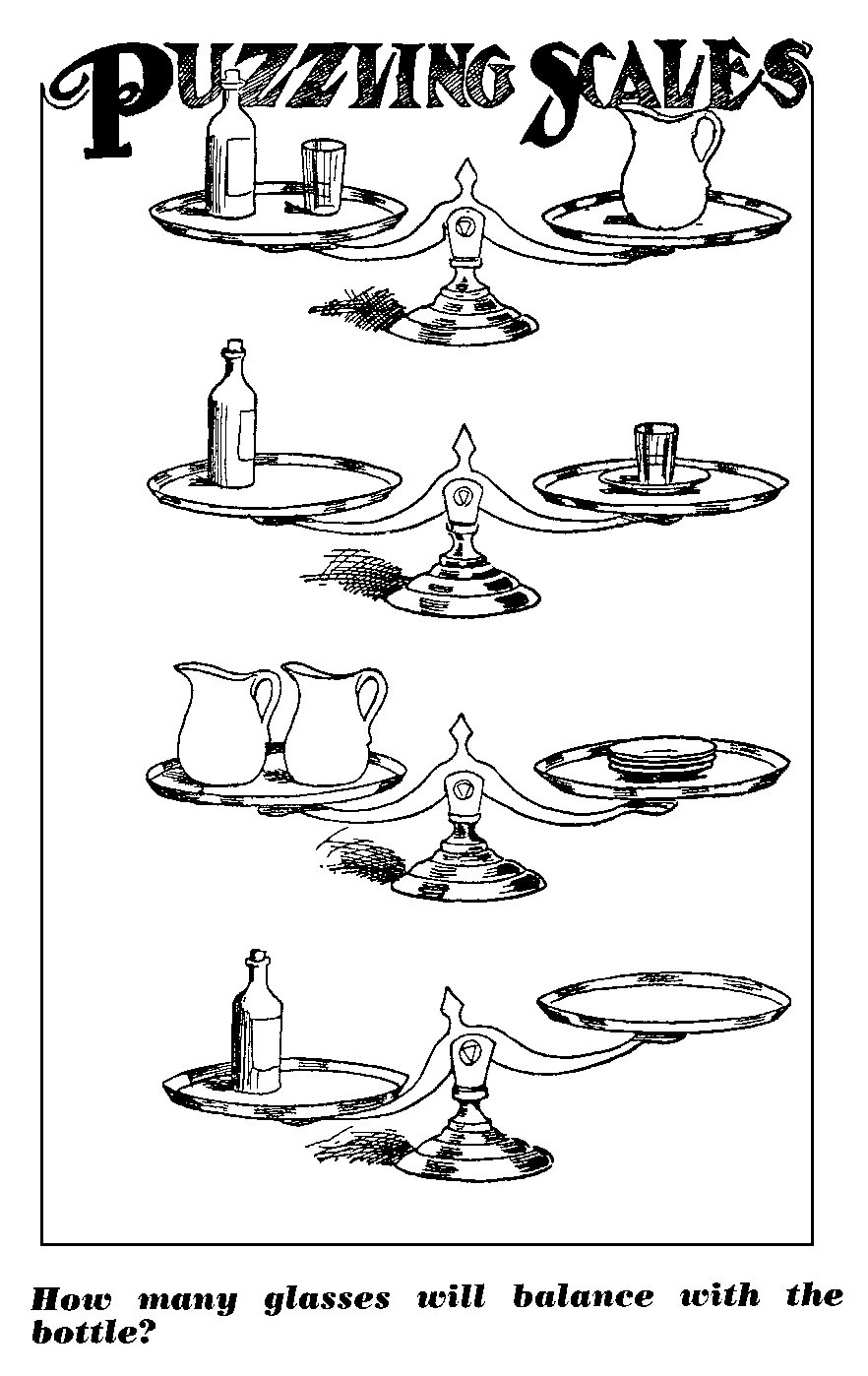
I wanted to show you some of Sam’s “Puzzling Scales” problems.  Why don’t you stop reading now and just solve them both?

Puzzling Scales 1 Puzzling Scales 2
Torque puzzle 1

These different weights balance because of the torque they apply

There are lots of puzzles like this, based on different weights balancing with each other.  A friend sent me this page of weight puzzles based on the idea of torque.  The farther out an object is placed, the more torque it applies to the balance, so it’s possible for a 1 pound weight to balance a 2 pound weight if you set them at the right distances.  The distance and wight multiply to give the torque applied.

These problems come from a massive bank of puzzles over on Erich’s Puzzle Palace.  If you like, you can also play this torque game I found.

Torque puzzle 1

Place 1 through 5 to balance the weights.

Torque puzzle 2

Place 1 through 6 to balance the weights.

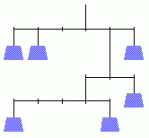
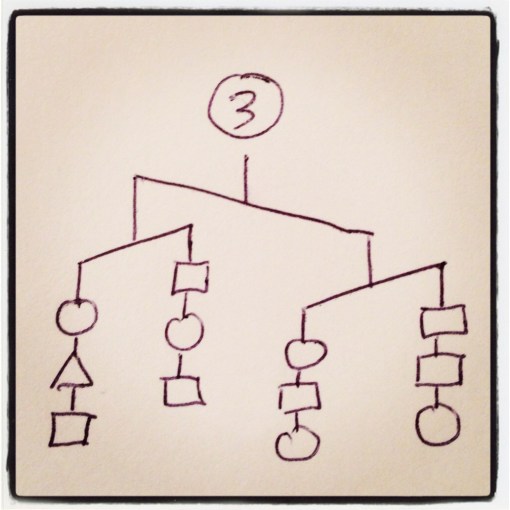
I love problems like this, but I started to wonder, “what if the scales don’t balance?  Maybe you could make a puzzle out of that.”  I did exactly that, creating a series of imbalance puzzles.  Your job is to order the shapes by weight.  They start out easy, but there are some tricky ones.  I especially like #6.

In each case, order the three objects by weight.

Imbalance 1 Imbalance 2 Imbalance 3

I’m also hosting an imbalance puzzle-writing contest.  My two favorite puzzlists will win a print of their choosing from my Stars of the Mind’s Sky series of mathematical art.  You should try your hand at writing one.  Just email it to Lost in Recursion.

Finally – we all love great problems and puzzles, but skill building is an important aspect of mathematics as well, and exercises help us build skill.  Exercises are often dull, but I found a website with some exercises I quite like, and I wanted to share them with you.  Check out the Coffee Break section over on StudyMaths.co.uk.

Detention Dash

Detention Dash

Find the Primes

Find the Primes

Odd One Out

Odd One Out

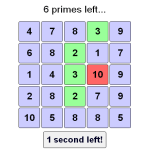
Detention Dash, for example, is just a timed multiplication chart, but typing the answers in on my computer really made me feel some of the patterns in the numbers.  You should try it.  Odd One Out also keeps you on your toes and makes you think about different kinds of numbers.  I find them surprisingly fun.  I hope you agree.

Bon appetit!

Collaborative Math, Petals, and Theseus

Welcome to this week’s Math Munch!

Collaborative MathematicsLet’s start with a great new blog – a place for you to do math – Collaborative Mathematics. It’s the pet project of mathematician, teacher, and juggler, Jason Ermer.  The idea is simple. Jason posts videos about a little mathematical idea, and he offers up a challenge question for viewers to solve. In fact, he has lots of ideas for how you can do some mathematical research of your own. After that, you make a response video explaining what you’ve come up with. That’s Collaborative Mathematics.

His first video was about ERMER numbers, like 12312 or 94794. Core Challenge: How many ERMER numbers are even? To learn all about it and get involved, check out this video.

On his site, Jason says, “when possible, students should work with a team of problem solving peers. Our ideas are formed and refined as we communicate our thoughts to others and as we hear a diversity of ways of interpreting the same concepts.” So don’t feel like you have to do it all alone. It is collaborative after all!

And don’t worry if things are tough! “Struggling in mathematics is not a bad thing! We expect sore muscles when we exercise and try to improve at, say, basketball. Why would we expect mathematical growth to be painless? We must exert ourselves to grow. There is glory in the struggle! “

And if you liked that. Here’s the second video challenge.

* * *

Up next is a simple little site I found called the Petals Challenge.

The secret of the game is in the name of the game: Petals around a roseHow many petals?

The secret of the game is in the name of the game: Petals around a rose
How many petals?

It’s a kind of riddle, because there aren’t really instructions. The only way to make sense of it is to give it a try. Good luck, and never tell anyone the secret of the game!

* * *

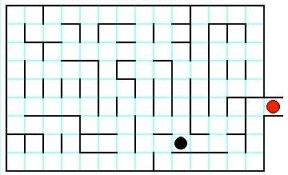
theseusLastly, here’s a great game called Theseus and the Minoataur. You’re Theseus, and you must exit a labyrinth while a minotaur chases you. The Minotaur is faster than you are, though, so you’ll have to be clever!

Unfortunately, this is a java game, which some computers won’t be able to play, so as a bonus, watch this beautiful animation from Numberphile showing the creation of the Dragon Fractal.

Bon appetit!