Author Archives: Paul Salomon

Rice, Rectangles, and Mathmagicland

Welcome to this week’s Math Munch!

Want to practice your math facts?  Want to help feed hungry people around the world?  Well, with Free Rice you can do both at once!  Every time you answer a question correctly, the website donates 10 grains of rice through the UN’s World Food Programme.  You can work on multiplication or pre-algebra, as well as vocabulary, flags of the world, and other subjects.  It’s good practice for a good cause!  What do you say?  Will you help?

Up next, meet Edmund Harriss.

I found him through his fantastic math blog, Maxwell’s Demon, but he’s also a visiting professor at the University of Arkansas and a mathematical artist to boot.  We’re going to take a look at his recent blog post, “the 2×1 rectangle and domes.”  I seriously encourage you to read the entire thing, but I’ll share a few highlights.  The 2×1 rectangle is called a domino, and when you cut one in half along the diagonal, you get a lovely triangle with nifty tiling capabilities!

Also, standard plywood comes in the same proportion (8’x4′), and they can be easily combined to make several types of domes, as you can see below.  Click here to see how a hexayurt is built.  Edmund goes on to talk about the truncated octahedron, and how we can use its shape to design these domes.  How amazingly clever!

Finally, let’s take a look at a classic Disney film, from 1959 – Donald in Mathmagicland.  Donald Duck, on some sort of hunt, finds himself in a very strange place, surrounded by numbers, shapes, and patterns.  The trees even have square roots!  Mr. Duck meets “The True Spirit of Invention,” a mysterious voice that leads him (and us) on an adventurous trip through Mathmagicland.  If you skip to 16:48 in the video, you can learn about Billiards, a game played on the 2×1 rectangle!  How fitting!

Bon appetit!

Origami, Games, and the Huang Twins

Welcome to this week’s Math Munch!

Origami Whale

We’ve had a few posts (like this, this, and this) that included paper folding, but this week we really focus on doing it yourself.  Check out Origamiplayer.com, a terrific website that doesn’t just show you origami models.  It has an animator that folds them in front of you and waits for you to fold along with it.  I really like this origami pentagon, but there’s lots of designs and you can even sort them by type or difficulty.  You can change the speed or click around to different steps, so find a model you like and get folding!

Up next, meet the Huang Twins, 14-year old brothers from California.  Mike and Cary have been working as a team to design and program all kinds of great web stuff.  They actually have their own orgami animator to fold polyhedra.  But my favorite thing of theirs is The Scale of the Universe 2, an incredible applet that let’s you compare the sizes of all kinds of things big and small.  It uses scientific notation to describe the sizes, so if you’ve never seen that before, you might want to read up.  It’s genius.

They’ve also written several excellent games, which we’ve added to our Math Games page.  Cube Roll has a familiar format with a twist; The cube has to land on the correct side.  I really like that one.  No Walking, No Problem is another neat little puzzler.  Use the objects to move side to side, because you can’t walk!  Lastly, (though the Huangs didn’t write it) we’ve added Morpion Solitaire, a tough little game you can play online or on paper.

Bon appetit!

Cube Roll

No Walking, No Problem

Morpion Solitaire

Numberphile, Cube Snakes, and the Hypercube.

Welcome to this week’s Math Munch!

Each one of those pictures takes you to a math video.  Numberphile is a YouTube channel full of fantastic math videos by Brady Haran, each one about a different number.  Is one Googolplex bigger than the universe?  Why does Pac Man end after level 255?  Is 1 a prime number?  Click the numbers to watch the related video.  They also feature James Grime, one of my favorite math people on the internet.

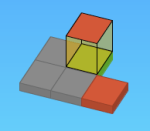
Next up, let’s work on the Saint Ann’s School Problem of the Week.  You can read the fully worded question by following the link, but here it is in short:  If we start in the center, we can snake our way through the 9 small squares of a 3×3 square.  Can we snake our way through the 27 small cubes a 3x3x3 cube?  Can we do it if we start in the middle?

Can we snake our way through the 3x3x3 cube starting in the center?

There’s a new question posted every week (obviously), and if you check the Problem of the Week Archives, you can find more than 4 years of previous questions!  How many do you think we could solve if we did a 24 hour math marathon?

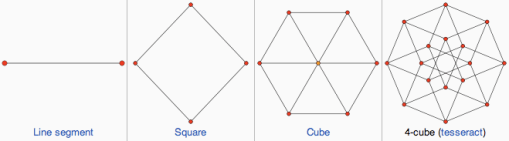
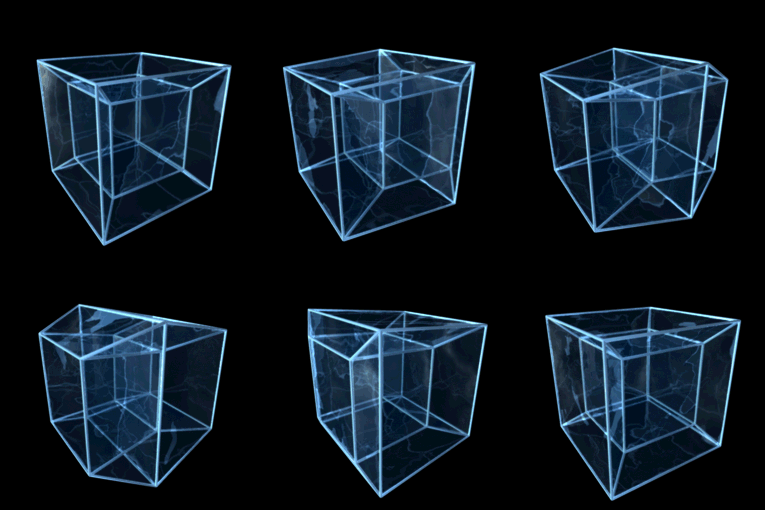
Finally, let’s have a mind-blowing look at higher dimensions.  The problem above is about whether a property of the square (a 2-dimensional object) can be carried over to the cube (its 3D counterpart).  So what is the 4-dimensional version of a cube?  The Hypercube!

The "cube" idea, from 1D to 4D

I’ve heard a lot of people say the 4th dimension is “time” or “duration,” but what would the 5th dimension be?  Well, here’s a video called “Imagining the Tenth Dimension.”  And if you’re hungry for more, there’s a series of 9 math videos called “Dimesions.”  All together it’s 2 amazing hours of math.  You can watch the first chapter online by clicking here.

Bon appetit!