Author Archives: Paul Salomon

Dearing, Edmark, and The Octothorpean Order

Welcome to this week’s Math Munch!

Dearing Wang

Dearing Wang

First up is a wonderful mathematical artist I found on instagram, under the name dearing_draws. Click to see the wonderful work of Dearing Wang. The instagram stream includes lots of timelapse videos showing the creation of the images, which is lovely, but even better is that Dearing has a youtube channel and a website devoted to teaching people how to make their own!! You should click over and follow a tutorial. Make something beautiful and send us a picture.

3 Fish in a Pond

3 Fish in a Pond

Tutorial Video

The Diamond Wedge Pattern

The Diamond Wedge Pattern

Tutorial Video

Impossible Octagon

Impossible Octagon

Tutorial Video

Another great thing about Dearing’s website is that he has a page where you can print out blank sheets to color, if that’s your thing. Not quite as mathematical, maybe, but it is nice. I like to color sometimes, and if you color systematically, maybe symmetrically, then it’s fairly mathematical after all. UPDATE: Dearing has agreed to let us host some some of his coloring sheets on Math Munch.  Click here for easily downloadable sheets to color.

John Edmark

John Edmark

Up next is another mathematical artist, John Edmark, a designer and adjunct professor at Stanford University. I was introduced to John’s incredible work through the following video. Just watch and let your jaw hit the floor in amazement.

This is a video of a zoetrope. The pieces spin and the camera shutter is timed to only show certain points in their rotation. What we see is sort of like a little loop of film showing us several frames of the animation. It’s impressive that John put all those frames together into sculptures that are beautiful, even when they’re not spinning.

PatTurn

PatTurn

But that isn’t all, there’s lots more to see on John’s website. I found his spiral videos pretty mesmerizing and fantastic. I also really like his artist statement, which begins “If change is the only constant in nature, it is written in the language of geometry.” I also just really like hearing artists talk about their work, because it’s a sort of behind the scenes look into their creative process and thinking.

(3D printable files are also available here for the incredibly fortunate among us with access to a 3D printer.)

An octothorpe

An Octothorpe

Finally, if you like solving riddles and puzzles, check out The Octothorpean Order. This is sort of an online puzzle hunt, with clues and tips on the website. You can read about it, but the best thing to do is dive in and start solving puzzles. You probably have to create a user name, but it’s good fun. I recommend it.

By the way,  “octothorpe” is the technical word for the “hashtag” or “pound” or “number sign.” It means eight fields, and I think it represents a farmers house in the middle and eight fields arround it. Cool right?

Here’s to having a mathematical week.  Bon appetit!

Mars, Triangulation, and LOMINOES.

Welcome to this week’s Math Munch!

First things first, I simply must mention a video that one of our readers sent us. Lily Ross was inspired by a recent post and created this amazing fake movie trailer!!! WOW! Thank you, Lily!

The video has been added to our Readers’ Gallery. Send us your creations and we’ll add them too.


Did you know that NASA is planning to send people to Mars around the year 2030? How far away would they be going? Click the picture to find out. It’s incredibly cool.

How Far is Mars?

How far is it to Mars?

Mars

Mars

The Moon

The Moon

distancetomars.com is an interactive website that answers the question, “how far is it to Mars?” It was created by a pair of designers, David Paliwoda and Jesse Williams. Think of how long that took to get there, and now realize that it takes light 3 times longer (since we were traveling impossibly fast, at 3 times the speed of light). That’s 3 light-minutes, so when we look at “the red planet,” we are seeing light that took more than 3 minutes to make the trip from Mars to our eye. We’re seeing what Mars looked like 3 minutes in the past!!! That’s pretty cool, I’d say.


Triangulation #9

Triangulation #9

Up next, another interactive website experience. This one is a series of interactive digital art — a sort of meditation on the essence of the triangle. Check out Triangulation.  Can you imagine adding a page to this? What would you design? Maybe you could use Scratch to actually make it!

Thanks to our friend, Malke Rosenfeld, for sending us this.

Screen Shot 2014-12-05 at 10.21.18 PM Screen Shot 2014-12-05 at 10.23.09 PM Screen Shot 2014-12-05 at 10.24.40 PM

Before we get to our last item this week, a couple of important announcements. As in prior years, Plus Magazine is hosting a mathematical advent calendar. Each day, a new number becomes clickable, linking to a page about nifty math stuff.

The 2014 Plus Magazine Mathematical Advent Calendar

The 2014 Plus Magazine Mathematical Advent Calendar

I also want to mention that The Aperiodical (an awesome (fairly advanced) math blog) is hosting a Math Pun Conmpetition!!! Here’s my submission, for those with a little bit of plane geometric knowledge:

Q: Why was it so hard for the equilateral quadrilateral to get home after school?

A: It got on the rhom BUS!

Rggie Rhombus


OK, now on to our last item of the week. Here it is…

A Pot-Pourri of People, Pictures, Places, Penrose Patterns, Polyhedra, Polyominoes, Posters, Posies, and Puzzles! (How about that?)

Alan Schoen with a model of a gyroid

Alan Schoen with a model of a gyroid

I don’t know a whole lot about Alan Schoen, but his website has some pretty enticing images on it. Really, all I know about Schoen is that he discovered the Gyroid when he worked at NASA in 1970. He also created The Geometry Garret, a website full of cool stuff.

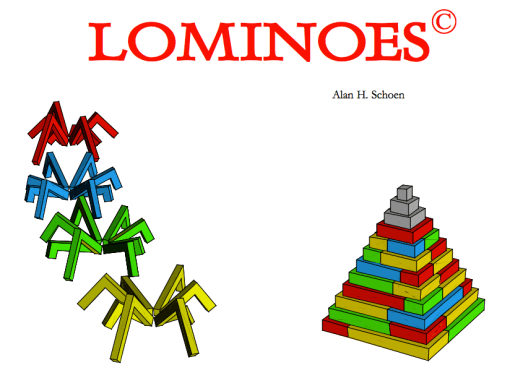
The thing that I want to share is something I’ve never seen before – LOMINOES. These are polyominoes, like the ones we’ve featured at least twice before, but they are simply in the shape of an L. Alan wrote a 10-page booklet on the subject as well as a much longer book. (147 pages!)

They’re both worth poking through. If an image grabs your fancy, start reading and see what you can learn.

Screen Shot 2014-12-06 at 1.52.16 PMHave a great week and bon appetit!

Scary-o-graphic Projection, Thinky the Dragon, and Martin Gardner

Welcome to this week’s Math Munch!

Halloween is quickly approaching, which is why last week, Anna shared some pumpkin polyhedra. It just so happens that Justin did some pumpkin-y math of his own last year. He created a must-watch video called “Scary-o’-graphic Projection,” which was shown in the 2014 Bridges Short Film Festival. Enjoy, but don’t get too scared.

A stereographic projection sculpture by Henry Segerman.

A stereographic projection sculpture by Henry Segerman.

To learn some more about stereographic projection, watch one of Henry Segerman’s videos. You’ll also get to see some of his 3D printed sculptures.  (1 2)

In other news, Oct. 21 marked the 100th anniversary of the birthday of Martin Gardner!! (previously featured here, here, and here, among others) Around this time every year people get together to do math in his honor as part of Celebration of Mind.

This year we’re featuring one of Gardner’s optical illusions. Let’s begin with a video. Meet Thinky the Dragon.

You can find printable make-your-own templates here. (There are other colors as well.) Thinky is an example of a “hollow face” illusion, many more of which can be found on mathaware.org. There you can also find this video explaining the geometry behind this illusion.

And look at this AMAZING movie trailer that one of our readers made.  Thank you Lily!!!

Can you fold this strip of 7 squares into a cube?

Can you fold this strip of 7 squares into a cube?

Whats special about this square?  More than you think!

Whats special about this square? More than you think!

Thank you to Colm Mulcahy for his recent post on the BBC website, where Colm put together a list of 10 really wonderful problems from the hundreds that Gardner wrote about and popularized during his career. Gardner helped show the world that thinking about problems and mathematics was a really fun way to spend time. Watch the video below to learn more about Celebration of Mind events, and click here to see if there’s an event near you.  Note: You can even host an event of your own.

https://www.youtube.com/watch?v=NQE_fF1vbIo

BONUS: I just have to mention MoSAIC for any math art enthusiasts in our audience. Around the country, small mathematical art conferences and exhibitions will go on this year. Click to learn more or find an event near you.

Munch in honor of Martin Gardner. Bon appetit!

Picture from the MoSAIC website.

Picture from the MoSAIC website.