Category Archives: Math Munch

8-bit, Pixel Art, and Aliens

Hello and welcome to this week’s Math Munch! I’m Mai Li, a current college student, and a former student of your regular team. I’m really happy to be making this week’s guest post! Today we’re going to be talking about one of my favourite topics, pixel art!

When I was a kid, the Game Boy Color came out.
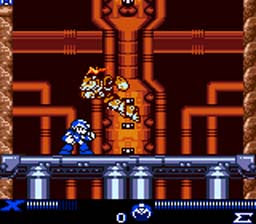
Everything was XTREME in the ninties.

15-bit graphics! No idea why 15.

It had impressive 15-bit color graphics, a huge step up from the 2-bit graphics of the original Game Boy. Just looking at the graphical difference between the original MegaMan on the Game Boy, and MegaMan Xtreme on the Game Boy Color, you can tell that 15-bit offers a much larger color variety than the mere four colors available with 2-bit graphics. But what exactly does it mean to be 15-bit, as opposed to 2-bit?
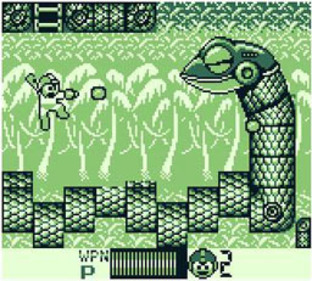
Kindergarten was an exciting time. Not that I was allowed a GB.

2-bit graphics, in this “pea soup” color scheme.

Well, what’s a bit? A bit is a single piece of information that can be stored by a computer, either a 1 or a 0. A 1-bit system can have up to two whole colors! Either color 1, or color 0. Take Pong, for instance. Let’s say the color scheme is black and white. Now, white can be color 0, and black can be color 1. The pixels making up the paddles, the ball, the board, and the score are color 0, and the background is color 1. Pretty simple! But what if we want more than that?
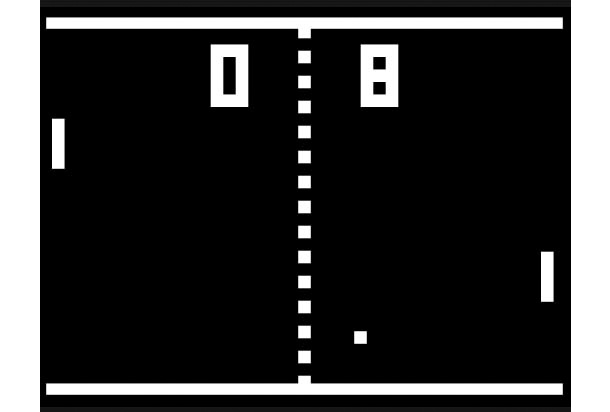
Pong, the oldest game many people are familiar with. 1-bit colors!

Pong, the oldest game many people are familiar with. 1-bit colors!

In comes 2-bit, to the rescue! The Game Boy had a 2-bit color system, usually four shades of green. As you might have guessed, this mean that each color had two pieces of information, two “bits,” for a total of four possible combinations- 00, 01, 10, 11. And there you go! Four combination, four colors, just like that. For each bit, there are two possibilities, so the number of total colors available is 2^2. That means that for a 15-bit system like the Game Boy Color, there are 2^15 available colors! That comes out to a palette of 32,768 colors! Although the Game Boy Color was only physically capable of displaying 56 different colors simultaneously, you can understand now why 15-bit looks so much nicer than it’s earlier 2-bit counterpart. Now that you know what 8-bit means, you probably want to make your own pixel art, so here are some programs to help you do just that: Piq is a simple program that is available online, without downloading. GraphicsGale is favorite of mine, however it is only for windows. If all else fails. GIMP is a free Photoshop alternative.
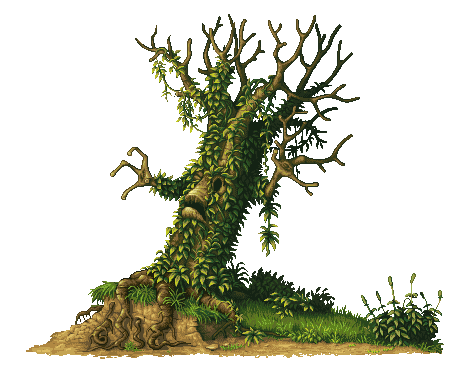
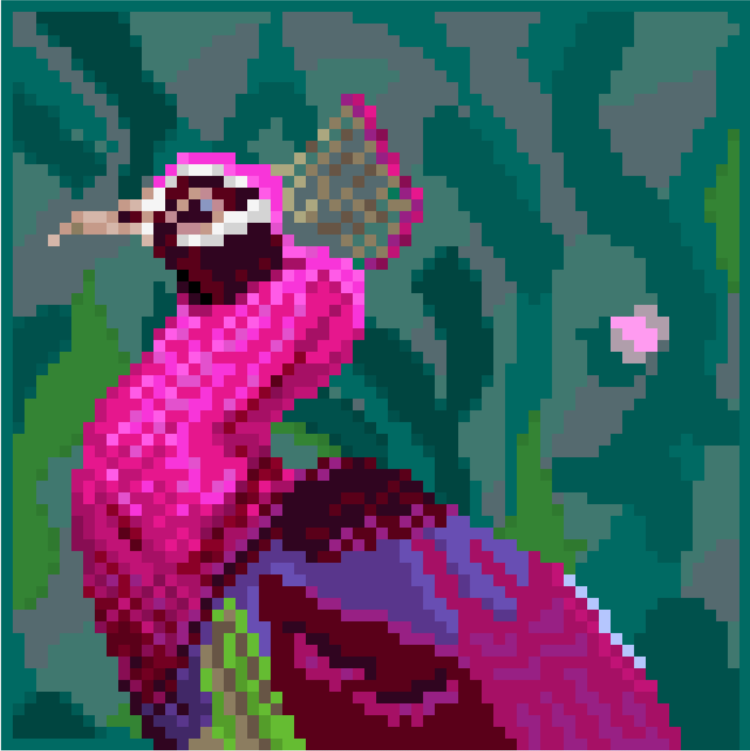
One of my all time favourite artists, Fool.

One of my all time favourite artists, Fool.

8-bit is a popular art style these days, and one I often work in myself. 8-bit is 2^8, or 256 different colors. Now days, this rule of 256 colors or less is entirely a stylistic choice, as computers and consoles can work with a much higher color resolution. Many artists, however, will limit themselves to even less than 256 colors, for aesthetic and color theory reasons. In addition, artists might also use a space constraint, like using a canvas that is only 256 pixels high and 256 pixels wide. Besides the limited number of colors, many people consider works to be pixel art only if each of the pixels was hand placed by the artist, read: no Photoshop filters. Because of this, pixel art is often limited in size, simply due to the amount of time it takes to hand place each pixel. Two of my favourite pixel artists are Fool, and Pixelatedcrown. My own artwork can be found here.
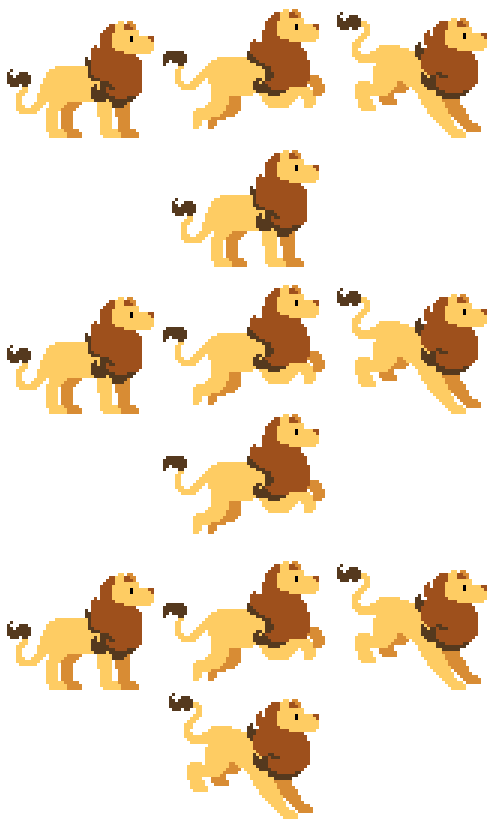
By Pixelatedcrown, who’s work I adore. She also does 3D modeling and game dev stuff.

My own work.

My own work.

Retro graphics are making a comeback, and I have to admit I love it. I’m going to shine a spotlight on one of the new games that I think has some of the best retro graphics I’ve seen in a while – Shovel Knight.
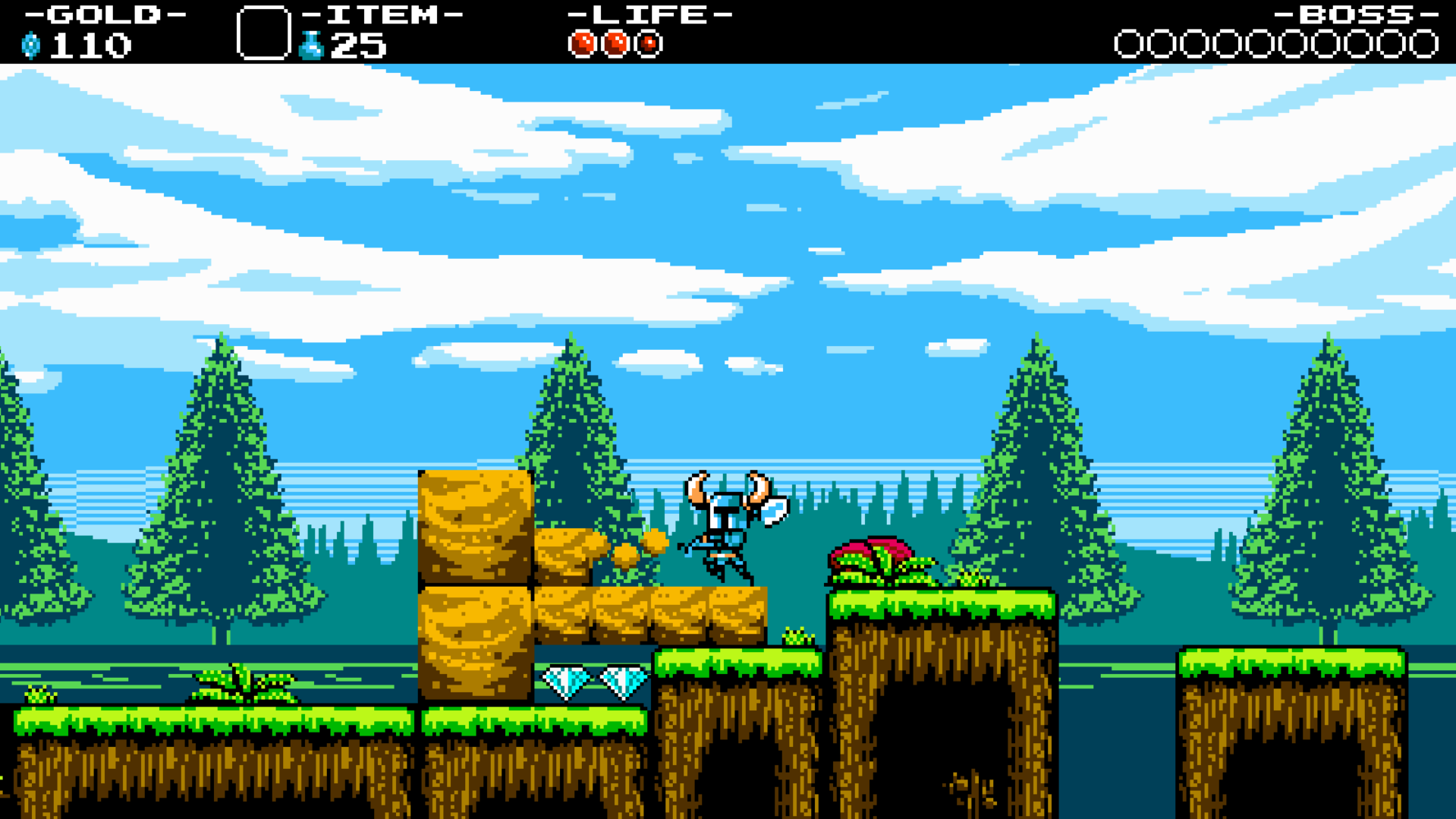
Shovel Knight must rescue his friend Shield Knight in a timeless tale of shovelry.

Shovel Knight must rescue his friend Shield Knight in a timeless tale of shovelry.

Looking and playing like something akin to an SNES platformer, Shovel Knight explores an attractive 8-bit world to find his partner, Shield Knight. Although the game itself is ten dollars (and totally worth it), a first impressions video by one of my favorite Youtubers, Rockleesmile, is completely free. The video is part of his Indie Impressions series, which covers a new indie game daily, and which I adore. If that’s not enough, he has a playthrough of the entire game available, if you just need to see all the graphics right now. And if you do, who could blame you?

Finally, an unexpected use of pixel graphics: to contact aliens. No, I’m not kidding.
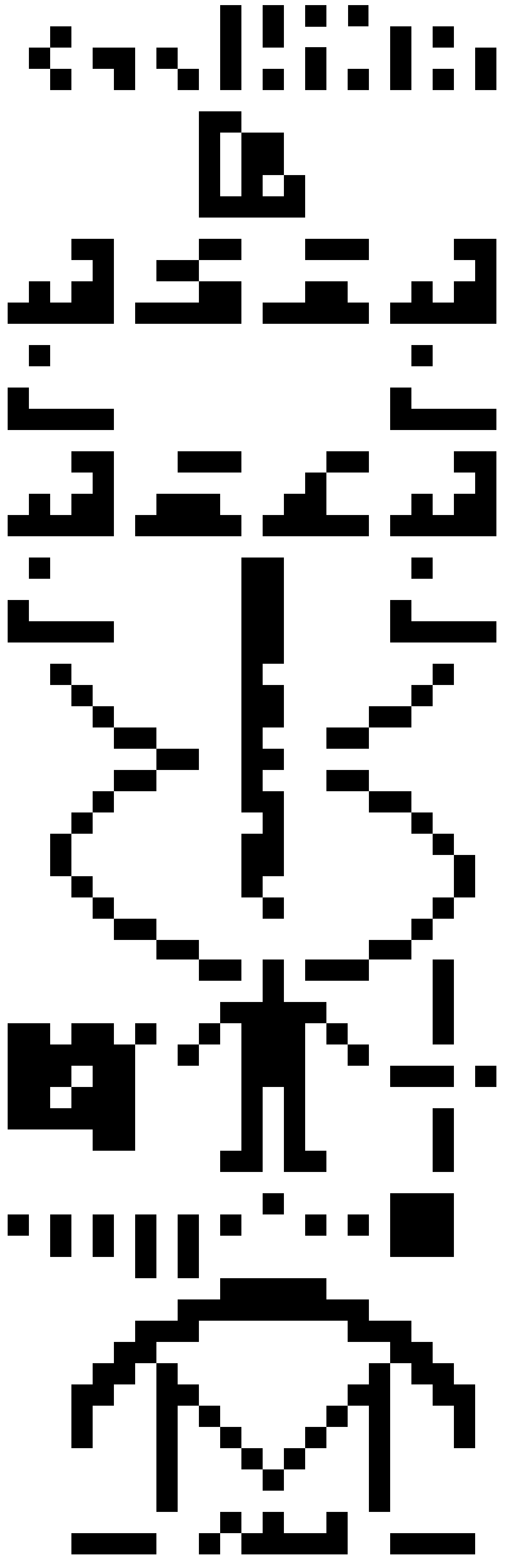
We sent this into space. No kidding.

We sent this into space. No kidding.

The Arecibo Message was a radio message sent into space in 1974 after the remodeling of the Arecibo Radio Telescope in Puerto Rico. The message, aimed at the globular star cluster M13, which is approximately 25,000 light years away, was mostly sent to prove that we could. Although scientists don’t really expect to hear anything back (and even it we did, it would spend 50,000 years in transit alone!), the message contained information that we thought would be important for aliens to know about us. The entire message is about 210 bits, and is in 1-bit resolution! Try and see if you can figure out what it’s trying to explain. If you can’t, the wiki page explains it all. And check out this Mental Floss article all about it! Speaking of which, if you want to de-code more alien messages, check out the Cosmic Call, a longer message sent by telescopes in Texas in 1999. I was given the message as a sixth grader, and with some friends, was able to decode the first few pages so I highly suggest giving it a try!
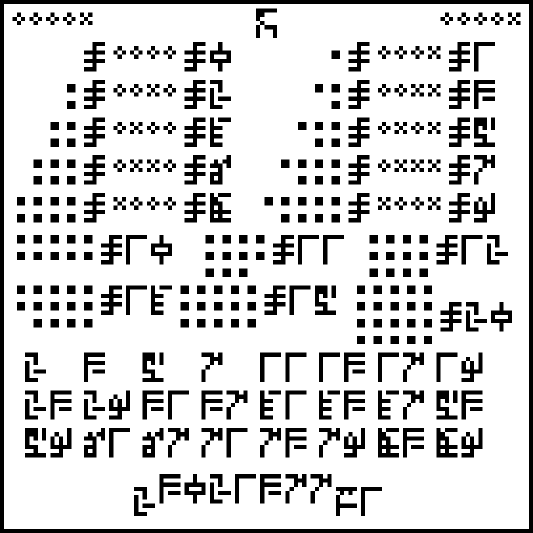
The Cosmic Call! Are you smarter than an alien?

The Cosmic Call! Are you smarter than an alien?

It’s generally the same idea as the Arecibo message, but it’s easier to de-code, and they sent it to many more star systems, in hopes of a response. If you were an alien and you received this message, could you understand it? I think so, but you should really see for yourself.

Thanks for reading! Bon appetit!
The World Cup Group Stage, Math at First Sight, and Geokone

Welcome to this week’s Math Munch! We’ve got some World Cup math from a tremendous recreational mathematics blog and a new mathematical art tool. Get ready to dig in!

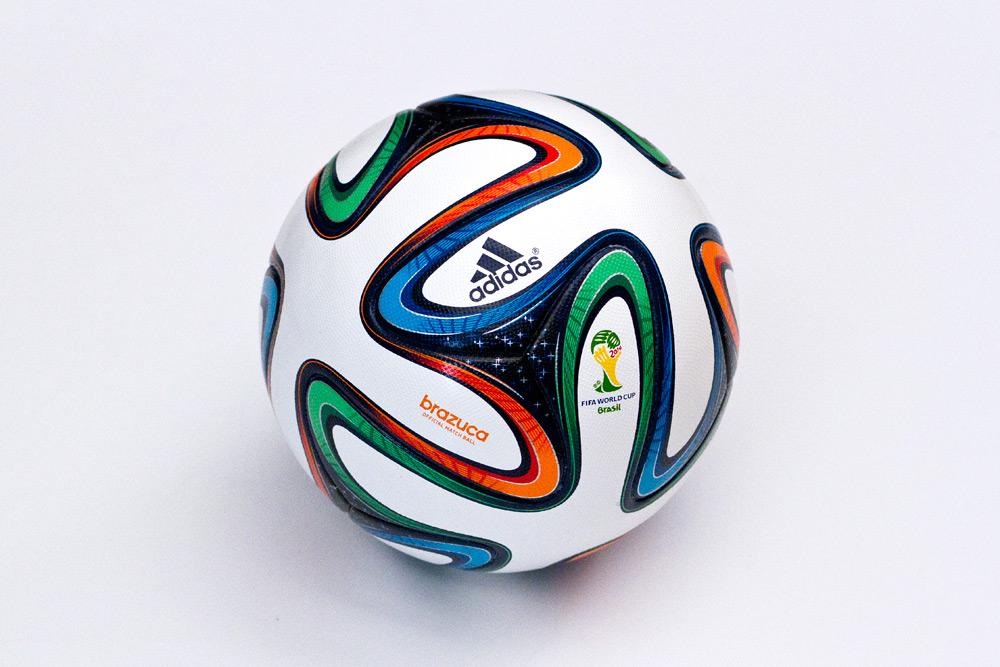
Brazuca: The 2014 World Cup Ball

Brazuca: The 2014 World Cup Ball

I’ve been meaning to share the really fantastic Puzzle Zapper Blog, because it’s so full of cool ideas, but the timing is perfect, because IT’S WORLD CUP TIME!!! and the most recent post is about the math of the world cup group stage! It’s called “World Cup Group Scores, and “Birthday Paradox” Paradoxes,” and I hope you’ll give it a read. (For some background on the Birthday Paradox, watch this Numberphile video called 23 and Football Birthdays.)

The thing that got me interested in the article was actually just this chart. I think it’s really cool, probably because I always find myself two games through the group stage, thinking of all the possible outcomes. If you do nothing else with this article, come to understand this chart. I was kind of surprised how many possible outcomes there are.

All Possible World Cup Group Stage Results

All Possible World Cup Group Stage Results

Long story short (though you should read the long story), there’s about a 40% chance that all 8 world cup groups will finish with different scores.

Alexandre Owen Muñiz, Author of Puzzle Zapper.  (click for an interview video about Alexandre's interactive fiction)

Alexandre Owen Muñiz, Author of Puzzle Zapper.  (click for an interview video about Alexandre’s interactive fiction)

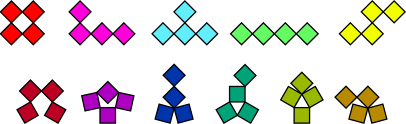
Puzzle Zapper is the recreational mathematics blog of Alexandre Owen Muñiz. You can also find much of his work on his Math at First Sight site. He has a lot of great stuff with polyominoes and other polyforms (see the nifty pics below). Alexandre is also a writer of interactive fiction, which is basically a sort of text-based video game. Click on Alexandre’s picture to learn more.

The Complete Set of "Hinged Tetriamonds"

The complete set of “hinged tetrominoes”

A lovely family portrait of the hinged tetriamonds.

A lovely, symmetric family portrait of the “hinged tetriamonds”

I hope you’ll poke around Alexandre’s site and find something interesting to learn about.

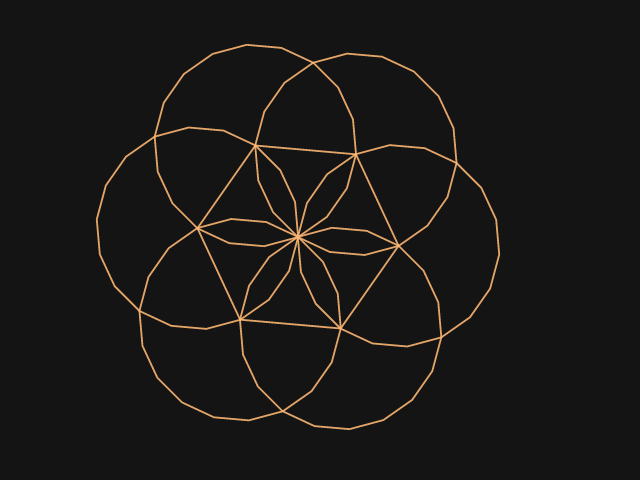
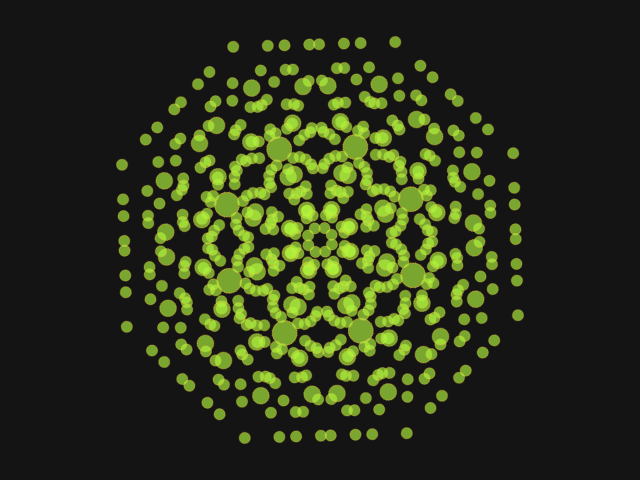
For our last item this week, I’ve decided to share a new mathematical art tool called Geokone. This app is a recursive, parametric drawing tool. It’s recursive, because it is based on a repeating structure, similar to those exhibited by fractals, and it’s parametric, because the tool bar on the right has a number of parameters that you can change to alter the image. The artistic creation is in playing with the parameter values and deciding what is pleasing. Below are some examples I created and exported.

geokone2 geokone1

geokone3

I have to say, Geokone is not the easiest thing in the world to use, but if you spend some time playing AND thinking, you can almost certainly figure some things out! As always, if you make something cool, please email it to us!

Now go create something!  Click to go to Geokone.net.

I hope you find something tasty this week. Bon appetit!

Girls’ Angle, Spiral Tilings, and Coins

Welcome to this week’s Math Munch!

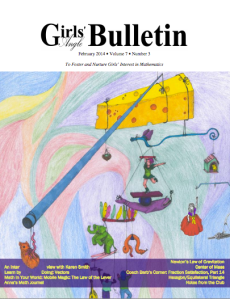
GirlsAngleCoverGirls’ Angle is a math club for girls. Since 2007 it has helped girls to grow their love of math through classes, events, mentorship, and a vibrant mathematical community. Girls’ Angle is based in Cambridge, Massachusetts, but its ideas and resources reach around the world through the amazing power of the internet. (And don’t you worry, gentlemen—there’s plenty for you to enjoy on the site as well.)

Amazingly, the site contains an archive of every issue of Girls’ Angle Bulletin, a wonderful bimonthly journal to “foster and nurture girls’ interest in mathematics.” In their most recent issue, you’ll find an interview with mathematician Karen E. Smith, along with several articles and puzzles about balance points of shapes.

There’s so much to dig into at Girls’ Angle! In addition to the Bulletins, there are two pages of mathematical videos. The first page shares a host of videos of women in mathematics sharing a piece of math that excited them when they were young. The most recent one is by Bridget Tenner, who shares about Pick’s Theorem. The second page includes several videos produced by Girls’ Angle, including this one called “Summer Vacation”.

Girls’ Angle can even help you buy a math book that you’d like, if you can’t afford it. For so many reasons, I hope you’ll find some time to explore the Girls’ Angle site over your summer break. (And while you’ve got your explorer’s hat on, maybe you’ll tour around Math Munch, too!)

I did a Google search recently for “regular tilings.” I needed a few quick pictures of the usual triangle, square, and hexagon tilings for a presentation I was making. As I scrolled along, this image jumped out at me:

hexspiral

What is that?! It certainly is a tiling, and all the tiles are the “same”—even if they are different sizes. Neat!

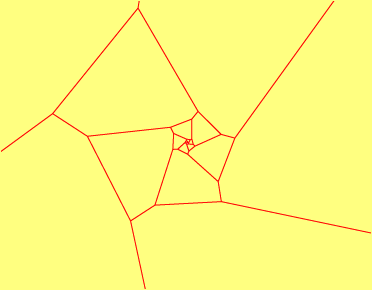
Clicking on the image, I found myself transported to a page all about spiral tilings at the Geometry Junkyard. The site is a whole heap of geometrical odds and ends—and a place that I’ve stumbled across many times over the years. Here are a few places to get started. I’m sure you’ll enjoy poking around the site to find some favorite “junk” of your own.

Spirals

Spirals

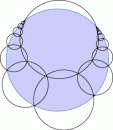
Circles and spheres

Circles & spheres

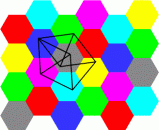
Coloring

Coloring

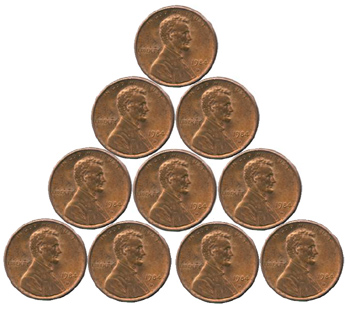
Last up this week, you may have seen this coin puzzle before. Can you make the triangle point downwards by moving just three pennies?triangleflip

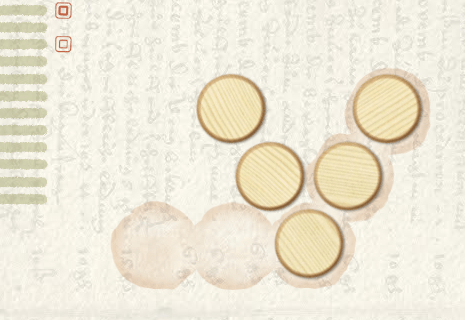
There are lots of variants of this puzzle. You can find some in an online puzzle game called Coins. In the game you have to make arrangements of coins, but the twist is that you can only move a coin to a spot where would it touch at least two other coins. I’m enjoying playing Coins—give it a try!

I solved this Coins puzzle in four moves. Can you? Can you do better?

I solved this Coins puzzle in four moves. Can you? Can you do better?

That’s it for this week’s Math Munch. Bon appetit!