We have a rare 5 Thursdays this month, so we get an extra rerun post. This one features a Q&A with mathematical artist Carolyn Yackel and much more beautiful stuff. Enjoy!
As Justin mentioned last week, the Math Munch team had a blast at the MOVES conference last week. I met so many lovely mathematicians and learned a whole lot of cool math. Let me introduce you to Carolyn Yackel. She’s a math professor at Mercer University in Georgia, and she’s also a mathematical fiber artist who specializes in the beautiful Temari balls you can see below or by clicking the link. Carolyn has exhibited at the Bridges conference, naturally, and her 2012 Bridges page contains an artist statement and some explanation of her art.
Icosidodecahedron
Truncated Dodecahedron
Cuboctahedron
Temari is an ancient form of japanese folk art. These embroidered balls feature various spherical symmetries, and part of Carolyn’s work has been figure out how to create and exploit these symmetries on the sphere. I mean how do you actually make it…
Have you ever played tic-tac-toe? If so, maybe you’ve noticed that unless you or your opponent makes a bad move, the game always ends in a tie! (Oops– spoiler alert!) Why is that? And what makes tic-tac-toe different from other games that have unpredictable outcomes, like Monopoly or the card game War?
We wrote about tic-tac-toe in this post! Click to learn more.
Tic-tac-toe is similar to other kinds of game that mathematicians call combinatorial games— or games where there is no chance involved in the outcome and neither player has information that the other one doesn’t. This means that depending on who starts, where they go, and where each player decides to go next, the outcome is completely predictable and everyone playing could know what it is before it even happens. No surprises!
Now, this might also sound like NO FUN to you (why play the game at all if everyone knows what’s going to happen?) but I think it introduces a new kind of fun– figuring out what the outcomes could be! One of my favorite combinatorial games is the game NIM.
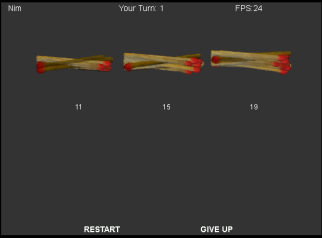
Here’s an example of a starting NIM board. If you go first, can you win? (Assuming your opponent never makes a mistake.)
NIM is a two-player game. You start with several piles or rows of objects (here they’re matches). On each turn, a player removes some objects from a pile– any number they want. BUT the player who’s forced to remove the last match loses!
There’s no chance in NIM– no dice determining how many matches you can remove, for example. Also both players know the rules and how many matches are in the piles at all times. That means that if you thought about it for a while, you could figure out who should win or lose any game of NIM. Maybe playing the game NIM isn’t super fun– but thinking about it like a puzzle is!
More versions of online NIM can be found here and here. And to read about combinatorial games we’ve written about in the past, check out this interview with mathematician Elwyn Berlekamp!
Next up, it’s presidential election time here again in the U.S.! Did you know that there’s a lot of mathematics behind what makes elections work? Four years ago, before the last presidential election, we shared a great series of YouTube videos about the math of elections.
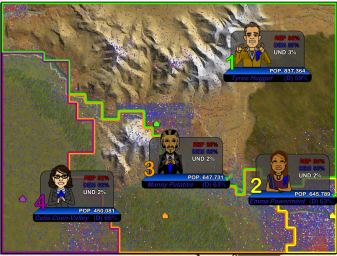
A map in the redistricting game.
A big way that math gets involved in elections is through how politicians decide to draw districts, or regions of states that get to elect their own representative to the House of Representatives and elector to the Electoral College. The math behind drawing districts ranges from simple arithmetic to graph theory, or the field of math that deals with how parts of a shape or diagram are connected. To learn more about drawing election districts and the math behind it, check out the Re-Districting Game! In this game, you play the part of a map maker who works with the Congress, governor of your state, and courts to make a district map that meets everyone’s needs.
Finally, I recently ran across a series of graph music videos! What’s that? Videos in which a graph (made on Desmos) dances along to music, much like people would in a regular music video. Here’s one of my favorites:
The equations on the left-hand side of the screen create the images you see and the rhythm of the animation. Want to make your own graph music video? Share it with us!
This post comes to us all the way from June of 2014! Enjoy this blast from the past!
Welcome to this week’s Math Munch!
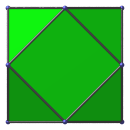
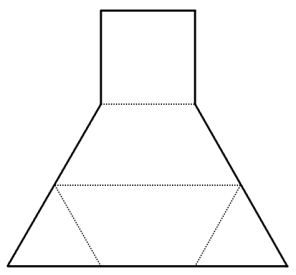
Print out two copies of this pattern, cut them out, and fold each along the dotted lines, making two identical solids. Then fit these two pieces together to make a regular tetrahedron.
Our first bit of fun comes from a blog called Futility Closet (previously featured). It’s a neat little cut-and-fold puzzle. The shape to the right can be folded up to make a solid with 5 sides. Two of them can be combined to make a solid with only 4 sides, the regular tetrahedron. If you’d like, you can use our printable version, which has two copies on one sheet.
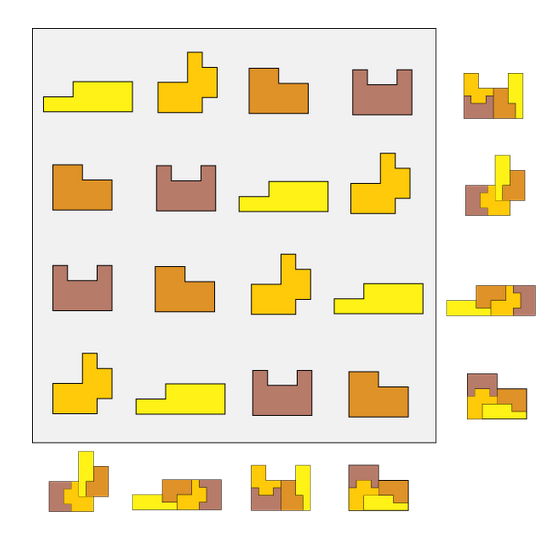
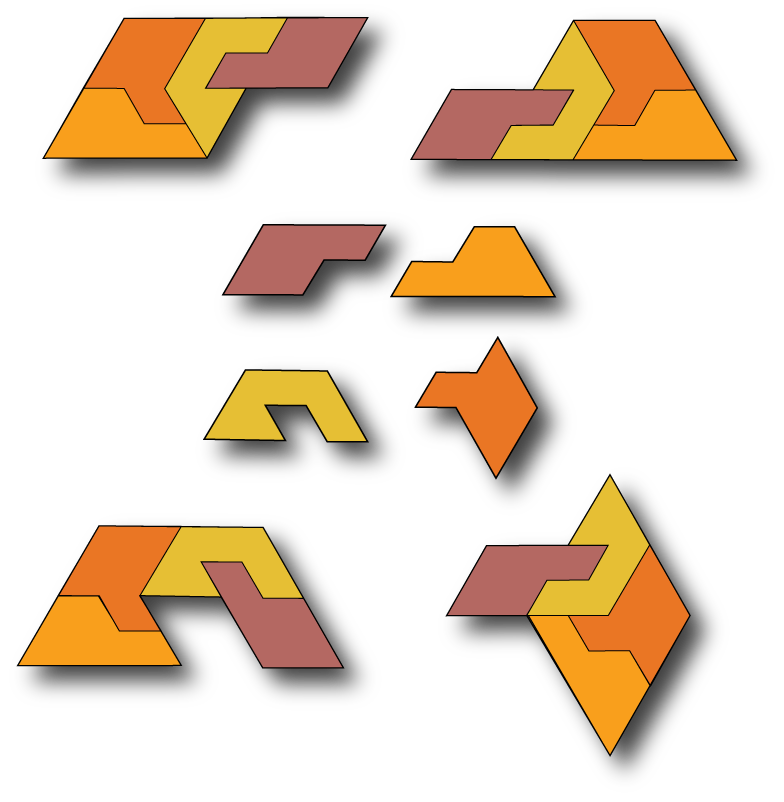
What do you know, I also found our second item on Futility Closet! Check out the cool family of tiles below. What do you notice?
A family of self-tiling tiles
Did you notice that the four shapes in the middle are the same as the four larger shapes on the outside? The four tiles in the middle can combine to create larger versions of themselves! They can make any and all of the original four!!
Recreational Mathematician, Lee Sallows
Naturally, I was reminded of the geomagic squares we featured a while back (more at geomagicsquares.com), and then I came to realize they were designed by the same person, the incredible Lee Sallows! (For another amazing one of Lee Sallows creations, give this incredible sentence a read.) You can also visit his website, leesallows.com.
A family of 6 self-tiling tiles
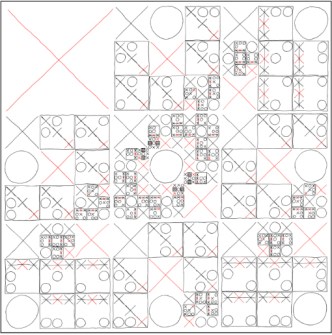
For more self-tiling tiles (and there are many more amazing sets) click here. I have to point out one more in particular. It’s like a geomagic square, but not quite. It’s just wonderful. Maybe it ought to be called a “self-tiling latin square.”
And for a final item this week, we have a powerful drawing tool. It’s a website that reminds me a lot of recursive drawing, but it’s got a different feel and some excellent features. It’s called Doodal. Basically, whatever you draw inside of the big orange frame will be copied into the blue frames. So if there’s a blue frame inside of an orange frame, that blue frame gets copied inside of itself… and then that copy gets copied… and then that copy…!!!
To start, why don’t you check out this amazing video showing off some examples of what you can create. They go fast, so it’s not really a tutorial, but it made me want to figure more things out about the program.
I like to use the “delete frame” button to start off with just one frame. It’s easier for me to understand if its simpler. You can also find instructions on the bottom. Oh, and try using the shift key when you move the blue frames. If you make something you like, save it, email it to us, and we’ll add it to our readers’ gallery.

 Carolyn Yackel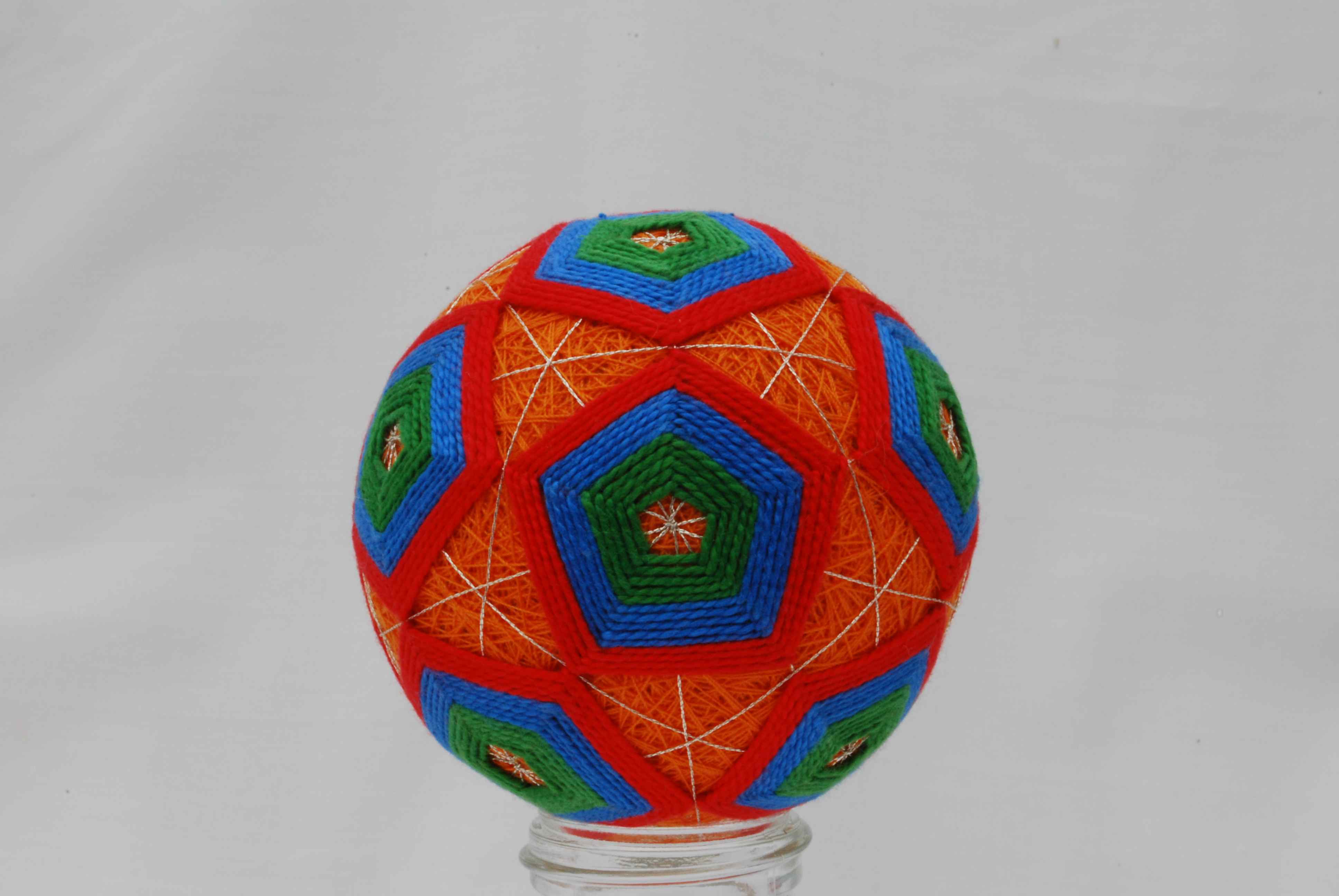





 Math Munch