Tag Archives: building

Polyominoes, Rubix, and Emmy Noether

Welcome to this week’s Math Munch!

Check out the Pentomino Project, a website devoted to all things about polyominoes by students and teachers from the K. S. O. Glorieux Ronse school in Belgium.

Their site is full of lots of useful information about polyominoes, such as what the different polyominoes look like and how they are formed.

In this puzzle, place the twelve pentominoes as "islands in a sea" so that the area of the sea is a small as possible. The pentominoes can't touch, even at corners. Here's a possible solution.

Even more awesome, though, is their collection of polyomino puzzles – about dissections, congruent pieces, tilings, and more!  They have a contest every year  – and people from around the world are encouraged to participate!  If you solve a puzzle, you can send them your solution and they might post it on their site.

Next, have you ever thought to yourself, “Gee, I wonder if I can make my own Rubix Cube?”  Well, sixth grader August did just that.  And, after several days of searching for patterns and working hard with paper, scissors, string, and tape, August succeeded!  His 2-by-2 Rubix Cube works just like any other, is fun to play with, and – even better – was fun to make.

Try it yourself:

Finally, ever heard of Emmy Noether?  It’s not surprising if you haven’t, because, according a New York Times article about her, “few can match in the depths of her perverse and unmerited obscurity….”  But, she was one of the most influential mathematicians and scientists of the 20th century – and was named by Albert Einstein the most “significant” and “creative” woman mathematician of all time.  You can read about Emmy’s influential theorem, and her struggles to become accepted in the mathematical community as a Jewish woman, in this article.

Want to learn more about women mathematicians throughout history?  Check out this site of biographies from Agnes Scott College.

Bon appetit!

(Beat, Beat, Beat…)

Welcome to this week’s Math Munch!

What could techno rhythms, square-pieces dissections, and windshield wipers have in common?

Animation in which progressively smaller square tiles are added to cover a rectangle completely.

The Euclidean Algorithm!

Say what?  The Euclidean Algorithm is all about our good friend long division and is a great way of finding the greatest common factor of two numbers. It relies on the fact that if a number goes into two other numbers evenly, then it also goes into their difference evenly.  For example, 5 goes into both 60 and 85–so it also goes into their difference, 25.  Breaking up big objects into smaller common pieces is a big idea in mathematics, and the way this plays out with numbers has lots of awesome aural and visual consequences.

Here’s the link that prompted this post: a cool applet where you can create your own unique rhythms by playing different beats against each other.  It’s called “Euclidean Rhythms” and was created by Wouter Hisschemöller, a computer and audio programmer from the Netherlands.

(Something that I like about Wouter’s post is that it’s actually a correction to his original posting of his applet.  He explains the mistake he made, gives credit to the person who pointed it out to him, and then gives a thorough account of how he fixed it.  That’s a really cool and helpful way that he shared his ideas and experiences.  Think about that the next time you’re writing up some math!)

For your listening pleasure, here’s a techno piece that Wouter composed (not using his applet, but with clear influences!)

Breathing Pavement

Here’s an applet that demonstrates the geometry of the Euclidean Algorithm.  If you make a rectangle with whole-number length sides and continue to chop off the biggest (non-slanty) square that you can, you’ll eventually finish.  The smallest square that you’ll chop will be the greatest common factor of the two original numbers.  See it in action in the applet for any number pair from 1 to 100, with thanks to Brown mathematics professor Richard Evan Schwartz, who maintains a great website.

Holyhedron, layer three

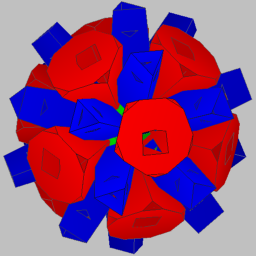
One more thing, on an entirely different note: Holyhedron! A polyhedron where every face contains a hole. The story is given briefly here. Pictures and further details can be found on the website of Don Hatch, finder of the smallest known holyhedron.  It’s a mathematical discovery less than a decade old–in fact, no one had even asked the question until John Conway did so in the 1990s!

Have a great week! Bon appétit!

Alphametics, Hyperbolic Crochet, and a Puzzle Contest

Welcome to the first Math Munch of December!


Did you know that SEND + MORE = MONEY?  Or that DOUBLE + DOUBLE + TOIL = TROUBLE?  It does if you replace the letters with the appropriate digits!  These very clever puzzles, where the digits in numbers of addition, subtraction, or multiplication problems are replaced by letters in words, are called alphametics (or sometimes cryptarithms).  Mathematician, software engineer, and writer Mike Keith calls them the “most elegant of puzzles” on his page devoted to some alphametics he’s found and created.  Check out the “doubly-true” alphametics – puzzles where the words are numbers – and Mike’s alphametic poetry.  In this poem, written in what Mike calls “Strict Alphametish,” the last word in each line is the sum of the previous words in that line!  Wow!

Next, take a look at these cool objects!

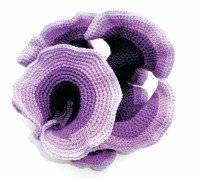
Purple hyperbolic plane

If you draw a line on a hyperbolic plane and a point not on that line, you can make an infinite number of lines parallel to the first line through the point.

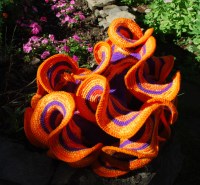
These are models of hyperbolic planes crocheted by Cornell University mathematician and artist Daina Taimina.  A hyperbolic plane is a surface that is kind of like the opposite of a sphere: on a sphere, the surface always curves in towards itself, but on a hyperbolic plane, the surface always curves away from itself.

Before Daina figured out how to crochet a hyperbolic plane, mathematicians had no durable, easy-to-use models of this very important geometric object!  But now, anyone with a little crocheting skill (or a willingness to learn!) can make a hyperbolic plane!  Here are instructions on how to crochet your very own hyperbolic plane, and here’s a link to Daina’s blog.

By the way, our favorite mathematical doodler Vi Hart also makes models of hyperbolic planes out of balloons.

Finally, do you like to play with Rubik’s Cubes, stacking puzzles, or other physical math puzzles?  Think you could make one of your own?   These are some of the entries in the 2011 Nob Yoshigahara Puzzle Design Competition.  Here are the winners!  The designer of the first-place puzzle won this cool trophy!

Bon Appetit!