Tag Archives: fractals

A Sweater, Paper Projects, and Math Art Tools

Sondra Eklund and her Prime Factorization Sweater

Welcome to this week’s Math Munch!

Check out Sondra Eklund and her awesome prime factorization sweater! Sondra is a librarian and a writer who writes a blog where she reviews books. She also is a knitter and a lover of math!

Each number from two to one hundred is represented in order on the front of Sondra’s sweater. Each prime number is a square that’s a different color; each composite number has a rectangle for each of the primes in its prime factorization. This number of columns that the numbers are arranged into draws attention to different patterns of color. For instance, you can see a column that has a lot of yellow in it on the front of the sweater–these are all number that contain five as a factor.

You can read more about Sondra and her sweater on her blog. Also, here’s a response and variation to Sondra’s sweater by John Graham-Cumming.

Next up, do you like making origami and other constructions out of paper? Then you’ll love the site made by Laszlo Bardos called CutOutFoldUp.

Laszlo Bardos

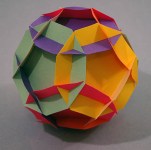
A Rhombic Spirallohedron

A decagon slide-together

Laszlo is a high school math teacher and has enjoyed making mathematical models since he was a kid. On CutOutFoldUp you’ll find gobs of projects to try out, including printable templates. I’ve made some slide-togethers before, but I’m really excited to try making the rhombic spirallohedron pictured above! What is your favorite model on the site?

Last up, Paul recently discovered a great mathematical art applet called Recursive Drawing. The tools are extremely simple. You can make circles and squares. You can stretch these around. But most importantly, you can insert a copy of one of your drawings into itself. And of course then that copy has a copy inside of it, and on and on. With a very simple interface and very simple tools, incredible complexity and beauty can be created.

Recursive Drawing was created by Toby Schachman, an artist and programmer who graduated from MIT and now lives in New York City and attends NYU.  You can watch a demo video below.

Recursive Drawing is one of the first applets on our new Math Art Tools page. We’ll be adding more soon. Any suggestions? Leave them in the comments!

Bon appetit!
Möbius, Escher, Hart

Happy New Year, and welcome to this week’s Math Munch!

Next week, the Math Munch team will be part of a Mathematical Art seminar, so we are featuring some great art.

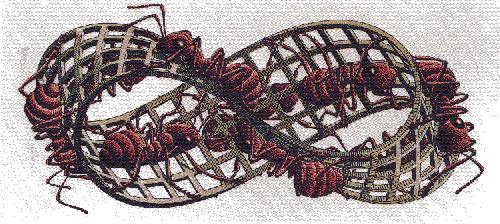
Möbius Strip II (Red Ants) | M.C. Escher

Check out the Möbius strip.  It’s a topological space you can make by by putting a twist in a looped strip of paper.  It has the bizarre property of being one-sided!  Here’s a video of someone making it, but the music is pretty strange.  I found some Möbius info on an amazing math website called Cut The Knot.  Click herehere and here for three different Möbius pages.

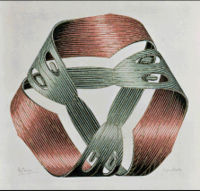
Möbius Strip I | M.C. Escher

M.C. Escher popularized the Möbius strip by featuring them in his famous and mathematical prints.  The picture to the right gives you some idea what happens if you cut a Möbius strip in half.  You could give that a try.

If you look at these pictures, you’ll see why mathematicians love Escher’s art so much.  Escher liked to play with the impossible in his art, but several mathematicians have made his dreams reality.  Take a look at this site called Escher For Real.  If you liked that, check out the sequel, Beyond Escher for Real.

And of course, Vi Hart has done it again, this time with two pieces of Möbius art.  First, Vi bought a DIY (do-it-yourself) music box and wrote a Möbius song!  You can get your own music box here.  She also wrote a Möbius story called Wind and Mr. Ug, and the video is embedded below.

Hoping you have a mathematical week.  Bon appetit!

Triangles, Triangles, Triangles!

Welcome to this week’s Math Munch!

Inspired by Vi Hart’s most recent doodling video “Triangle Party!”, this week’s post is all about triangles.

Connie Liu

One of the most amazing things about mathematics is that there are always new discoveries to be made about even the simplest of objects–even triangles!  Check out this article about Connie Liu, a Hawaiian teenager who just last year discovered some new formulas that relate special points of triangles to each other.  Connie has found some new, simple, and interesting ways of describing the triangle inequality – just by sticking with her questions and digging into a particular part of mathematics a little deeper than anyone had before.

Next up, here are some visual perspectives on Pascal’s triangle.  Even folks who are well acquainted with this numerical cascade are likely to find something new to see in these blog posts by Tao Wang.  Tao is a math and computer teacher in NYC.  My favorite visualization is the video that depicts the entries of Pascal’s triangle as blocks that are as tall as their numerical value.

Hat tip to Patrick Honner, a math teacher from Brooklyn, for the Pascal’s triangle visualizations.  Patrick writes a sweet mathematical blog, including a running series of photographs about the math that he sees in the world.  Check out his posts about which of these isosceles triangles is “more equilateral.”

Zooming in on the corner of a Koch snowflake.

Finally, Vi mentions and doodles a Koch snowflake in her video.  This seems timely, what with snowfalls likely just around the corner.  Here are some great images of generalizations of the Koch snowflake by Phil Keenan that he made using computers.

Wow, what a great crop of other blogs for you to explore!

Here is a list of them all:

Math Laoshi by Tao Wang

Math Appreciation by Patrick Honner

Meandering Through Mathematics by Phil Keenan

and of course Vi Hart’s Blog

Stay tuned for more winter-inspired mathematics next week!

Bon appetit!