Tag Archives: music

Math Cats, Frieze Music, and Numbers

Welcome to this week’s Math Munch!

I just ran across a website that’s chock full of cool math applets, links, and craft ideas – and perfect for fulfilling those summer math cravings!  Math Cats was created by teacher and parent Wendy Petti to, as she says on her site, “promote open-ended and playful explorations of important math concepts.”

Math Cats has a number of pages of interesting mathematical things to do, but my favorite is the Math Cats Explore the World page.  Here you’ll find links to cool math games and explorations made by Wendy, such as…

… the Crossing the River puzzle!  In this puzzle, you have to get a goat, a cabbage, and a wolf across a river without any of your passengers eating each other!  And…

… the Encyclogram!  Make beautiful images called harmonograms, spirographs, and lissajous figures with this cool applet.  Wendy explains some of the mathematics behind these images, too. And, one of my favorites…

Scaredy Cats!  If you’ve ever played the game NIM, this game will be very familiar.  Here you play against the computer to chase cats away – but don’t be left with the last cat, or you’ll lose!

These are only a few of the fun activities to try on Math Cats.  If you happen to be a teacher or parent, I recommend that you look at Wendy’s Idea Bank.  Here Wendy has put together a very comprehensive and impressive list of mathematics lessons, activities, and links contributed by many teachers.

Next, Vi Hart has a new video that showcases one of my favorite things in mathematics – the frieze.  A frieze is a pattern that repeats infinitely in one direction, like the footsteps of the person walking in a straight line above.  All frieze patterns have translation symmetry – or symmetry that slides or hops – but some friezes have additional symmetries.  The footsteps above also have glide reflection symmetry – a symmetry that flips along a horizontal line and then slides.  Frieze patterns frequently appear in architecture.  You can read more about frieze patterns here.

Reading about frieze patterns is all well and good – but what if you could listen to them?  What would a translation sound like?  A glide reflection?  The inverse of a frieze pattern?  Vi sings the sounds of frieze patterns in this video.

[youtube http://www.youtube.com/watch?v=Av_Us6xHkUc&feature=BFa&list=UUOGeU-1Fig3rrDjhm9Zs_wg]

Do you have your own take on frieze music?  Send us your musical compositions at MathMunchTeam@gmail.com .

Finally, if I were to ask you to name the number directly in the middle of 1 and 9, I bet you’d say 5.  But not everyone would.  What would these strange people say – and why would they also be correct?  Learn about this and some of the history, philosophy, and psychology of numbers – and hear some great stories – in this podcast from Radiolab.  It’s called Numbers.
Bon appetit!

P.S. – Paul made a new Yoshimoto video!  The Mega-Monster Mesh comes alive!  Ack!

[youtube https://www.youtube.com/watch?v=PMpr8pA5lJw&feature=player_embedded]

P.P.S. – Last week – June 28th, to be exact – was Tau Day.  For more information about Tau Day and tau, check out the last bit of this old Math Munch post.  In honor of the occasion, Vi Hart made this new tau video.  And there’s a remix.
Music Box, FatFonts, and the Yoshimoto Cube

Welcome to this week’s Math Munch!

The Whitney Music Box

Jim Bumgardner

Solar Beat

With the transit of Venus just behind us and the summer solstice just ahead, I’ve got the planets and orbits on my mind. I can’t believe I haven’t yet shared with you all the Whitney Music Box. It’s the brainchild of Jim Bumgardner, a man of many talents and a “senior nerd” at Disney Interactive Labs. His music box is one of my favorite things ever–so simple, yet so mesmerizing.

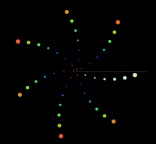
It’s actually a bunch of different music boxes–variations on a theme. Colored dots orbit in circles, each with a different frequency, and play a tone when they come back to their starting points. In Variation 0, for instance, within the time it takes for the largest dot to orbit the center once, the smallest dot orbits 48 times. There are so many patterns to see–and hear! There are 21 variations in all. Go nuts! In this one, only prime dots are shown. What do you notice?

You can find a more astronomical version of this idea at SolarBeat.

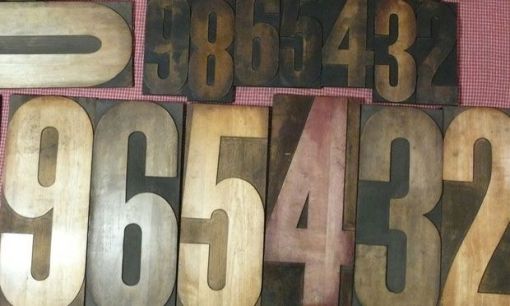
Above you’ll find a list of the numerals from 1 to 9. Or is it 0 to 9?

Where’s the 0 you ask? Well, the idea behind FatFonts is that the visual weight of a number is proportional to its numerical size. That would mean that 0 should be completely white!

FatFonts can also be nested. The first number below is 64. Can you figure out the second?

This is 64 in FatFonts.

What number is this?
Click to zoom!

FatFonts was developed by the team of Miguel NacentaUta Hinrichs, and Sheelagh Carpendale. You can see some uses that FatFonts has been put to on their Gallery page, and even download FatFonts to use in your word processor. Move over, Times New Roman!

This past week, Paul pointed me to this cool video by George Hart about interlocking complementary polyhedra that together form a cube. It reminded me of something I saw for the first time a few years ago that just blew me away. You have to see the Yoshimoto Cube to believe it:

In addition to its more obvious charms, something that delights me about the Yoshimoto Cube is how it was found so recently–only in 1971, by Naoki Yoshimoto.  (That other famous cube was invented in 1974 by Ernő Rubik.) How can it be that simple shapes can be so inexhaustible? If you’re feeling inspired, Make Magazine did a short post on the Yoshimoto Cube a couple of years that includes a template for making a Yoshimoto Cube out of paper. Edit: These template and instructions aren’t great. See below for better ones!

Since it’s always helpful to share your goals to help you stick to them, I’ll say that this week I’m going to make a Yoshimoto Cube of my own. Begone, back burner! Later in the week I’ll post some pictures below. If you decide to make one, share it in the comments or email us at

MathMunchTeam@gmail.com

We’d love to hear from you.

Bon appetit!

Update:

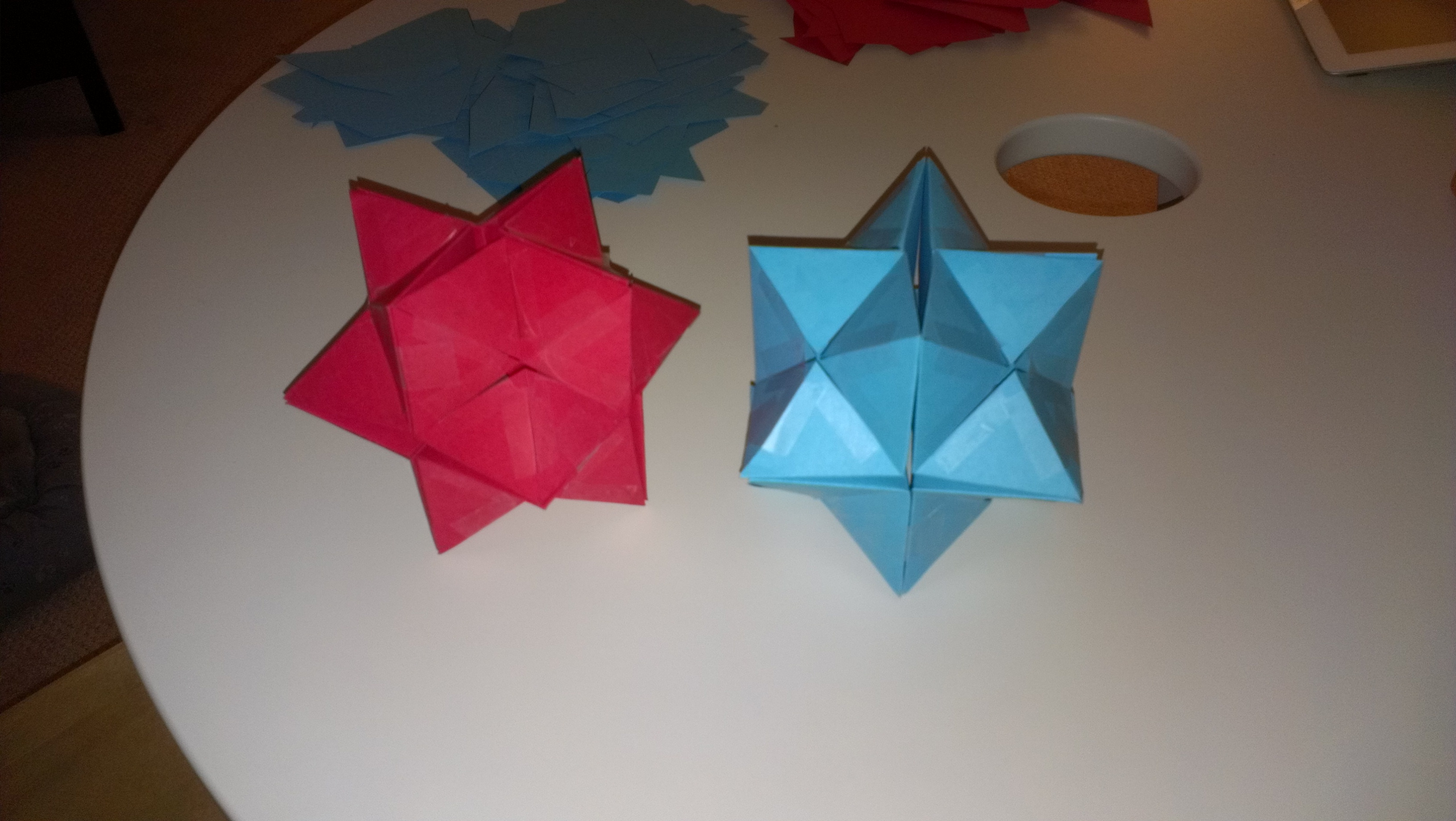
Here are the two stellated rhombic dodecahedra that make the Yoshimoto Cube that Paul and I made! Templates, instructions, and video to follow!

Here are two different templates for the Yoshimoto cubelet. You’ll need eight cubelets to make one star.

And here’s how you tape them together:

The Fractal Foundation, Schoolhouse Rock, and More

Welcome to this week’s Math Munch!

Triangle Cutout Fractal

Up first, check out the Fractal Foundation.  They’re mission is simple: “We use the beauty of fractals to inspire interest in Science, Math and Art.”  If you played around with recursive drawing a few weeks ago, then perhaps you were as inspired by fractals as they hope you’ll be.  If you’re not really sure what fractals actually are, here’s a great one-page explanation from the Fractal Foundation website.  They also have an excellent page of “fractivities,” including instructions for the beautiful paper cutout fractal pictured on the right.  If you want to have your mind blow, check out their fantastic page of fractal videos.  Just amazing.


Next up, have you ever heard of Schoolhouse Rock?  It’s a series of rocking animated music videos that originally ran on TV from 1973 to 1985.  Vintage math goodness!  They cover all kinds of educational stuff like grammar and history, but I totally love the math videos, and a few of them are on YouTube!  Down below you can watch two of my favorites, and you can find the others here.  if you poke around YouTube, you could probably find a few more as well.


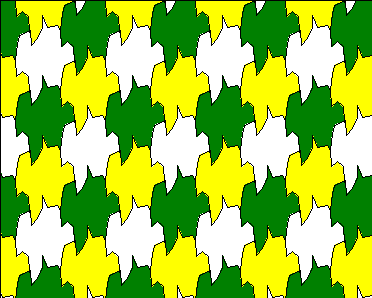
Finally, a few additions to our resource pages.  For the Math Games page, we’re adding Linebounder.  You and the computer battle to draw a line towards your goal.  I had a really hard time with this at first, but there are certain strategies that the computer simply cannot beat.  You just have to find them.  Also new is Shift, another fun game that plays with the relationship between figure and ground.  For the new Math Art Tools page, we’re adding Tessellate!  It’s an interactive applet that lets you make custom tiles to cover the plane.  Here’s a few examples I just made.


Bon appetit!

Hexagonal

Triangular

Rectangular