Tag Archives: music

(Beat, Beat, Beat…)

Welcome to this week’s Math Munch!

What could techno rhythms, square-pieces dissections, and windshield wipers have in common?

Animation in which progressively smaller square tiles are added to cover a rectangle completely.

The Euclidean Algorithm!

Say what?  The Euclidean Algorithm is all about our good friend long division and is a great way of finding the greatest common factor of two numbers. It relies on the fact that if a number goes into two other numbers evenly, then it also goes into their difference evenly.  For example, 5 goes into both 60 and 85–so it also goes into their difference, 25.  Breaking up big objects into smaller common pieces is a big idea in mathematics, and the way this plays out with numbers has lots of awesome aural and visual consequences.

Here’s the link that prompted this post: a cool applet where you can create your own unique rhythms by playing different beats against each other.  It’s called “Euclidean Rhythms” and was created by Wouter Hisschemöller, a computer and audio programmer from the Netherlands.

(Something that I like about Wouter’s post is that it’s actually a correction to his original posting of his applet.  He explains the mistake he made, gives credit to the person who pointed it out to him, and then gives a thorough account of how he fixed it.  That’s a really cool and helpful way that he shared his ideas and experiences.  Think about that the next time you’re writing up some math!)

For your listening pleasure, here’s a techno piece that Wouter composed (not using his applet, but with clear influences!)

Breathing Pavement

Here’s an applet that demonstrates the geometry of the Euclidean Algorithm.  If you make a rectangle with whole-number length sides and continue to chop off the biggest (non-slanty) square that you can, you’ll eventually finish.  The smallest square that you’ll chop will be the greatest common factor of the two original numbers.  See it in action in the applet for any number pair from 1 to 100, with thanks to Brown mathematics professor Richard Evan Schwartz, who maintains a great website.

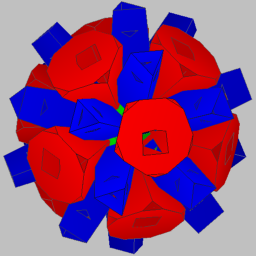
Holyhedron, layer three

One more thing, on an entirely different note: Holyhedron! A polyhedron where every face contains a hole. The story is given briefly here. Pictures and further details can be found on the website of Don Hatch, finder of the smallest known holyhedron.  It’s a mathematical discovery less than a decade old–in fact, no one had even asked the question until John Conway did so in the 1990s!

Have a great week! Bon appétit!

Pi Digits, Pi-oetry, and Anti-Pi

This week’s Math Munch is brought to you by the number pi, because Wednesday (March 14th) is Pi Day!
 

Pi is an irrational number – meaning that it cannot be written as a ratio of integers.  Consequently, it’s decimal expansion goes on and on forever without any repeats.  But, that doesn’t mean people haven’t tried to list as many digits of pi as they can!  This site lists the first million digits of pi.  This site sings many of them – the tune is rather catchy.  And here you can search for strings of numbers in the decimal expansion for pi!  I searched for my birthday, 10/01/87 – it occurs 885,826 digits after the decimal point!

Remember the alphametics puzzle creator, Mike Keith?  Well, he writes poems and short stories in what he calls “Pilish,” in which the lengths of successive words represent successive digits of pi.  Here’s an explanation of the different forms of Pilish.  Mike holds the world record for the longest and second longest texts written in Pilish – they are his book, Not A Wake, and a short story, “Cadaeic Cadenza.”

Finally, as we celebrate pi on Wednesday, we should do so with some skepticism.  In the opinion of some mathematicians, pi is the wrong constant.  Inspired by this article by mathematician Bob Palais, some people have been speaking up in favor of the constant tau, which is double pi.  Here’s our favorite Vi Hart on the issue of pi:

You’ve heard what pi sounds like.  Want to know what tau sounds like?

Bon appetit!

Möbius, Escher, Hart

Happy New Year, and welcome to this week’s Math Munch!

Next week, the Math Munch team will be part of a Mathematical Art seminar, so we are featuring some great art.

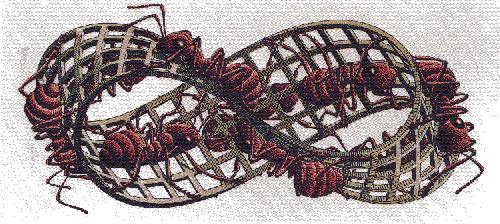
Möbius Strip II (Red Ants) | M.C. Escher

Check out the Möbius strip.  It’s a topological space you can make by by putting a twist in a looped strip of paper.  It has the bizarre property of being one-sided!  Here’s a video of someone making it, but the music is pretty strange.  I found some Möbius info on an amazing math website called Cut The Knot.  Click herehere and here for three different Möbius pages.

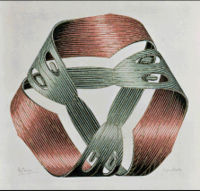
Möbius Strip I | M.C. Escher

M.C. Escher popularized the Möbius strip by featuring them in his famous and mathematical prints.  The picture to the right gives you some idea what happens if you cut a Möbius strip in half.  You could give that a try.

If you look at these pictures, you’ll see why mathematicians love Escher’s art so much.  Escher liked to play with the impossible in his art, but several mathematicians have made his dreams reality.  Take a look at this site called Escher For Real.  If you liked that, check out the sequel, Beyond Escher for Real.

And of course, Vi Hart has done it again, this time with two pieces of Möbius art.  First, Vi bought a DIY (do-it-yourself) music box and wrote a Möbius song!  You can get your own music box here.  She also wrote a Möbius story called Wind and Mr. Ug, and the video is embedded below.

Hoping you have a mathematical week.  Bon appetit!