Welcome to this week’s Math Munch!
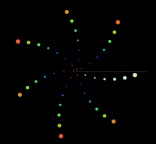 The Whitney Music Box |
 Jim Bumgardner |
 Solar Beat |
With the transit of Venus just behind us and the summer solstice just ahead, I’ve got the planets and orbits on my mind. I can’t believe I haven’t yet shared with you all the Whitney Music Box. It’s the brainchild of Jim Bumgardner, a man of many talents and a “senior nerd” at Disney Interactive Labs. His music box is one of my favorite things ever–so simple, yet so mesmerizing.
It’s actually a bunch of different music boxes–variations on a theme. Colored dots orbit in circles, each with a different frequency, and play a tone when they come back to their starting points. In Variation 0, for instance, within the time it takes for the largest dot to orbit the center once, the smallest dot orbits 48 times. There are so many patterns to see–and hear! There are 21 variations in all. Go nuts! In this one, only prime dots are shown. What do you notice?
You can find a more astronomical version of this idea at SolarBeat.

Above you’ll find a list of the numerals from 1 to 9. Or is it 0 to 9?
Where’s the 0 you ask? Well, the idea behind FatFonts is that the visual weight of a number is proportional to its numerical size. That would mean that 0 should be completely white!
FatFonts can also be nested. The first number below is 64. Can you figure out the second?
 This is 64 in FatFonts. |
 What number is this? |
FatFonts was developed by the team of Miguel Nacenta, Uta Hinrichs, and Sheelagh Carpendale. You can see some uses that FatFonts has been put to on their Gallery page, and even download FatFonts to use in your word processor. Move over, Times New Roman!
This past week, Paul pointed me to this cool video by George Hart about interlocking complementary polyhedra that together form a cube. It reminded me of something I saw for the first time a few years ago that just blew me away. You have to see the Yoshimoto Cube to believe it:
In addition to its more obvious charms, something that delights me about the Yoshimoto Cube is how it was found so recently–only in 1971, by Naoki Yoshimoto. (That other famous cube was invented in 1974 by Ernő Rubik.) How can it be that simple shapes can be so inexhaustible? If you’re feeling inspired, Make Magazine did a short post on the Yoshimoto Cube a couple of years that includes a template for making a Yoshimoto Cube out of paper. Edit: These template and instructions aren’t great. See below for better ones!
Since it’s always helpful to share your goals to help you stick to them, I’ll say that this week I’m going to make a Yoshimoto Cube of my own. Begone, back burner! Later in the week I’ll post some pictures below. If you decide to make one, share it in the comments or email us at
We’d love to hear from you.
Bon appetit!
Update:
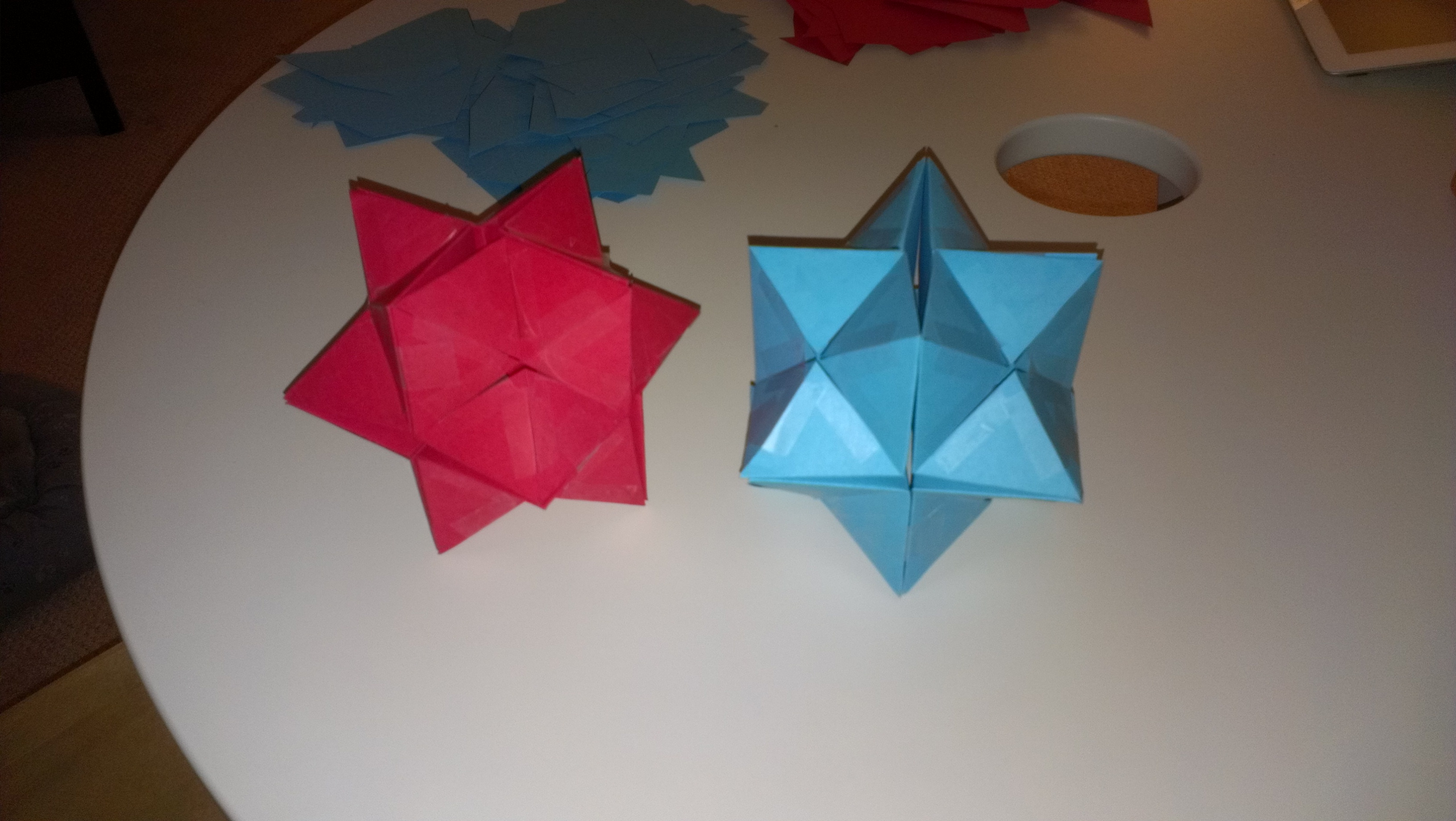
Here are the two stellated rhombic dodecahedra that make the Yoshimoto Cube that Paul and I made! Templates, instructions, and video to follow!
Here are two different templates for the Yoshimoto cubelet. You’ll need eight cubelets to make one star.
|
|
|


And here’s how you tape them together:


 Math Munch