Tag Archives: symmetry

Mathpuzzle, Video Contests, and Snowflakes

Welcome to this week’s Math Munch!

mathpuzzle

One of my favorite math sites on the internet is mathpuzzle. It’s written and curated by recreational mathematician Ed Pegg Jr. About once a month, Ed makes a post that shares a ton of awesome math—interesting tilings, tricky puzzles, results about polyhedra and polyominos, and so much more. Below are some of my favorite finds at mathpuzzles. Go to the site to discover much more to explore!

z5l4l3

Shapes that three kinds of polyominoes can tile.

2

Erich Friedman’s 2012 holiday puzzles

Abyss_01

A slideable, flexible hypercube you can hold in your hands! Video below.

hero_01

Next, have you ever wanted to be a movie star? How about a math movie star? Then there are two math video contests that you should know about. The first is for middle schoolers— the Reel Math Challenge. It’s run by MATHCOUNTS, which has for many years run a middle school problem solving contest. (I competed in it when I was in middle school.) This is only the second year for the Reel Math Challenge, but lots of videos have already been created. You can check them out here.

MathovisionThe second contest is for high schoolers and is called Math-O-Vision. The challenge is to make a video that shows “the way Math fills our world.” Math-O-Vision is sponsored by the Dartmouth College Math Department and the Neukom Institute.

makeaflakeFinally, here’s a fun little applet I found called Make-a-Flake. You can use it to make intricate digital snowflake designs.

flake

Two snowflakes from the Make-a-Flake gallery.

Of course, it’s a lot of fun to make non-virtual snowflakes as well—find a pair of scissor and some paper and go for it! For basic instructions, head over to snowflakes.info. And for some inspiration, check out this Flickr group!

Bon appetit!

Newroz, a Math Factory, and Flexagons

Welcome to this week’s Math Munch!

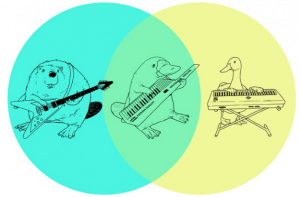
You’ve probably seen Venn diagrams before. They’re a great way of picturing the relationships among different sets of objects.

But I bet you’ve never seen a Venn diagram like this one!

Frank Ruskey

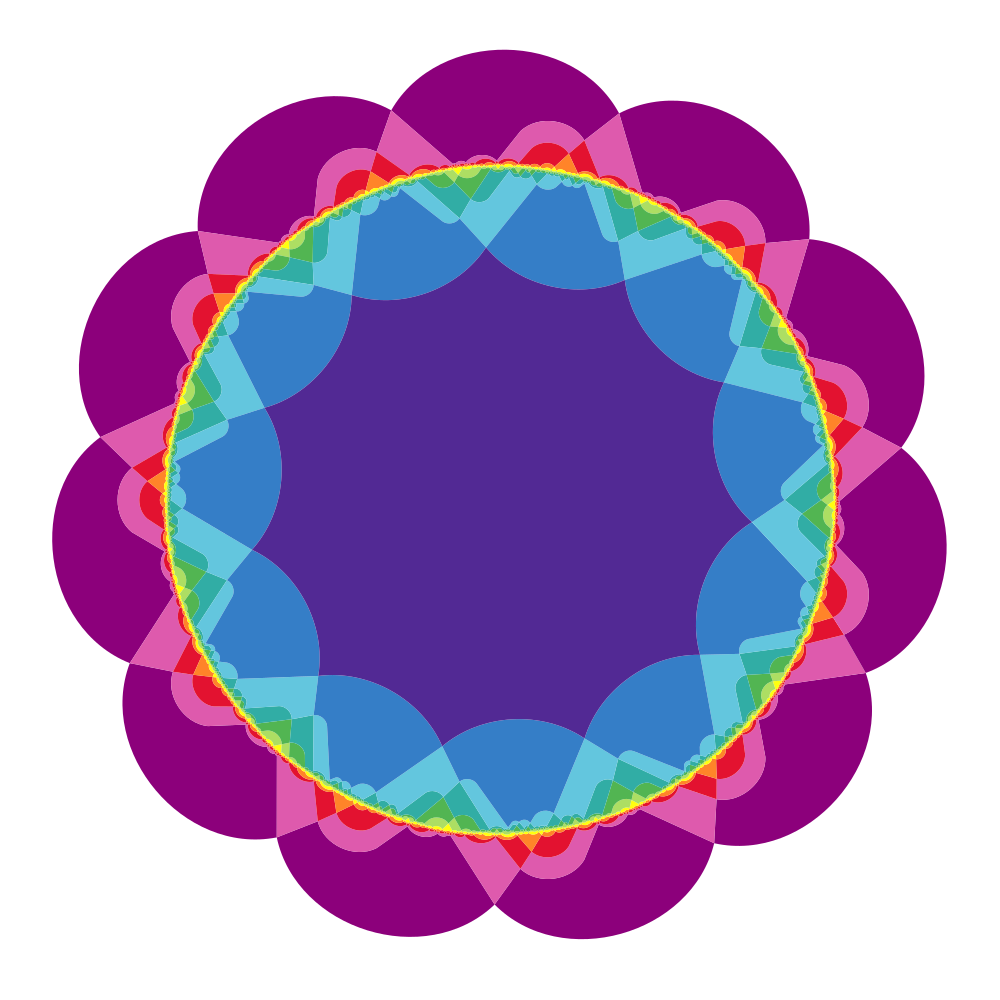
That’s because its discovery was announced only a few weeks ago by Frank Ruskey and Khalegh Mamakani of the University of Victoria in Canada. The Venn diagrams at the top of the post are each made of two circles that carve out three regions—four if you include the outside. Frank and Khalegh’s new diagram is made of eleven curves, all identical and symmetrically arranged. In addition—and this is the new wrinkle—the curves only cross in pairs, not three or more at a time. All together their diagram contains 2047 individual regions—or 2048 (that’s 2^11) if you count the outside.

Frank and Khalegh named this Venn diagram “Newroz”, from the Kurdish word for “new day” or “new sun”. Khalegh was born in Iran and taught at the University of Kurdistan before moving to Canada to pursue his Ph.D. under Frank’s direction.

Khalegh Mamakani

“Newroz” to those who speak English sounds like “new rose”, and the diagram does have a nice floral look, don’t you think?

When I asked Frank what it was like to discover Newroz, he said, “It was quite exciting when Khalegh told me that he had found Newroz. Other researchers, some of my grad students and I had previously looked for it, and I had even spent some time trying to prove that it didn’t exist!”

Khalegh concurred. “It was quite exciting. When I first ran the program and got the first result in less than a second I didn’t believe it. I checked it many times to make sure that there was no mistake.”

You can click these links to read more of my interviews with Frank and Khalegh.

I enjoyed reading about the discovery of Newroz in these articles at New Scientist and Physics Central. And check out this gallery of images that build up to Newroz’s discovery. Finally, Frank and Khalegh’s original paper—with its wonderful diagrams and descriptions—can be found here.

A single closed curve—or “petal”— of Newroz. Eleven of these make up the complete diagram.

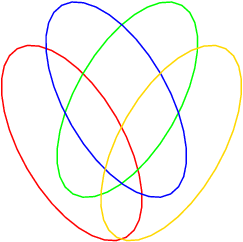
A Venn diagram made of four identical ellipses. It was discovered by John Venn himself!

For even more wonderful images and facts about Venn diagrams, a whole world awaits you at Frank’s Survey of Venn Diagrams.

On Frank’s website you can also find his Amazing Mathematical Object Factory! Frank has created applets that will build combinatorial objects to your specifications. “Combinatorial” here means that there are some discrete pieces that are combined in interesting ways. Want an example of a 5×5 magic square? Done! Want to pose your own pentomino puzzle and see a solution to it? No problem! Check out the rubber ducky it helped me to make!

A pentomino rubber ducky!

Finally, Frank mentioned that one of his early mathematical experiences was building hexaflexagons with his father. This led me to browse around for information about these fun objects, and to re-discover the work of Linda van Breemen. Here’s a flexagon video that she made.

And here’s Linda’s page with instructions for how to make one. Online, Linda calls herself dutchpapergirl and has both a website and a YouTube channel. Both are chock-full of intricate and fabulous creations made of paper. Some are origami, while others use scissors and glue.

I can’t wait to try making some of these paper miracles myself!

Bon appetit!

Math Cats, Frieze Music, and Numbers

Welcome to this week’s Math Munch!

I just ran across a website that’s chock full of cool math applets, links, and craft ideas – and perfect for fulfilling those summer math cravings!  Math Cats was created by teacher and parent Wendy Petti to, as she says on her site, “promote open-ended and playful explorations of important math concepts.”

Math Cats has a number of pages of interesting mathematical things to do, but my favorite is the Math Cats Explore the World page.  Here you’ll find links to cool math games and explorations made by Wendy, such as…

… the Crossing the River puzzle!  In this puzzle, you have to get a goat, a cabbage, and a wolf across a river without any of your passengers eating each other!  And…

… the Encyclogram!  Make beautiful images called harmonograms, spirographs, and lissajous figures with this cool applet.  Wendy explains some of the mathematics behind these images, too. And, one of my favorites…

Scaredy Cats!  If you’ve ever played the game NIM, this game will be very familiar.  Here you play against the computer to chase cats away – but don’t be left with the last cat, or you’ll lose!

These are only a few of the fun activities to try on Math Cats.  If you happen to be a teacher or parent, I recommend that you look at Wendy’s Idea Bank.  Here Wendy has put together a very comprehensive and impressive list of mathematics lessons, activities, and links contributed by many teachers.

Next, Vi Hart has a new video that showcases one of my favorite things in mathematics – the frieze.  A frieze is a pattern that repeats infinitely in one direction, like the footsteps of the person walking in a straight line above.  All frieze patterns have translation symmetry – or symmetry that slides or hops – but some friezes have additional symmetries.  The footsteps above also have glide reflection symmetry – a symmetry that flips along a horizontal line and then slides.  Frieze patterns frequently appear in architecture.  You can read more about frieze patterns here.

Reading about frieze patterns is all well and good – but what if you could listen to them?  What would a translation sound like?  A glide reflection?  The inverse of a frieze pattern?  Vi sings the sounds of frieze patterns in this video.

[youtube http://www.youtube.com/watch?v=Av_Us6xHkUc&feature=BFa&list=UUOGeU-1Fig3rrDjhm9Zs_wg]

Do you have your own take on frieze music?  Send us your musical compositions at MathMunchTeam@gmail.com .

Finally, if I were to ask you to name the number directly in the middle of 1 and 9, I bet you’d say 5.  But not everyone would.  What would these strange people say – and why would they also be correct?  Learn about this and some of the history, philosophy, and psychology of numbers – and hear some great stories – in this podcast from Radiolab.  It’s called Numbers.

Bon appetit!

P.S. – Paul made a new Yoshimoto video!  The Mega-Monster Mesh comes alive!  Ack!

[youtube https://www.youtube.com/watch?v=PMpr8pA5lJw&feature=player_embedded]

P.P.S. – Last week – June 28th, to be exact – was Tau Day.  For more information about Tau Day and tau, check out the last bit of this old Math Munch post.  In honor of the occasion, Vi Hart made this new tau video.  And there’s a remix.