Tag Archives: tessellation

Light Bulbs, Lanterns, and Lights Out

Welcome to this week’s Math Munch!
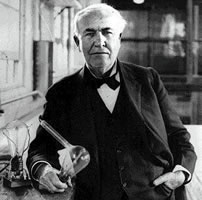
thomas-edison

Edison with his light bulb.

On this day in 1880, Thomas Edison was given a patent for his most famous bright idea—the light bulb.

Edison once said, “Genius is one per cent inspiration, ninety-nine per cent perspiration”—a good reminder that putting in some work is important both in math and in life. He also said, “We don’t know a millionth of one percent about anything.” A humbling thought. Also, based on that quote, it sounds like Edison might have had a use for permilles or even permyraids in addition to percents!
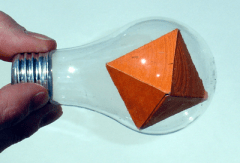
Mike's octahedron.

Mike’s octahedron-in-a-light-buld.

In celebration of this illustrious anniversary, I’d like to share some light mathematical fare relating to, well, light bulbs. For starters, J. Mike Rollins of North Carolina has created each of the Platonic solids inside of light bulbs, ship-in-a-bottle style. Getting just the cube to work took him the better part of twelve hours! Talk about perspiration. Mike has also made a number of lovely Escher-inspired woodcuts. Check ’em out!
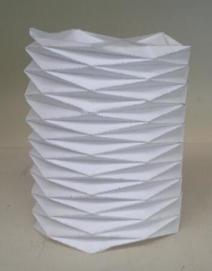
Evelyn's Schwartz lantern.

Evelyn’s Schwartz lantern.

Next up is a far-out example from calculus that’s also a good idea for an art project. It’s called the Schwartz lantern. I found out about this amazing object last fall when Evelyn Lamb tweeted and blogged about it.

The big idea of calculus is that we can find exact answers to tough problems by setting up a pattern of approximations that get better and better and then—zoop! take the process to its logical conclusion at infinity. But there’s a catch: you have to be careful about how you set up your pattern!
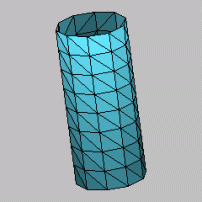
A "nicely" triangulated cylinder.

A “nicely” triangulated cylinder.

For example, if you take a cylinder and approximate its surface with a bunch of triangles carefully, you’ll end up with a surface that matches the cylinder in shape and size. But if you go about the process in a different way, you can end up with a surface that stays right near the cylinder but that has infinite area. That’s the Schwartz lantern, first proposed by Karl Hermann Amandus Schwarz of Cauchy-Schwartz fame. The infinite area happens because of all the crinkles that this devilish pattern creates. For some delightful technical details about the lantern’s construction, check out Evelyn’s post and this article by Conan Wu.

Maybe you’ll try folding a Schwartz lantern of your own. There’s a template and instructions on Conan’s blog to get you started. You’ll be glowing when you finish it up—especially if you submit a photo of it to our Readers’ Gallery. Even better, how about a video? You could make the internet’s first Schwartz lantern short film!
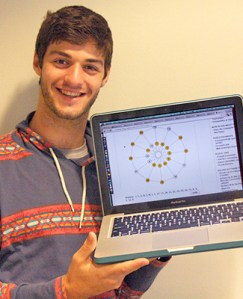
Robert Torrence and his Lights Out puzzle.

Robert and his Lights Out puzzle.

At the MOVES Conference last fall, Bruce Torrence of Randolf-Macon College gave a talk about the math of Lights Out. Lights Out is a puzzle—a close relative of Ray Ray—that’s played on a square grid. When you push one of the buttons in the grid it switches on or off, and its neighbors do, too. Bruce and his son Robert created an extension of this puzzle to some non-grid graphs. Here’s an article about their work and here’s an applet on the New York Times website where you can play Lights Out on the Peterson graph, among others. You can even create a Lights Out puzzle of your own! If it’s more your style, you can try a version of the original game called All Out on Miniclip.

The original Lights Out handheld game from 1995.

The original Lights Out handheld game from 1995.

There’s a huge collection of Lights Out resources on Jaap’s Puzzle Page (previously), including solution strategies, variations, and some great counting problems. Lights Out and Ray Ray are both examples of what’s called a “sigma-plus game” in the mathematical literature. Just as a bonus, there’s this totally other game called Light Up. I haven’t solved a single puzzle yet, but my limitations shouldn’t stop you from trying. Perspiration!

All this great math work might make you hungry, so…bon appetit!

Math Meets Art, Quarto, and Snow!

Welcome to this week’s Math Munch!

article-0-19F9E81700000578-263_634x286… And, if you happen to write the date in the European way (day/month/year), happy Noughts and Crosses Day! (That’s British English for Tic-Tac-Toe Day.) In Europe, today’s date is 11/12/13– and it’s the last time that the date will be three consecutive numbers in this century! We in America are lucky. Our last Noughts and Crosses Day was November 12, 2013 (11/12/13), and we get another one next year on December 13 (12/13/14). To learn more about Noughts and Crosses Day and find out about an interesting contest, check out this site. And, to our European readers, happy Noughts and Crosses Day!

p3p13Speaking of Noughts and Crosses (or Tic-Tac-Toe), I have a new favorite game– Quarto! It’s a mix of Tic-Tac-Toe and another favorite game of mine, SET, and it was introduced to me by a friend of mine. It’s quite tricky– you’ll need the full power of your brain to tackle it. Luckily, there are levels, since it can take a while to develop a strategy. Give it a try, and let us know if you like it!

BRUCKER-ICS-DARKRYE-SQUARE

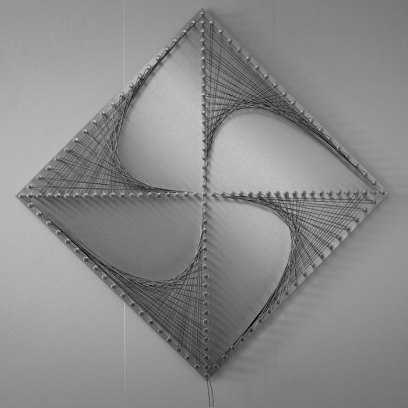
Looking to learn about some new mathematical artists? Check out this article, “When Math Meets Art,” from the online magazine Dark Rye. It profiles seven mathematical artists– some of whom we’ve written about (such as Erik and Martin Demaine, of origami fame, and Henry Segerman), and some of whom I’ve never heard of. The work of string art shown above is by artist Adam Brucker, who specializes in making “unexpected” curves from straight line segments.

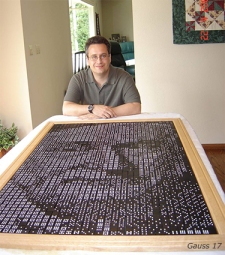
gauss17_smallAnother of my favorites from this article is the work of Robert Bosch. One of his specialities is making mosaics of faces out of tiles, such as dominoes. The article features his portrait of the mathematician Father Sebastien Truchet made out of the tiles he invented, the Truchet tiles. Clever, right? The mosaic to the left is of the great mathematician Gauss, made out of dominoes. Check out Robert’s website to see more of his awesome art.

Finally, it snowed in New York City yesterday. I love when it snows for the first time in winter… and that got me wanting to make some paper snowflakes to celebrate! Here’s a video by Vi Hart that will teach you to make some of the most beautiful paper snowflakes.

Hang them on your windows, on the walls, or from the ceiling, and have a very happy wintery day! Bon appetit!

Isomorphisms in Five, Parquet Deformations, and POW!

Welcome to this week’s Math Munch!

Here’s a catchy little video. It’s called “Isomorphisms in Five.” Can you figure out why? The note posted below the video says:

An isomorphism is an underlying structure that unites outwardly different mathematical expressions. What underlying structure do these figures share? What other isomorphisms of this structure will you discover?

One of the reasons I LOVE this video is because I really like how the shapes change with the music– which is played in a very interesting time signature. I also love how you can learn a lot about the different growing shape patterns by comparing them. Watch how they grow as the video flips from pattern to pattern. What do you notice? What does the music tell you about their growth?

This video is by a math educator from North Carolina named Stuart Jeckel. The only thing written about him on his “About” page is, “The Art of Math”– so he’s a bit of a mystery! He has three more beautiful videos, all of which present little puzzles for you to solve. Check them out!

(Five-four isn’t a common time-signature for music, but it makes some great pieces. Check out this particularly awesome one. Anyone want to try making a growing shape pattern video to this tune?)

parquet-10

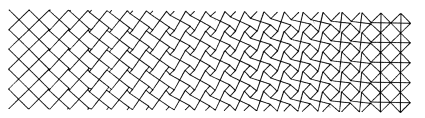
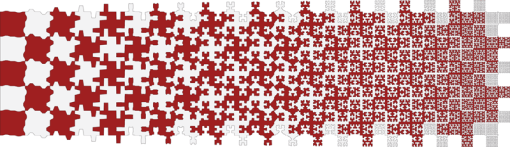
Here is an example of one of my favorite types of geometric patterns– the parquet deformation. To make one, you start with a tessellation. Then you change it- very gradually- until you’ve made a completely different tessellation that’s connected by many tiny steps to the original one.

I love to draw them. It’s challenging, but full of surprises. I never know what it’s going to look like in the end.

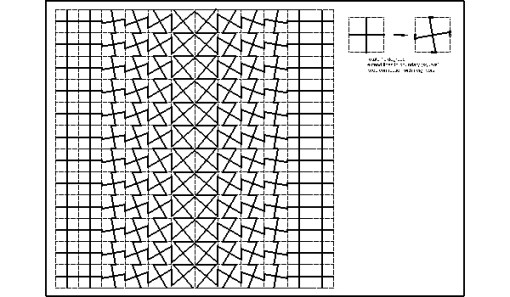
2012_10_31-par5Want to try making your own? Check out this site by the professors/architects Tuğrul Yazar and Serkan Uysal. They had one of their classes map out how some different parquet deformations are made. They mostly used computers, but you could follow their instructions by hand, if you like. The image above is a map for the first deformation I showed.

Click on this link to see some awesome deformations made out of tiles. Aren’t they beautiful? And here’s one made by mathematical artist Craig Kaplan. It has a great fractal quality to it:

hilbert_ih62_a

Finally, here’s something I’ve been meaning to share with you for ages! Do you ever crave a good puzzle and aren’t sure where to find one? Look no farther than the Saint Ann’s School Problem of the Week! Each week, math teacher Richard Mann writes a new awesome problem and posts it on this website. Here’s this week’s problem:

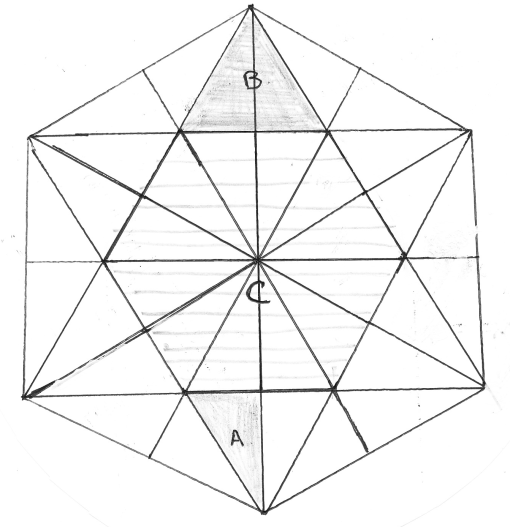
For November 26, 2013– In the picture below, find the shaded right triangle marked A, the equilateral triangle marked B and the striped regular hexagon marked C. Six students make the following statements about the picture below: Anne says “I can find an equilateral triangle three times the area of B.”  Ben says I can find an equilateral triangle four times the area of B.” Carol says, “I can find a find a right triangle triple the area of A.” Doug says, “I can find a right triangle five times the area of A.” Eloise says, “I can find a regular hexagon double the area of C.” Frank says, “I can find a regular hexagon three times the area of C.” Which students are undoubtedly mistaken?

30- 60-90

If you solve this week’s problem, send us a solution!

Bon appetit!