Tag Archives: video

(Beat, Beat, Beat…)

Welcome to this week’s Math Munch!

What could techno rhythms, square-pieces dissections, and windshield wipers have in common?

Animation in which progressively smaller square tiles are added to cover a rectangle completely.

The Euclidean Algorithm!

Say what?  The Euclidean Algorithm is all about our good friend long division and is a great way of finding the greatest common factor of two numbers. It relies on the fact that if a number goes into two other numbers evenly, then it also goes into their difference evenly.  For example, 5 goes into both 60 and 85–so it also goes into their difference, 25.  Breaking up big objects into smaller common pieces is a big idea in mathematics, and the way this plays out with numbers has lots of awesome aural and visual consequences.

Here’s the link that prompted this post: a cool applet where you can create your own unique rhythms by playing different beats against each other.  It’s called “Euclidean Rhythms” and was created by Wouter Hisschemöller, a computer and audio programmer from the Netherlands.

(Something that I like about Wouter’s post is that it’s actually a correction to his original posting of his applet.  He explains the mistake he made, gives credit to the person who pointed it out to him, and then gives a thorough account of how he fixed it.  That’s a really cool and helpful way that he shared his ideas and experiences.  Think about that the next time you’re writing up some math!)

For your listening pleasure, here’s a techno piece that Wouter composed (not using his applet, but with clear influences!)

Breathing Pavement

Here’s an applet that demonstrates the geometry of the Euclidean Algorithm.  If you make a rectangle with whole-number length sides and continue to chop off the biggest (non-slanty) square that you can, you’ll eventually finish.  The smallest square that you’ll chop will be the greatest common factor of the two original numbers.  See it in action in the applet for any number pair from 1 to 100, with thanks to Brown mathematics professor Richard Evan Schwartz, who maintains a great website.

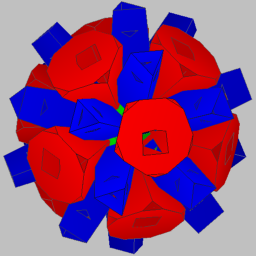
Holyhedron, layer three

One more thing, on an entirely different note: Holyhedron! A polyhedron where every face contains a hole. The story is given briefly here. Pictures and further details can be found on the website of Don Hatch, finder of the smallest known holyhedron.  It’s a mathematical discovery less than a decade old–in fact, no one had even asked the question until John Conway did so in the 1990s!

Have a great week! Bon appétit!

Numberphile, Cube Snakes, and the Hypercube.

Welcome to this week’s Math Munch!

Each one of those pictures takes you to a math video.  Numberphile is a YouTube channel full of fantastic math videos by Brady Haran, each one about a different number.  Is one Googolplex bigger than the universe?  Why does Pac Man end after level 255?  Is 1 a prime number?  Click the numbers to watch the related video.  They also feature James Grime, one of my favorite math people on the internet.

Next up, let’s work on the Saint Ann’s School Problem of the Week.  You can read the fully worded question by following the link, but here it is in short:  If we start in the center, we can snake our way through the 9 small squares of a 3×3 square.  Can we snake our way through the 27 small cubes a 3x3x3 cube?  Can we do it if we start in the middle?

Can we snake our way through the 3x3x3 cube starting in the center?

There’s a new question posted every week (obviously), and if you check the Problem of the Week Archives, you can find more than 4 years of previous questions!  How many do you think we could solve if we did a 24 hour math marathon?

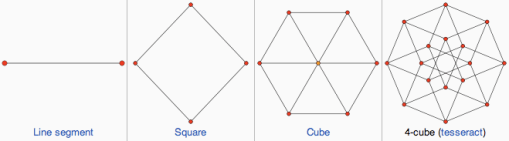
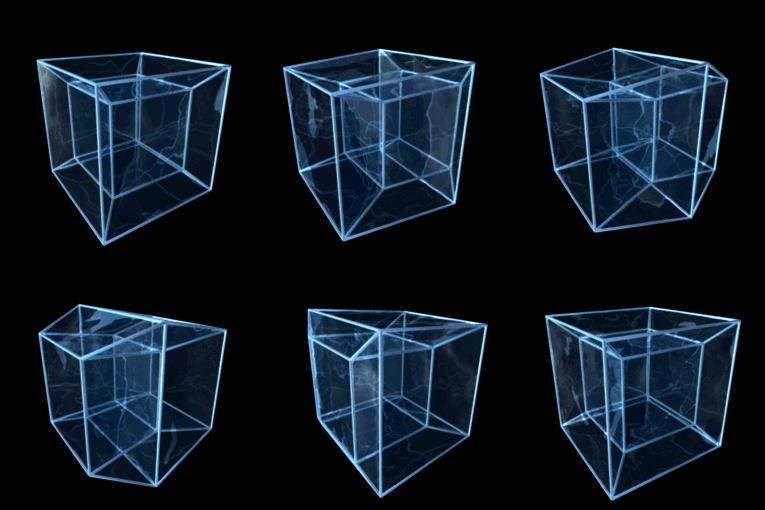
Finally, let’s have a mind-blowing look at higher dimensions.  The problem above is about whether a property of the square (a 2-dimensional object) can be carried over to the cube (its 3D counterpart).  So what is the 4-dimensional version of a cube?  The Hypercube!

The "cube" idea, from 1D to 4D

I’ve heard a lot of people say the 4th dimension is “time” or “duration,” but what would the 5th dimension be?  Well, here’s a video called “Imagining the Tenth Dimension.”  And if you’re hungry for more, there’s a series of 9 math videos called “Dimesions.”  All together it’s 2 amazing hours of math.  You can watch the first chapter online by clicking here.

Bon appetit!

Cubes, Curves, and Geometric Romance

Welcome to this week’s Math Munch!

If you like Rubik’s Cubes, then check out Oskar van Deventer’s original Rubik’s cube-type puzzles!  Oskar is a Dutch scientist who has been designing puzzles since he was 12 years old.  He makes many of his puzzles using a 3D printer, with a company called Shapeways.

Oskar has posted a number of videos of himself explaining his creations.  Here’s him demonstrating the Oh Cube:

Next, take a look at these beautiful curved-crease sculptures made by MIT mathematician and origami artist Erik Demaine and his father, Martin Demaine.  Erik and Martin make these hyperbolic paraboloid structures by folding rings of creases in a circular piece of paper.  They have exhibits of their artwork in various museums and galleries, including in the MoMA permanent collection and the Guided By Invoices gallery in Chelsea, NYC.  So, if you live in NYC, then you could go see these!

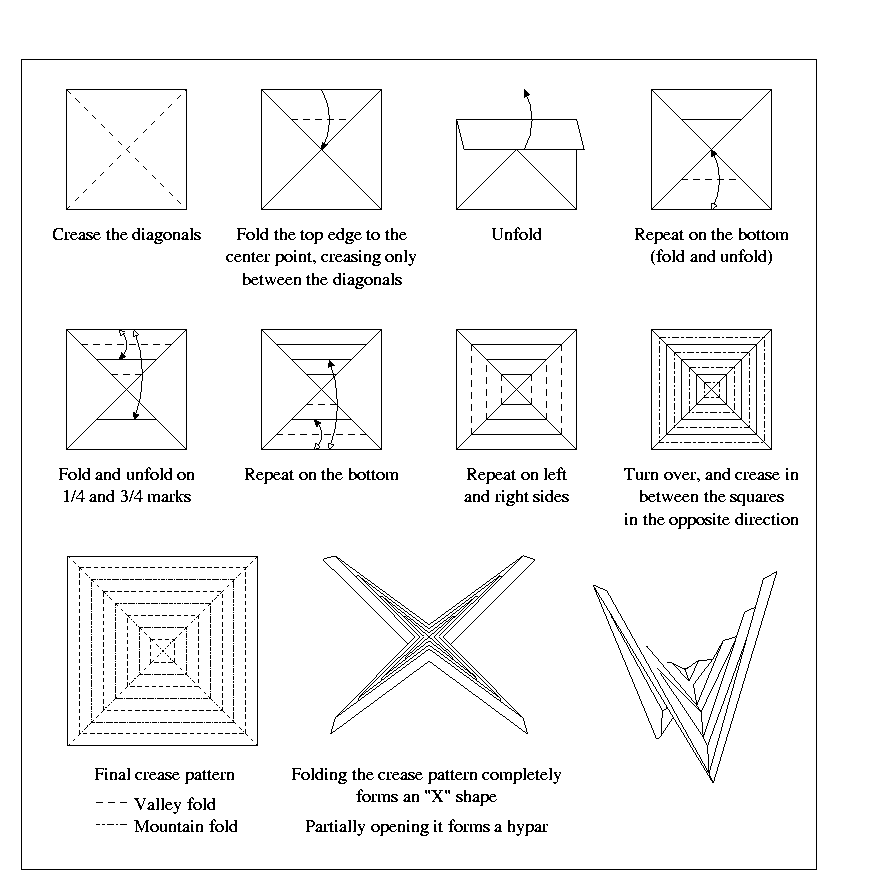
Want to learn how to fold your own hyperbolic paraboloid?  Erik has these instructions for making one out of a square piece of paper with straight folds.

Finally, here is a wonderful video made of Norton Juster’s picture book, The Dot and the Line.  Enjoy!

Bon appetit!