Monthly Archives: July 2013

Bridges, Unfolding the Earth, and Juggling

Welcome to this week’s Math Munch – from the Netherlands!

I’m at the Bridges Mathematical Art Conference, which this year is being held in Enschede, a city in the Netherlands. I’ve seen so much beautiful mathematical artwork, met so many wonderful people, and learned so many interesting new things that I can’t wait to start sharing them with you! In the next few weeks, expect many more interviews and links to sites by some of the world’s best mathematical artists.

But first, have a look at some of the artwork from this year’s art gallery at Bridges.

Hyperbolic lampshade

By Gabriele Meyer

Bunny!

By Henry Segerman and Craig Kaplan

Here are three pieces that I really love. The first is a crocheted hyperbolic plane lampshade. I love to crochet hyperbolic planes (and we’ve posted about them before), and I think the stitching and lighting on this one is particularly good. The second is a bunny made out of the word bunny! (Look at it very closely and you’ll see!) It was made by one of my favorite mathematical artists, Henry Segerman. Check back soon for an interview with him!

Hexagonal flower

By Francisco De Comite

This last is a curious sculpture. From afar, it looks like white arcs surrounding a metal ball, but up close you see the reflection of the arcs in the ball – which make a hexagonal flower! I love how this piece took me by surprise and played with the different ways objects look in different dimensions.

Jack van WijkMathematical artists also talk about their work at Bridges, and one of the talks I attended was by Jack van Wijk, a professor from Eindhoven University of Technology in the Netherlands. Jack works with data visualization and often uses a mixture of math and images to solve complicated problems.

One of the problems Jack tackled was the age-old problem of drawing an accurate flat map of the Earth. The Earth, as we all now know, is a sphere – so how do you make a map of it that fits on a rectangular piece of paper that shows accurate sizes and distances and is simple to read?
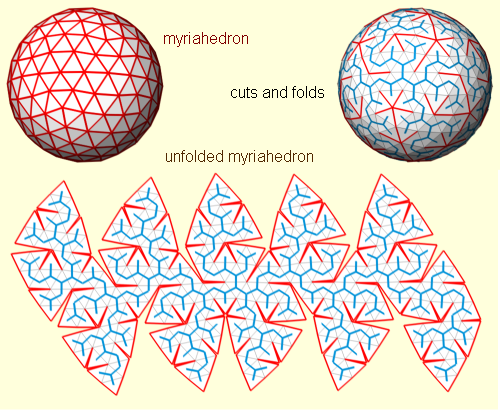
myriahedronTo do this, Jack makes what he calls a myriahedral projection. First, he draws many, many polygons onto the surface of the Earth – making what he calls a myriahedron, or a polyhedron with a myriad of faces. cylindrical mapThen, he decides how to cut the myriahedron up. This can be done in many different ways depending on how he wants the map to look. If he wants the map to be a nice, normal rectangle, maybe he’ll cut many narrow, pointed slits at the North and South Poles to make a map much like one we’re used to. But, maybe he wants a map that groups all the continents together or does the opposite and emphasizes how the oceans are connected…crazy maps

Jack made a short movie that he submitted to the Bridges gallery. He animates the transformation of the Earth to the map projections beautifully.

Jack’s short movie wasn’t the only great film I saw at Bridges. The usual suspects – Vi Hart and her father, George Hart – also submitted movies. George’s movie is about a math topic that I find particularly fascinating: juggling! The movie stars professional juggler Rod Kimball. Click on the picture below to watch:

juggling

This is only the tip of the iceberg that is the gorgeous and interesting artwork I saw at Bridges. Check out the gallery to see more (including artwork by our own Paul and a video by Paul and Justin!), or visit Math Munch again in the coming weeks to learn more about some of the artists.

Bon appetit!

Yang Hui, Pascal, and Eusebeia

Yanghui_triangleWelcome to this week’s Math Munch! I’ve got some mathematical history, an interactive visualization site, some math art, and a mathematical story from the fourth dimension for you.

Yang Hui's Triangle animated

First, take a look at the animation and picture above. What do you notice? This is sometimes called Pascal’s Triangle (click for background info and cool properties of the triangle.) It’s named for Blaise Pascal, the mathematician who published a treatise on its properties in 1653. (Click here for some history of Pascal’s life and work.)

Yang Hui

Yang Hui

BUT actually, Pascal wasn’t the first to play with the triangle. Yang Hui, a 13th century Chinese mathematician, published writings about the triangle more than 500 years earlier! Maybe we ought to be calling it Yang Hui’s Triangle! The picture above is the original image from Yang Hui’s 13th century book. (Also look at the way the Chinese did numbers at that time. Can you see out how it works at all?)  Edit: David Masunaga sent us an email telling us about an error in Yang Hui’s chart.  He says some editors will even correct the error before publishing.  Can you find the mistake?

I bring this all up, because I found a neat website that illustrates patterns in this beautiful triangle. Justin posted before on the subject, including this wonderful link to a page of visual patterns in Yang Hui’s triangle. But I found a website that lets you explore the patterns on your own! The website lets you pick a number and then it colors all of its multiples in the triangle. Below you can see the first 128 lines of the triangle with different multiples colored. NOW YOU TRY!

2s

Evens

Multiples of 4

Multiples of 4

Ends in 5 or 0

Ends in 5 or 0

* * *

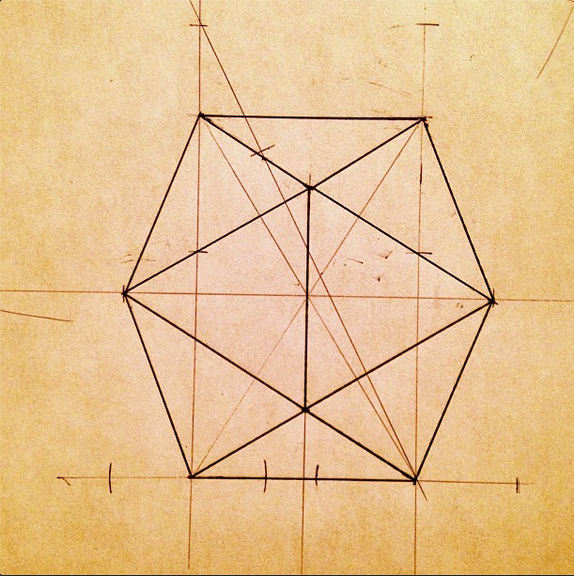
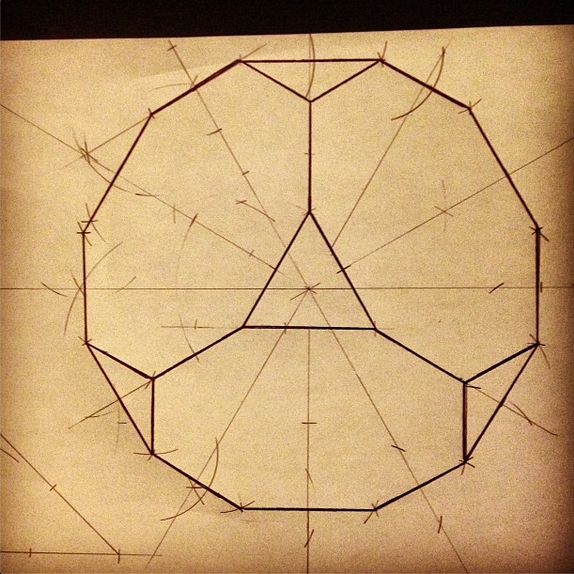
Recently, I’ve been working on a series of artworks based on the Platonic and Archimedean solids. You can see three below, but I’ll share many more in the future. These are compass and straight-edge constructions of the solids, viewed along various axes of rotational symmetry.

All of these drawings were done without “measuring” with a ruler, but I still had to get all of the sizes right for the lines and angles, which meant a lot of research and working things out. Along the way, I found eusebeia, a brilliant site that shows off some beautiful geometric objects in 3D and 4D. There’s a rather large section of articles (almost a book’s worth) describing 4D visualization. This includes sections on vision, cross-sections, projections, and anything you need to understand how to visualize the 4th dimension.

Uniform Polyhedra

A few uniform solids

The 5-cell and a story about it called "Legend of the Pyramid"

The 5-cell, setting for the short story, “Legend of the Pyramid

The site goes through all of the regular and uniform polyhedra, also known as the Platonic and Archimedean solids, and shows their analogs in 4D, the regular and uniform polychora. You may know the hypercube, but it’s just one of the 6 regular polychora.

I got excited to share eusebeia with you  when I found this “4D short story” at the bottom of the index. “Legend of the Pyramid” gives us a sense of what it would be like to live inside of the 5-cell, the 4D analog of the tetrahedron.

Well there you have it. Dig in. Bon appetit!

Yanghui_magic_squareBonus: Yang Hui also spent time studying magic squares.  (Remember this?)  In the animation to the right, you can see a clever way in which Yang Hui constructed a 3 by 3 magic square.

Lincoln, Blinkin’, and Fraud

Welcome to this week’s Math Munch!

Lincoln problem

Abraham Lincoln, figuring out a word problem.
Can you decipher his steps?

About a month ago I ran across an article about Abraham Lincoln and math. Lincoln is often celebrated as a self-made frontiersman who had little formal education. The article describes how two professors from Illinois State University recently discovered two new pages of math schoolwork done by Lincoln, which may show that he had somewhat more formal schooling than was previously believed. The sheet shows the young Abe figuring problems like, “If 4 men in 5 days eat 7 lb. of bread, how much will be sufficient for 16 men in 15 days?” Here are some further details about the manuscript’s discovery from the Illinois State University website and a high-quality scan of Lincoln’s figuring from the Harvard University Library.

Lincoln is also known for his study of Euclid’s Elements—that great work of mathematics from ancient times. Lincoln began to read the Elements when he was a young lawyer interested in what exactly it means to “prove” something. Euclid’s work even made a brief appearance in the recent movie about Lincoln. Thinking about Lincoln and math got me to wondering about how our presidents in general have interacted with the subject. Certainly they must all have had some kind of experience with math! In my searching and remembering, I’ve run across these tidbits about Ulysses S. Grant, James Garfield, and President Obama. Still, my searches haven’t turned up so very much. Maybe you’ll keep your eyes open for further bits of mathy presidential trivia?

481121_466454960066144_511840398_nNext up, check out these math problems about blinking on a wonderful online resource called Bedtime Math. Every day, the site posts a few math problems that parents and children can share and ponder at bedtime—just like families often do with storybooks. Bedtime Math was founded by Laura Bilodeau Overdeck. She is involved with several math-related nonprofits and is the mother of three kids. Bedtime Math grew out of the way that Laura shared math problems with her own children. A few of my favorite Bedtime Math posts are “You Otter Know” and “Booking Down the Hall“.

Today’s Bedtime Math is titled “Space Saver” and contains some problems about hexagon tilings and our mathematical chum, the honeybee. Here is today’s “big kid” problem: If a bee builds 5 hexagons flush in a horizontal row, how many total sides did the bee make, given the shared sides? I hope you find some problems to enjoy at Bedtime Math. You can sign up to receive their daily email of problems on the righthand side of the Bedtime Math frontpage.

Zome inventor Paul Hildebrand and a PCMI Fourth of July float!

Zome inventor Paul Hildebrandt and
a mathy PCMI Fourth of July float!

Did you know that people blink differently when they lie? I’ve been thinking a lot these past few weeks about frauds and fakes as I’ve worked with some teacher friends on this year’s PCMI problem sets. PCMI—the Park City Math Institute—is a math event held each summer that gathers math professors, math teachers, and college math students to do mathematics together for three weeks. It all happens in beautiful Park City, Utah. The first week of PCMI coincides with the Fourth of July, and the PCMI crew always makes a mathy entry in the local Independence Day Parade!

The theme of the high school teachers’ program this year is “Probability, Randomization, and Polynomials”. The first problem set introduces the following conundrum:

Suppose you were handed two lists of 120 coin flips, one real and
one fake. Devise a test you could use to decide which was which.
Be as precise as possible.

Which is real? Which is fake?

Which is real? Which is fake?

If you understand what this problem is all about, then you can understand my recent fascination with frauds! Over to the left I’ve shared two sequences I concocted. One I made by actually flipping a coin, while the other I made up out of my head. Can you tell which is which?

For more sleuthing fun, check out this applet on Khan Academy, which challenges you to distinguish lists of coin flips. Some are created by a fair coin, others are made by an unfair coin, and still others are made by human guesses. This coin-flipping challenge is a part of Khan Academy’s Journey into Cryptography series. You should also know that the PCMI problem sets from previous years are all online, filed by years under “Class Notes”. They are rich with fantastic, brain-teasing problems that are woven together in expert fashion.

And finally, to go along with your Bedtime Math, how about a little bedtime poetry? Check out the video below.

Sweet dreams, and bon appetit!