Author Archives: Anna Weltman

Stand-Up, Relatively Prime, and Aliens?

Welcome to this week’s Math Munch!

As you may have noticed, we here at Math Munch are all about good math videos.  Well, with Matt Parker’s math stand-up comedy YouTube channel, we feel like we’ve hit the jackpot!

Yes, you read it right – Matt is a math stand-up comedian.  Matt does stand-up comedy routines about mathematics at schools and math conferences in the United Kingdom.  In fact, he and several other mathematicians and teachers have started an organization called Think Maths that sends funny and entertaining mathematicians to schools to get kids more excited about math.  He also does podcasts  and is writing a book!  Cool!

Here are two of my favorite videos from Matt’s channel.  The first is a problem involving a sleeping princess and a sneaky prince.  I haven’t solved the problem yet – so, if you do, don’t give away the answer!

[youtube http://www.youtube.com/watch?v=nv0Onj3wXCE&feature=plcp]

In the second, Matt shows you how to look like you know how to solve a Rubik’s cube and impress your friends.  And it teaches you some interesting facts about Rubik’s cubes at the same time.

[youtube http://www.youtube.com/watch?v=aPD_OkjnCqU&feature=plcp]

We’ve dug deep into the world of cool, mathy videos – but how about cool, mathy radio?  Personally, I love radio.  And I love math – so what could be better than a radio podcast about math?

Check out this new series of podcasts about mathematics by Samuel Hansen.  It’s called Relatively Prime.  The first episode has just been released!  It’s about the fascinating (and a little scary) topic of the three mathematical tools that you’ll need to survive, in Samuel’s words, “the coming apocalypse.”  And what are these tools?  Game theory, the mathematics of risk, and geometric reasoning.  How will these mathematical ideas help you?  Well, listen to the podcast and find out!  The podcast features interviews with many mathematicians, including Edmund Harris (who we wrote about in April) and Matt Parker.

I especially like this podcast because it gives some good answers to the question, “What can mathematics be used for?”  Even though I love doing math just for fun, I sometimes wonder how math can be used in other subjects and problems I might face in my life outside of math.  If you wonder this sometimes, too, you might like listening to this podcast.

We had the opportunity to interview Samuel about mathematics and the making of Relatively Prime.  Check out the interview on the Q&A page.

Finally, talking about the apocalypse (and the uses of math) makes me think about alien encounters.  What are the chances that there’s an intelligent alien civilization out there?  There are a lot of factors that go into answering this question – such as, what are the chances that a planet will develop life?  The evaluation of these chances is largely a matter of science, as is actually contacting aliens.  But math can be used to come up with a formula that tells us how likely it is that we’ll encounter aliens, given the other chances and how they relate to each other.

The equation that models this is called the Drake Equation.  It was developed in 1961 by a scientist named Dr. Frank Drake and has been used by scientists ever since to calculate the chances that there are intelligent aliens for us to talk to.  The equation is particularly interesting because small changes in, say, the number of stars that have planets, can drastically change the chance that we’ll encounter aliens.

Want to play with this equation?  Check out this awesome infographic about the Drake Equation from the BBC.  You can decide for yourself the chances that a planet will develop life and the number of years we’ll be sending messages to aliens or use numbers that scientists think might be accurate.

Bon appetit!  And watch out for aliens.  If my calculations are correct, there are a lot of them out there.

Algorithmic House, Billiards, and Picma

Welcome to this week’s Math Munch!

Check out this beautiful building:

This is the Endesa Pavilion, located in Barcelona, Spain.  It’s also called Solar House 2.0, and that’s because the tops of all of those pyramid-spikes are covered in solar panels.  But that’s not all – this house was designed to best capture sunlight in the exact location it was built using a mathematical algorithm.

To build this house, architect Rodrigo Rubio, who works for the Institute for Advanced Architecture of Catalonia, first tracked the path of the sun over the spot he wanted to build the house.  He then plugged that data into a computer program.  This program is a set of mathematical steps called an algorithm that turns data about the movement of the sun in the sky into a geometric building.  The building it creates is the best – or optimal – building for that spot.

It puts solar panels in locations on the building that get the most sunlight and orients them to get the most exposure.  It places windows of different sizes and overhangs at different angles around the house to get the best ventilation, block sunlight from entering the house, and keep the house cool in the summer and warm in the winter.   And, because it’s an algorithm, it can be used to design the optimal house for any location.  The program then creates a pattern for the wooden pieces that make up the house.  This pattern can be sent to a machine that cuts out the pieces, which builders put together like a puzzle.

In this video, Rodrigo explains how the building was designed, how the design works, and how this design can be used to make eco-friendly houses all over the world.

[youtube http://www.youtube.com/watch?v=3R1CBFBxuew&feature=player_embedded]

Next, have you ever played billiards?  Maybe you’ve played pool or watched Donald Duck play billiards.  It’s interesting to see how a pool ball moves around on a rectangular billiards table, which is how the table is usually shaped.  But it’s even more interesting to see how a ball moves around on a triangular, pentagonal, circular, or elliptical billiards table!

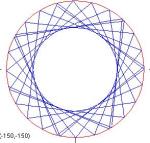
Want to try?  Check out this series of applets from Serendip, an exploratory math and science website started by some professors at Bryn Mawr College in Pennsylvania.  Serendip aims to help people ask and answer their own questions about the world we live in.  In these billiards applets, you can explore dynamical systems – mathematical structures in which an object moves according to a rule.   In some situations, the object will move in a predictable way.  But in other situations, the object moves chaotically.  As you play with the applets, see if you can figure out how the shape of the table effects whether the billiard ball will move chaotically or predictably.  These applets also make some beautiful star-like designs!

Finally, here’s a new game: Picma Squared.  In this game, you use logic to figure out how to color the squares in the grid to make a picture.  It starts out simple, but the higher levels are really challenging!  Enjoy!


Look for this game and others on our Games page!


Bon appetit!

3D Printer MArTH, Polyhedra, and Hart Videos

Welcome to this week’s Math Munch!

It’s my turn now to post about how much fun we had at Bridges!  One of the best parts of Bridges was seeing the art on display, both in the galleries and in the lobby where people were displaying and selling their works of art.  We spent a lot of time oogling over the 3D printed sculptures of Henry Segerman.  Henry is a research fellow at the University of Melbourne, in Australia, studying 3-dimensional geometry and topology.  The sculptures that he makes show how beautiful geometry and topology can be.

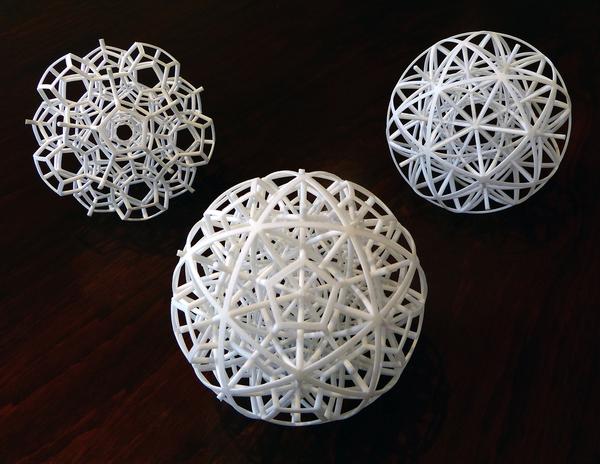
These are the sculptures that Henry had on display in the gallery at Bridges.  They won Best Use of Mathematics!  These are models of something called 4-dimensional regular polytopes.  A polytope is a geometric object with flat sides – like a polygon in two dimensions or a polyhedron in three dimensions.  4-dimensional polyhedra?  How can we see these in three dimensions?  The process Henry used to make something 4-dimensional at least somewhat see-able in three dimensions is called a stereographic projection.  Mapmakers use stereographic projections to show the surface of the Earth – which is a 3-dimensional object – on a flat sheet of paper – which is a 2-dimensional object.

A stereographic projection of the Earth.

To do a stereographic projection, you first set the sphere on the piece of paper, or plane.  It’ll touch the plane in exactly 1 point (and will probably roll around, but let’s pretend it doesn’t).  Next, you draw a straight line starting at the point at the top of the sphere, directly opposite the point set on the plane, going through another point on the sphere, and mark where that line hits the plane.  If you do that for every point on the sphere, you get a flat picture of the surface of the sphere.  The point where the sphere was set on the plane is drawn exactly where it was set – or is fixed, as mathematicians say.  The point at the top of the sphere… well, it doesn’t really have a spot on the map.  Mathematicians say that this point went to infinity.  Exciting!

A stereographic projection like this draws a 3-dimensional object in 2-dimensions.  The stereographic projection that Henry did shows a 4-dimensional object in 3-dimensions.  Henry first drew, or projected, the vertices of his 4-dimensional polytope onto a 4-dimensional sphere – or hypersphere.  Then he used a stereographic projection to make a 3D model of the polytope – and printed it out!  How beautiful!

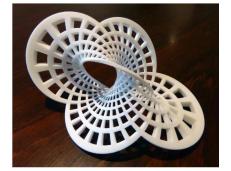
Here are some more images of Henry’s 3D printed sculptures.  We particularly love the juggling one.

Henry will be dropping by to answer your questions! So if you have a question for him about his sculptures, the math he does, or something else, then leave it for him in the comments.

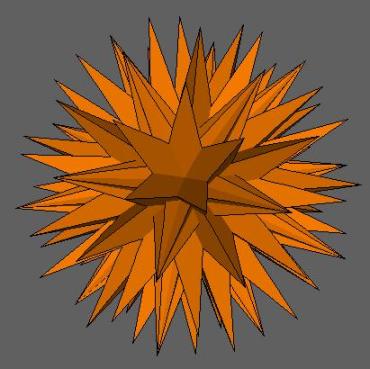
Speaking of polyhedra, check out this site of applets for visualizing polyhedra.  You can look at, spin, and get stats on all kinds of polyhedra – from the regular old cube to the majestic great stellated dodecahedron to the mindbogglingly complex uniform great rhombicosidodecahedron.  You can also practice your skills with Greek prefixes and suffixes.

Finally, two Math Munches ago, we told you about some videos made by the mathematical artist George Hart.  He’s the man who brought us the Yoshimoto cube.  And now he’s brought us… Pentadigitation.  In this video, George connects stars, knots, and rubber bands.  Enjoy watching – and trying the tricks!

Bon appetit!