Author Archives: Anna Weltman

Halving-Fun, Self-Tiling Tile Sets, and Doodal

This post comes to us all the way from June of 2014! Enjoy this blast from the past!

Welcome to this week’s Math Munch!
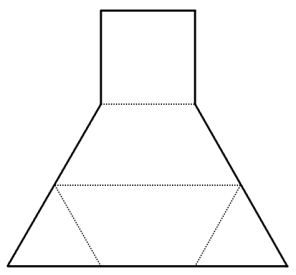
Print out two copies of this pattern, cut them out, and fold each along the dotted lines, making two identical solids. Then fit these two pieces together to make a regular tetrahedron.

Print out two copies of this pattern, cut them out, and fold each along the dotted lines, making two identical solids. Then fit these two pieces together to make a regular tetrahedron.

Our first bit of fun comes from a blog called Futility Closet (previously featured). It’s a neat little cut-and-fold puzzle. The shape to the right can be folded up to make a solid with 5 sides. Two of them can be combined to make a solid with only 4 sides, the regular tetrahedron. If you’d like, you can use our printable version, which has two copies on one sheet.

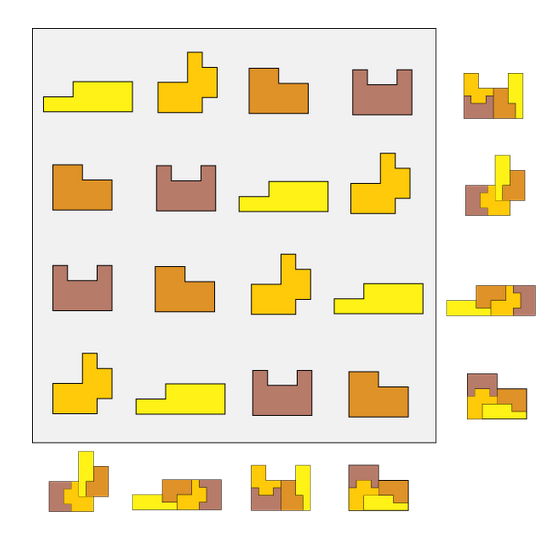
What do you know, I also found our second item on Futility Closet! Check out the cool family of tiles below. What do you notice?
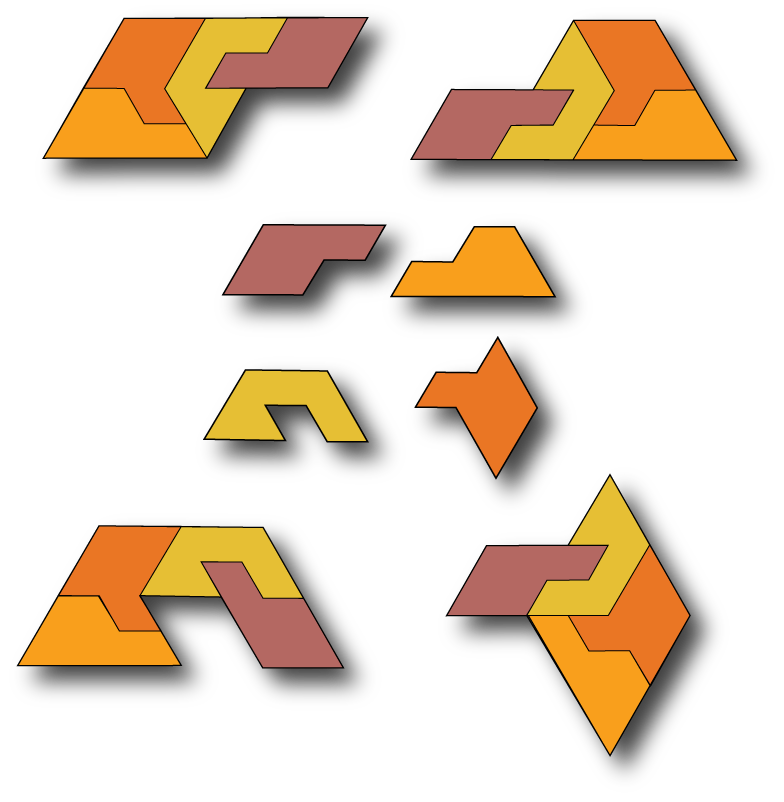
A family of self-tiling tiles

A family of self-tiling tiles

Did you notice that the four shapes in the middle are the same as the four larger shapes on the outside? The four tiles in the middle can combine to create larger versions of themselves! They can make any and all of the original four!!

Lee Sallows

Recreational Mathematician, Lee Sallows

Naturally, I was reminded of the geomagic squares we featured a while back (more at geomagicsquares.com), and then I came to realize they were designed by the same person, the incredible Lee Sallows! (For another amazing one of Lee Sallows creations, give this incredible sentence a read.) You can also visit his website, leesallows.com.

reptile3

A family of 6 self-tiling tiles

For more self-tiling tiles (and there are many more amazing sets) click here. I have to point out one more in particular. It’s like a geomagic square, but not quite. It’s just wonderful. Maybe it ought to be called a “self-tiling latin square.”

And for a final item this week, we have a powerful drawing tool. It’s a website that reminds me a lot of recursive drawing, but it’s got a different feel and some excellent features. It’s called Doodal. Basically, whatever you draw inside of the big orange frame will be copied into the blue frames.  So if there’s a blue frame inside of an orange frame, that blue frame gets copied inside of itself… and then that copy gets copied… and then that copy…!!!

To start, why don’t you check out this amazing video showing off some examples of what you can create. They go fast, so it’s not really a tutorial, but it made me want to figure more things out about the program.

I like to use the “delete frame” button to start off with just one frame. It’s easier for me to understand if its simpler. You can also find instructions on the bottom. Oh, and try using the shift key when you move the blue frames. If you make something you like, save it, email it to us, and we’ll add it to our readers’ gallery.

Start doodaling!

Make something you love. Bon appetit!
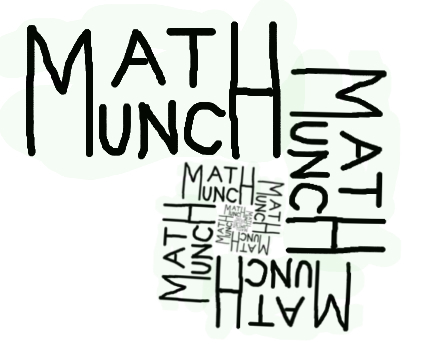
A fractal Math Munch Doodal

A fractal Math Munch Doodal

Forest Fires, Scrubbing Calculator, and Bongard Problems

Welcome to this week’s Math Munch!

Last summer where I live, in California, there were a lot of forest fires. We’re having a big drought, and that made fires started for lots accidental of reasons– lightning, downed power lines, things like that– get much bigger than usual. I thought I’d learn a little about forest fires so that I can be a more responsible resident of my state.

And I found this great website with an awesome computer simulation that you can manipulate to experiment with the factors that lead to forest fires!

Forest fire.png

My forest fire, just starting to burn. Click on this picture to play with the simulation! (Note: It doesn’t work as well in certain browsers. I recommend Firefox.)


This site was built by Nicky Case, who studies things that mathematicians and scientists call complex systems. Basically, a complex system is some phenomenon that has a simple set of causes but unpredictable results. An environment with forest fires is a good example– a simple lightning strike in a drought-ridden forest can cause a wildfire to spread in patterns that firefighters struggle to predict. It turns out that simulations are perfect for modeling complex systems. With just a few simple program rules we can create a huge number of situations to study. Even better, we can change the rules to see what will happen if, say, the weather changes or people are more careful about where and when they set fires.

Forest fire what if

What do you think? Click the picture to see Nicky’s simulation.

You can use Nicky’s program to change the probability that trees grow, a burning tree sets its neighbors on fire, and many other factors. You can even invent your own and model them with emojis. What if there were two kinds of trees and one was more flammable than the other? What if trees grew quickly but lightning was common? As Nicky shows, simulations are useful for exploring what-if questions in complex systems. Use your imagination and explore!

Next up, have you ever heard of a scrubbing calculator? No, it’s not a calculator that doubles as a sponge. It’s a calculator that helps you solve for unknowns in equations by “scrubbing,” or approximating, the answer until you find a number that works.

Scrubbing calculator equation

Here’s how it works: Say you’re trying to solve for an unknown, like the x in the equation above (maybe for some practical reason or just because you’re doing your homework). You could do some pretty complicated algebraic manipulations so that the x alone equals some number. But what if you could make a guess and change it until the equation worked?

Scrubbing calculator

Click on this image to see a scrubbing calculator in action!

If your guess was too big, you’d know because the expression wouldn’t equal 768 anymore– it would equal something larger. And if you had a calculator that instantly told you the solution based on your guess, you could do this guessing and checking pretty quickly.

Well, lucky for you I found a scrubbing calculator that you can use online! It’s very simple– just type in your equation and your guess, and click on the number you want to change (most likely the guess) to make it larger or smaller. It’s useful for solving equations, like I said. But I actually find it most interesting to watch how the whole expression changes as you change one of the numbers in it. For instance, check out the Pythagorean triple calculator I built. What do you notice as you gradually change one of the numbers in the expression?

https://www.cruncher.io/?/embed/xiY1IjwUJS

Finally, I’m excited to share with you one of my favorite kinds of puzzles– Bongard problems!
Bongard 1A Bongard problem has two sets of pictures, with six pictures in each set. All of the pictures on the left have something in common that the pictures on the right do not. The challenge is to figure out what distinguishes the two groups of pictures.

Bongard 2

This problem was made by Douglas Hofstadter, who introduced Bongard problems to the U.S. I haven’t figured it out yet. Can you?

I got the Bongard problems shown above from a collection of problems put together by cognitive scientist Harry Foundalis. He has almost 300 of them, some made by Mikhail Bongard himself, who developed these problems while studying how to train computers to recognize patterns.

Harry also has guidelines for how to develop your own Bongard problems. He encourages people to send their problems to him and says he might even put them up on his site!

Bon appetit!

Mobiles, Mathematical Objects, and Math Magazine

Welcome to this week’s Math Munch!

Before we start, a little business. You may have noticed that posts have been few and far between lately. Those of you who know us, the members of the Math Munch Team, know that we’ve all made a lot of life changes in the past year or two. We started out together teaching in the same school in New York– but now we live on far corners of the country and spend our time doing very different things. In case you’re curious, here are some pictures of the things we’ve been up to!

stack

Justin’s genus 19, rotationally symmetric surface

But even though we’ve moved apart physically, we’ve decided that we really want to keep the Math Munch Team together. We LOVE sharing our love of math with you– and we love hearing from you about the amazing things you make and do with math, too.

So, we’ve decided to revamp our posting process and came up with a schedule for when you can expect posts. There will be a new post every Thursday. (Though if Anna is posting from the West Coast, it might come out in the wee hours of Friday morning for some of you!) And here’s the monthly schedule of Thursday posts:

  • The first Thursday of the month will be a post from Justin
  • The second Thursday of the month will be a rerun!! Did you know we have over 150 posts on this site?? And we’ve been posting for almost five years??
  • The third Thursday of the month will be a post from Anna
  • The last Thursday of the month will be a post from Paul

And for those mysterious months with five Thursdays (ooh, when will that be, I wonder?)… There will be a surprise!

And now… for some math!

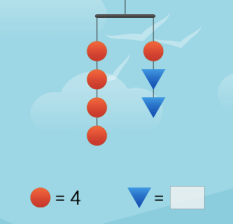
Screen Shot 2016-04-22 at 1.44.50 AMFirst up is a little game called SolveMe Mobiles! This game is full of little puzzles in which you have to figure out what each of the different shapes in a mobile weighs. You’re given different clues in different puzzles. So, for instance, in the puzzle to the left, you’re given the weight of the red circle and you have to figure out how much a blue triangle is. But you’re not given the weight of the whole mobile… Hmmm…

Screen Shot 2016-04-22 at 1.53.04 AMAnd this one, to the right, gives you the weight of one of the shapes and of the whole mobile– but now there are three shapes! Tricky!
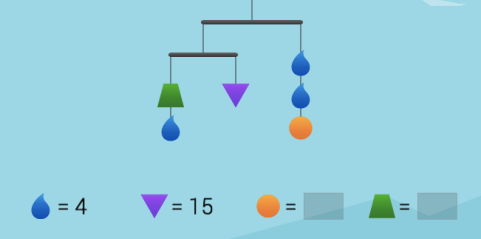
Even better, you can build your own mobile puzzle for others to solve! I made this one, shown below– like my use of a mobile within a mobile?

Screen Shot 2016-04-22 at 2.04.48 AM

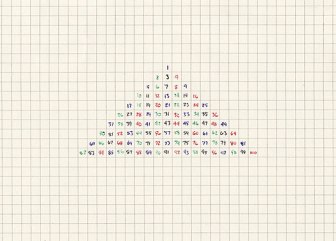
Next up, I found a beautiful Tumblr account that I’d like to share with you full of pictures of found mathematical objects. It’s called… Mathematical Objects! (How clever.) The author of the site writes that the aim of the blog is to “show that mathematics, aside from its practicality, is also culturally significant. In other words, mathematics not only makes the trains run on time but also fundamentally influences the way we view the world.

tumblr_mkkrp6acm11rnwsgbo1_540

“Counting to One Hundred with my Four-Color Pen”

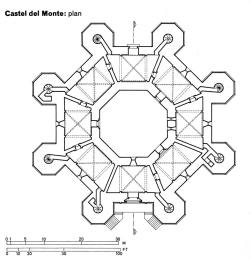
tumblr_n07pvisVvm1rnwsgbo2_1280Some of the images are mathematical art, like the one above; others are more “practical,” such as plans for buildings or images drawn from science.

Do you ever see an interesting mathematical object in the wild and feel the urge to take a picture of it? If so, go ahead and send it to us! We’d love to see what you find.

I’m very excited to share this last find with you all. It was sent to me by a wonderful math teacher, Mark Dittmer, and his math students. This year, they were inspired by Math Munch to make their own fun online math sites! I think what they made is super awesome– and I want to share it with you. I’ll be featuring some of their work in my next few posts, one thing at a time to give each its own day in the sun. First up is this adorable adventure story about the residents of Number Land. I hope you enjoy it!

Screen Shot 2016-04-22 at 9.46.00 AM

Bon appétit!