Author Archives: Paul Salomon

Temari, Function Families, and Clapping Music

Welcome to this week’s Math Munch!

Carolyn Yackel

Carolyn Yackel

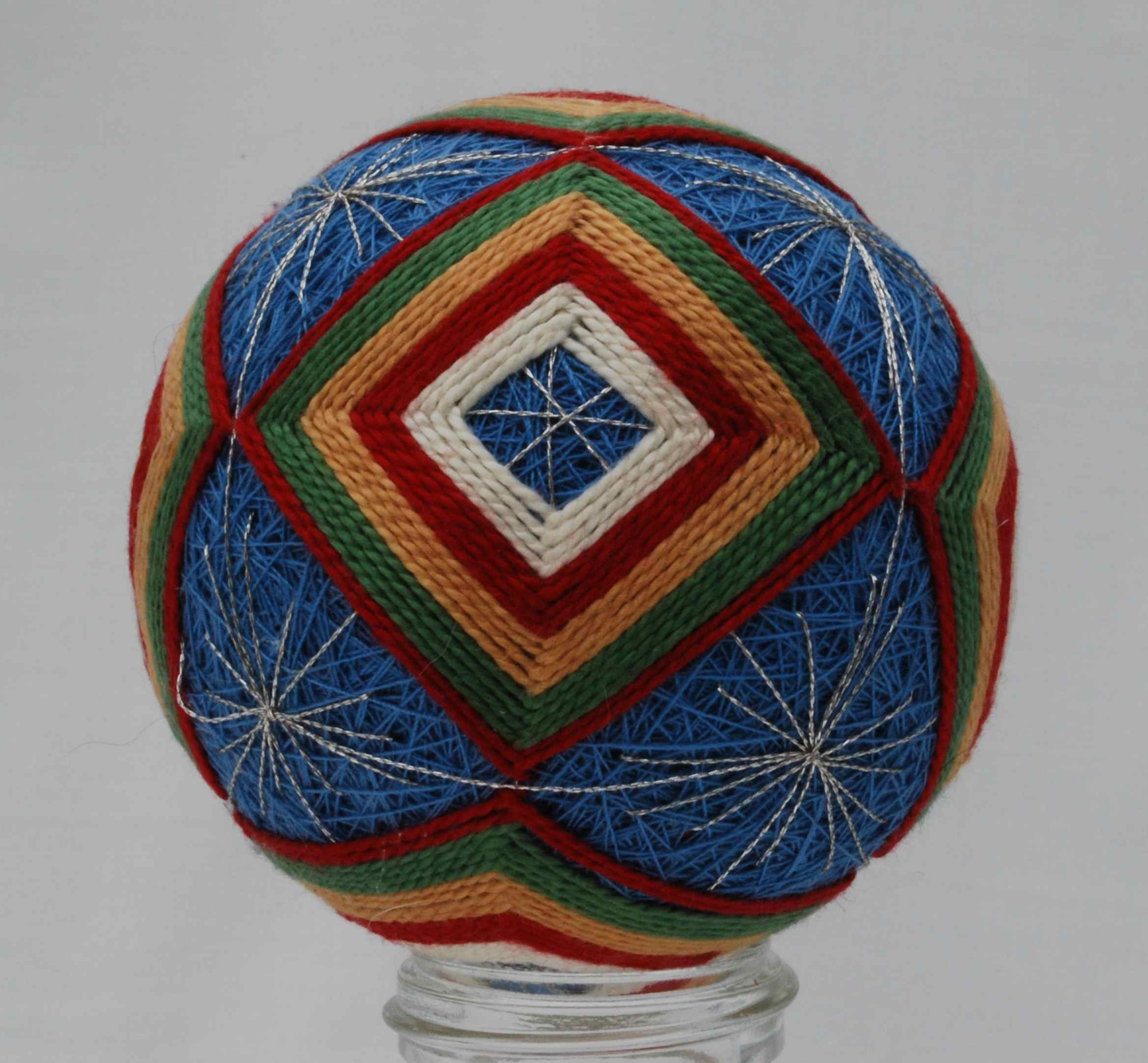
As Justin mentioned last week, the Math Munch team had a blast at the MOVES conference last week.  I met so many lovely mathematicians and learned a whole lot of cool math. Let me introduce you to Carolyn Yackel. She’s a math professor at Mercer University in Georgia, and she’s also a mathematical fiber artist who specializes in the beautiful Temari balls you can see below or by clicking the link. Carolyn has exhibited at the Bridges conference, naturally, and her 2012 Bridges page contains an artist statement and some explanation of her art.
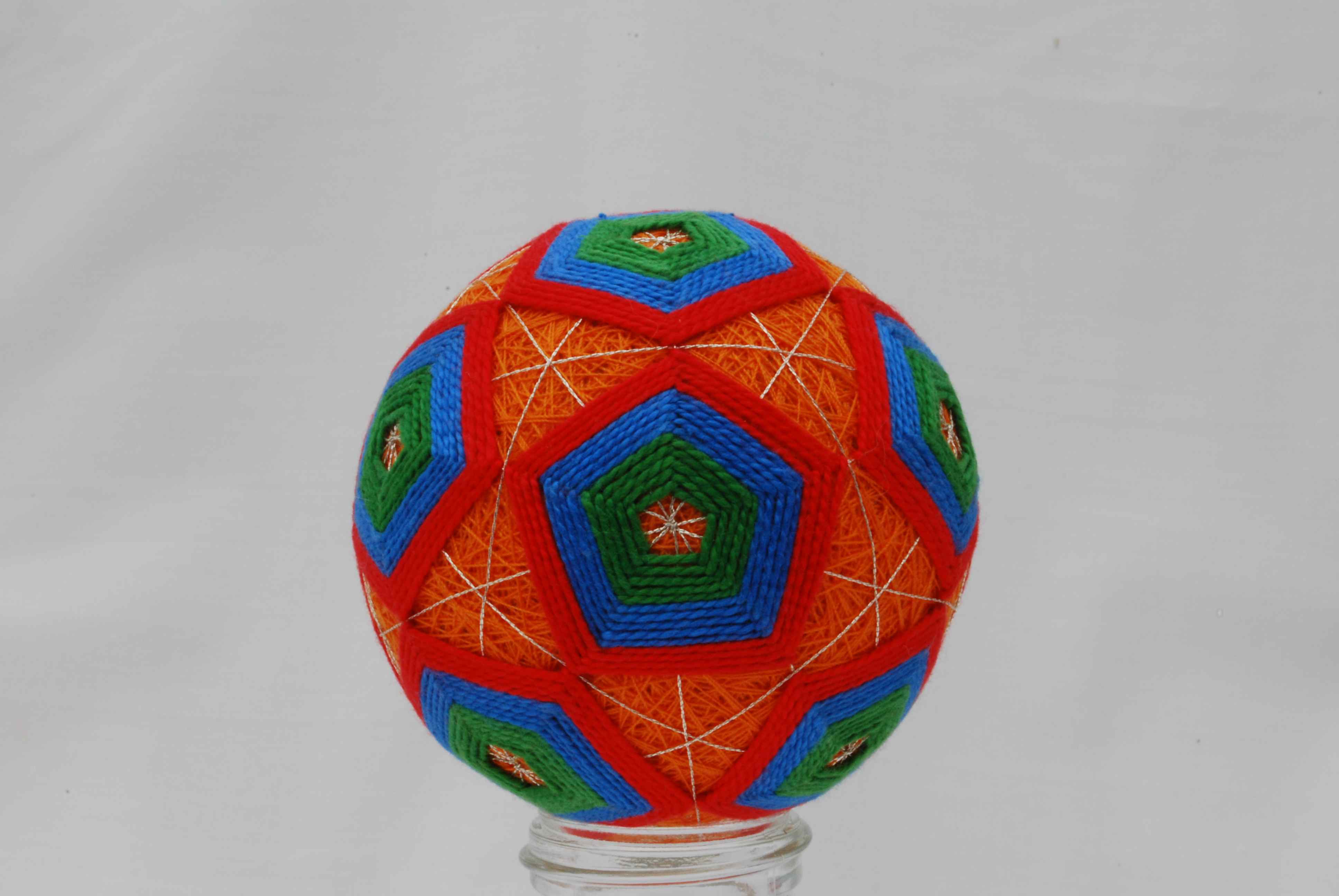
temari15 temari3 temari16

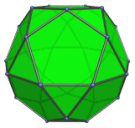
Icosidodecahedron

Icosidodecahedron

Truncated Dodecahedron

Truncated Dodecahedron

Cuboctahedron

Cuboctahedron

Temari is an ancient form of japanese folk art. These embroidered balls feature various spherical symmetries, and part of Carolyn’s work has been figure out how to create and exploit these symmetries on the sphere.  I mean how do you actually make it that symmetric? Can you see in the pictures above how the symmetry of the Temari balls mimic the Archimedean solids? Carolyn has even written about using Temari to teach mathematics, some of which you can read here, if you like.

Read Carolyn Yackel’s Q&A with Math Munch.


Edmund Harriss

Edmund Harriss

Up next, you may remember Edmund Harriss from this post, and you might recall Desmos from this post. Well the two have come together! On his blog, Maxwell’s Demon, Edmund shared a whole bunch of interactive graphs from Desmos, in a post he called “Form Follows Function.” Click on the link to read the article, and click on the images to get graphs full of sliders you can move to alter the images. In fact, you can even alter the equations that generate them, so dig in, play some, and see what you can figure out.

graph2 graph1 graph3

Finally, I want to share a piece of music I really love. “Clapping Music” was written by Steve Reich in 1972. It is considered minimalist music, perhaps because it features two performers doing nothing but clapping. If you watch this performance of “Clapping Music” first (and I suggest you do) it might just sound like a bunch of jumbled clapping. But the clapping is actually built out of some very simple and lovely mathematical patterns. Watch the video below and you’ll see what I mean.

Did you see the symmetries in the video? I noticed that even though the pattern shifts, it’s always the same backwards as forwards. And I also noticed that the whole piece is kind of the same forwards and backwards, because of the way that the pattern lines back up with itself. Watch again and see if you get what I mean.

Bonus: Math teacher, Greg Hitt tweeted me about “Clapping Music” and shared this amazing performance by six bounce jugglers!!!  It’s cool how you can really see the patterns in the live performance.

I hope you find something you love and dig in. Bon appetit!

Yang Hui, Pascal, and Eusebeia

Yanghui_triangleWelcome to this week’s Math Munch! I’ve got some mathematical history, an interactive visualization site, some math art, and a mathematical story from the fourth dimension for you.

Yang Hui's Triangle animated

First, take a look at the animation and picture above. What do you notice? This is sometimes called Pascal’s Triangle (click for background info and cool properties of the triangle.) It’s named for Blaise Pascal, the mathematician who published a treatise on its properties in 1653. (Click here for some history of Pascal’s life and work.)

Yang Hui

Yang Hui

BUT actually, Pascal wasn’t the first to play with the triangle. Yang Hui, a 13th century Chinese mathematician, published writings about the triangle more than 500 years earlier! Maybe we ought to be calling it Yang Hui’s Triangle! The picture above is the original image from Yang Hui’s 13th century book. (Also look at the way the Chinese did numbers at that time. Can you see out how it works at all?)  Edit: David Masunaga sent us an email telling us about an error in Yang Hui’s chart.  He says some editors will even correct the error before publishing.  Can you find the mistake?

I bring this all up, because I found a neat website that illustrates patterns in this beautiful triangle. Justin posted before on the subject, including this wonderful link to a page of visual patterns in Yang Hui’s triangle. But I found a website that lets you explore the patterns on your own! The website lets you pick a number and then it colors all of its multiples in the triangle. Below you can see the first 128 lines of the triangle with different multiples colored. NOW YOU TRY!

2s

Evens

Multiples of 4

Multiples of 4

Ends in 5 or 0

Ends in 5 or 0

* * *

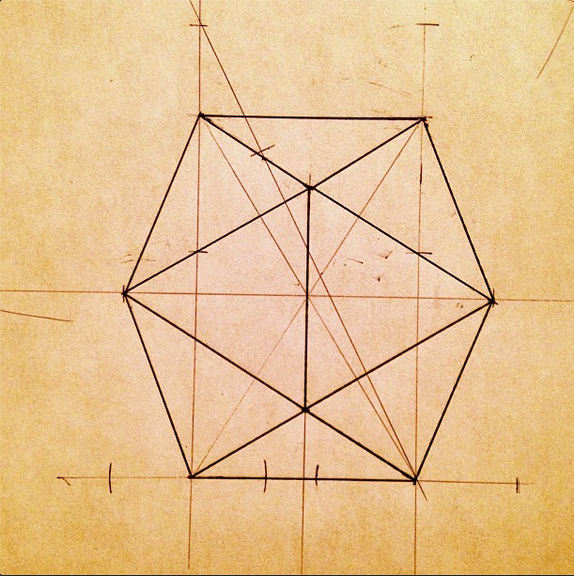
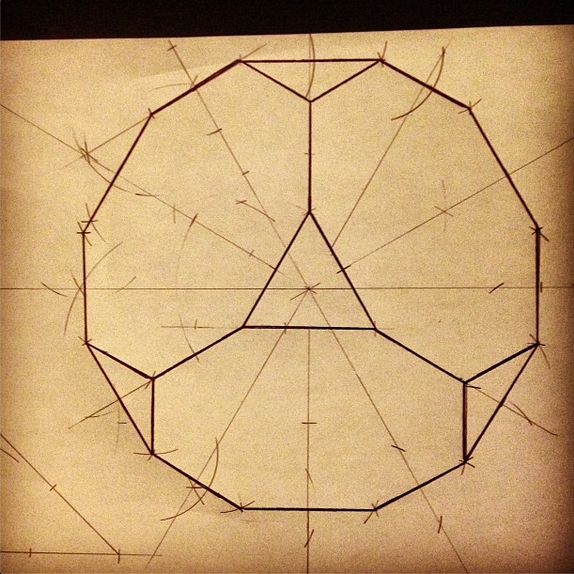
Recently, I’ve been working on a series of artworks based on the Platonic and Archimedean solids. You can see three below, but I’ll share many more in the future. These are compass and straight-edge constructions of the solids, viewed along various axes of rotational symmetry.

All of these drawings were done without “measuring” with a ruler, but I still had to get all of the sizes right for the lines and angles, which meant a lot of research and working things out. Along the way, I found eusebeia, a brilliant site that shows off some beautiful geometric objects in 3D and 4D. There’s a rather large section of articles (almost a book’s worth) describing 4D visualization. This includes sections on vision, cross-sections, projections, and anything you need to understand how to visualize the 4th dimension.

Uniform Polyhedra

A few uniform solids

The 5-cell and a story about it called "Legend of the Pyramid"

The 5-cell, setting for the short story, “Legend of the Pyramid

The site goes through all of the regular and uniform polyhedra, also known as the Platonic and Archimedean solids, and shows their analogs in 4D, the regular and uniform polychora. You may know the hypercube, but it’s just one of the 6 regular polychora.

I got excited to share eusebeia with you  when I found this “4D short story” at the bottom of the index. “Legend of the Pyramid” gives us a sense of what it would be like to live inside of the 5-cell, the 4D analog of the tetrahedron.

Well there you have it. Dig in. Bon appetit!

Yanghui_magic_squareBonus: Yang Hui also spent time studying magic squares.  (Remember this?)  In the animation to the right, you can see a clever way in which Yang Hui constructed a 3 by 3 magic square.

The Rhombic Dodec, Honeycombs, and Microtone

Welcome to this week’s Math Munch! Some cool pictures, videos, and a new game this week.

A couple of week’s ago, Anna wrote about the familiar hexagonal honeycomb that bees make, but that’s not the only sort of honeycomb. Mathematically, a honeycomb is the 3D version of a tessellation. Instead of covering the plane with some kind of polygon, a honeycomb fills space with some polyhedron. The cube works. Do you think tetrahedra would work? Can you think of other shapes that might work. Can you believe this works!?! (Look at the one at the bottom of that page.)

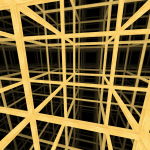
Inside the cubic honeycomb

Inside the cubic honeycomb

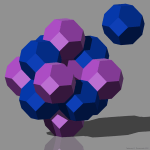
Truncated Octahedra

Truncated Octahedra

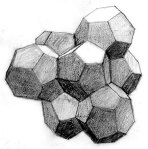
Tetradecahedra

Tetradecahedra

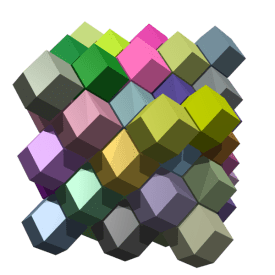
Rhombic Dodecahedral Honeycomb

Rhombic Dodecahedral Honeycomb

I want to introduce you to one of my new favorite “space-filling polyhedra.” Meet, the rhombic dodecahedron, which you can see packed nicely on the right or in crystal form below. (Click the crystal for a really great video by George Hart about crystals and polyhedra.)

Garnet Crystal

Garnet Crystal

I’ll let this video serve as an introduction to the rhombic dodecahedron and some of its features. Plus, it gives you something to make if you’d like. You’ll just need a deck of cards, and maybe a ruler and some tape.

Pretty wonderful, am I right? Here’s a link for a simple paper net you can fold up into a rhombic dodecahedron. For the really adventurous or dexterous, here’s a how-to video for a pretty tricky origami model. And here’s two more related videos showing how one can be built from two cubes.

Yoshimoto Stack

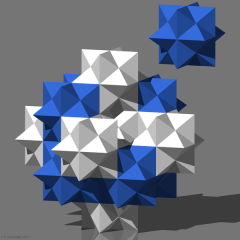
Stellated rhombic dodecahedral honeycomb

Here’s one final amazing fact about the rhombic dodecahedron. Its first stellation is the star form of the Yoshimoto Cube!!! (background info on stellation here) Perhaps more amazing is the fact that even this shape can stack to fill 3D space!

Microtone

Microtone

But now, as promised, I present a new game. Microtone is a mindbending pathwinding game played on, you guessed it, rhombic dodecahedra. (I know.) Click to move around the shape and land on all of the X’s. To rotate the dodecahedra, click and drag on the page.

Bon appetit!