Category Archives: Math Munch

Math Meets Art, Quarto, and Snow!

Welcome to this week’s Math Munch!
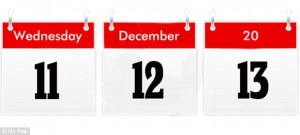
article-0-19F9E81700000578-263_634x286… And, if you happen to write the date in the European way (day/month/year), happy Noughts and Crosses Day! (That’s British English for Tic-Tac-Toe Day.) In Europe, today’s date is 11/12/13– and it’s the last time that the date will be three consecutive numbers in this century! We in America are lucky. Our last Noughts and Crosses Day was November 12, 2013 (11/12/13), and we get another one next year on December 13 (12/13/14). To learn more about Noughts and Crosses Day and find out about an interesting contest, check out this site. And, to our European readers, happy Noughts and Crosses Day!

p3p13Speaking of Noughts and Crosses (or Tic-Tac-Toe), I have a new favorite game– Quarto! It’s a mix of Tic-Tac-Toe and another favorite game of mine, SET, and it was introduced to me by a friend of mine. It’s quite tricky– you’ll need the full power of your brain to tackle it. Luckily, there are levels, since it can take a while to develop a strategy. Give it a try, and let us know if you like it!
BRUCKER-ICS-DARKRYE-SQUARE

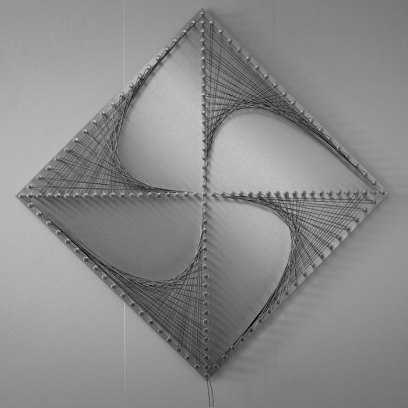
Looking to learn about some new mathematical artists? Check out this article, “When Math Meets Art,” from the online magazine Dark Rye. It profiles seven mathematical artists– some of whom we’ve written about (such as Erik and Martin Demaine, of origami fame, and Henry Segerman), and some of whom I’ve never heard of. The work of string art shown above is by artist Adam Brucker, who specializes in making “unexpected” curves from straight line segments.
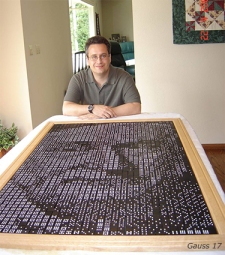
gauss17_smallAnother of my favorites from this article is the work of Robert Bosch. One of his specialities is making mosaics of faces out of tiles, such as dominoes. The article features his portrait of the mathematician Father Sebastien Truchet made out of the tiles he invented, the Truchet tiles. Clever, right? The mosaic to the left is of the great mathematician Gauss, made out of dominoes. Check out Robert’s website to see more of his awesome art.

Finally, it snowed in New York City yesterday. I love when it snows for the first time in winter… and that got me wanting to make some paper snowflakes to celebrate! Here’s a video by Vi Hart that will teach you to make some of the most beautiful paper snowflakes.

Hang them on your windows, on the walls, or from the ceiling, and have a very happy wintery day! Bon appetit!

Jim Loy, Exploding Dots, and an Advent Calendar

Jim Loy

Jim Loy

Welcome to this week’s Math Munch! We’ve got a mathematical advent calendar for you, two new puzzle pages, and a whole course’s worth of videos and problems to think about. Let’s get into it.

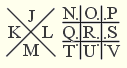
Up first, if you like you can read all about Jim Loy (and just about anything else) on his enormous website. The thing I want to share with you are Jim’s puzzle pages. You could pull out some toothpicks or spaghetti and try these matchstick puzzles, or perhaps you want to give his maze a try. Or maybe you just want to learn about the pig pen cipher, a kind of code.

Matchstick Puzzles

Matchstick Puzzles

Jim's Maze

Jim’s Maze

pig pen cipher

Pig Pen Cipher

advent calendar 2Up next, some math in the holiday spirit. Plus Magazine has a nice little advent calendar going on again this year. They’re counting down to Christmas by posting their “favourite bits of maths” – a new post each day. On the website you can see preview pictures for each day, which has me pretty excited. What could #7 be? What is going on in 18?! Check out #2. It’s a nice little explanation of a classic math story about Achilles and the tortoise. (Zeno’s Paradox). Plus Magazine is a great website in general, but you have to be prepared to do some reading. According to their about page,

Plus is an internet magazine which aims to introduce readers to the beauty and the practical applications of mathematics. A lot of people don’t have a very clear idea what “real” maths consists of, and often they don’t realise how many things they take for granted only work because of a generous helping of it.”

BONUS:  Take a look at the Plus Mag puzzle page!

Finally, you might remember James Tanton for his partition videos. Well, he just released a really cool series of videos and math activities that’s completely free and online. It’s kind of an entire math course (but it’s unlike any course you’ve  seen before), and it’s called “Exploding Dots.” As James says in the intro video above, this is his favorite topic of all time! The course is broken up into 4 lessons, with a handful of videos in each lesson, and there are some really nice questions to think about. I’ve studied math for many years at this point, but there were lots of things that surprised me.

If you’re ready to dig in, here’s a link to Lesson 1.1 Base Machines.

Have a great week, and bon appetit!

Isomorphisms in Five, Parquet Deformations, and POW!

Welcome to this week’s Math Munch!

Here’s a catchy little video. It’s called “Isomorphisms in Five.” Can you figure out why? The note posted below the video says:

An isomorphism is an underlying structure that unites outwardly different mathematical expressions. What underlying structure do these figures share? What other isomorphisms of this structure will you discover?

One of the reasons I LOVE this video is because I really like how the shapes change with the music– which is played in a very interesting time signature. I also love how you can learn a lot about the different growing shape patterns by comparing them. Watch how they grow as the video flips from pattern to pattern. What do you notice? What does the music tell you about their growth?

This video is by a math educator from North Carolina named Stuart Jeckel. The only thing written about him on his “About” page is, “The Art of Math”– so he’s a bit of a mystery! He has three more beautiful videos, all of which present little puzzles for you to solve. Check them out!

(Five-four isn’t a common time-signature for music, but it makes some great pieces. Check out this particularly awesome one. Anyone want to try making a growing shape pattern video to this tune?)

parquet-10

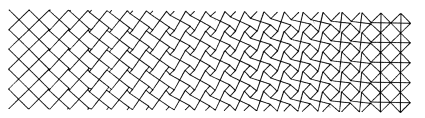
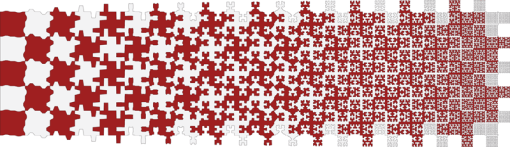
Here is an example of one of my favorite types of geometric patterns– the parquet deformation. To make one, you start with a tessellation. Then you change it- very gradually- until you’ve made a completely different tessellation that’s connected by many tiny steps to the original one.

I love to draw them. It’s challenging, but full of surprises. I never know what it’s going to look like in the end.

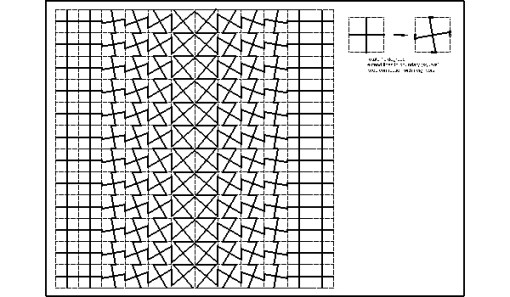
2012_10_31-par5Want to try making your own? Check out this site by the professors/architects Tuğrul Yazar and Serkan Uysal. They had one of their classes map out how some different parquet deformations are made. They mostly used computers, but you could follow their instructions by hand, if you like. The image above is a map for the first deformation I showed.

Click on this link to see some awesome deformations made out of tiles. Aren’t they beautiful? And here’s one made by mathematical artist Craig Kaplan. It has a great fractal quality to it:

hilbert_ih62_a

Finally, here’s something I’ve been meaning to share with you for ages! Do you ever crave a good puzzle and aren’t sure where to find one? Look no farther than the Saint Ann’s School Problem of the Week! Each week, math teacher Richard Mann writes a new awesome problem and posts it on this website. Here’s this week’s problem:

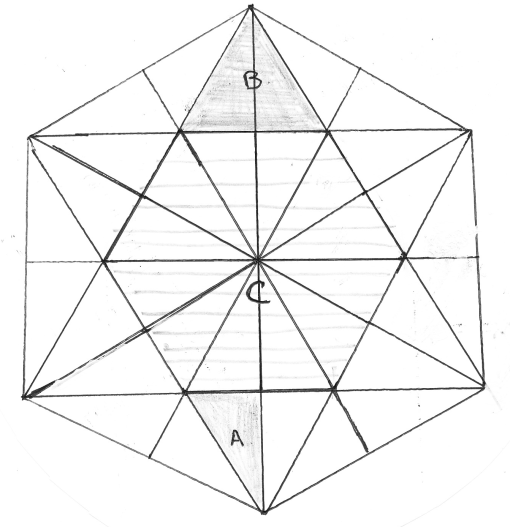
For November 26, 2013– In the picture below, find the shaded right triangle marked A, the equilateral triangle marked B and the striped regular hexagon marked C. Six students make the following statements about the picture below: Anne says “I can find an equilateral triangle three times the area of B.”  Ben says I can find an equilateral triangle four times the area of B.” Carol says, “I can find a find a right triangle triple the area of A.” Doug says, “I can find a right triangle five times the area of A.” Eloise says, “I can find a regular hexagon double the area of C.” Frank says, “I can find a regular hexagon three times the area of C.” Which students are undoubtedly mistaken?

30- 60-90

If you solve this week’s problem, send us a solution!

Bon appetit!