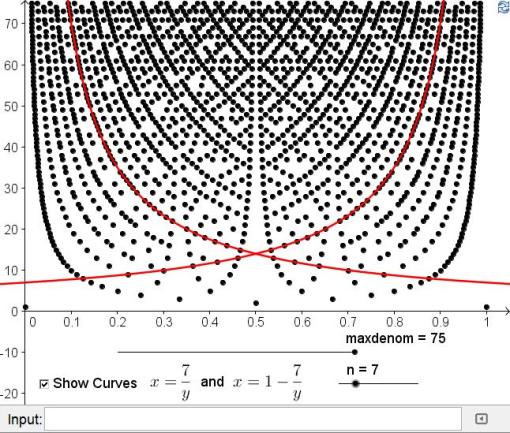
What is it? It’s a graph of the Farey Fractions, with the denominator of the (simplified) fraction on the vertical axis and the value of the fraction on the horizontal axis, made by mathematician and professor at Wheelock College Debra K. Borkovitz (previously). Now, I’d never heard of Farey Fractions before I saw this image – but the graph was so cool that I wanted to learn all about them!
So, what are Farey Fractions, you ask? Debra writes all about them and the cool visual patterns they make in this post. To make a list of Farey Fractions you first pick a number – say, 5. Then, you list all of the fractions between 0 and 1 whose denominators are less than or equal to the number you picked. So, as Debra writes in…
You should definitely take some time to explore Wild Maths, a site dedicated to the creative aspects of mathematics. Wild Maths is produced by the Millennium Mathematics Project, which also makes NRICH and Plus.
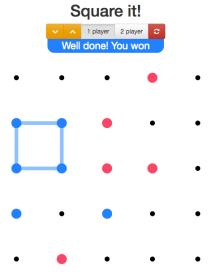
I won!
One fun things you’ll find on Wild Maths is a game called Square It! You can play it with a friend or against the computer. The goal is to color dots on a square grid so that you are the first to make a square in your color. It is quite challenging! To the left you’ll find my first victory against the computer after losing the first several matches.
You’ll find lots more on Wild Maths, including an equal averages challenge, a number grid journey, and some video interviews with mathematicians Katie Steckles and Nira Chamberlain. Wild Maths also has a Showcase of work that has been submitted by their readers, much like our own Readers’ Gallery. (We love hearing from you and seeing your creations!)
Next up is a video of an amazing illusion:
Now, I am as big of a fan of squircles as anyone, but this video really threw me for a loop. The illusion just gets crazier and crazier! The illusion was designed by Kokichi Sugihara of Meiji University in Japan. It recently won second place in the Best Illusion of the Year Contest.
We are fortunate that Dave Richeson has hit it out of the park again, this time sharing both an explanation of the mathematics behind the illusion and a paper template you can use to make your own ambiguous cylinder!
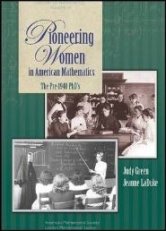
Finally this week, I’d like to share a fascinating document with you. It is a supplement to a book called Pioneering Women in American Mathematics: The Pre-1940s PhD’s by Judy Green and Jeanne LaDuke.
The supplement gives biographies of all 228 American women who earned their PhD’s in mathematics during the first four decades of the 20th century. You might enjoy checking out this page from the National Museum of American History, which describes some about the origin of the book project.
Judy Green, Jeanne LaDuke, and fifteen women who received their PhD’s in math before 1940.
I hope you will find both pleasure and inspiration in reading the stories of these pioneers in American mathematics. I have found them to be a lot of fun to read.
For the 5th and final Thursday of June we will once again take a look at some of the goodness over on our facebook page, and oh my goodness what a huge load of goodness we have indeed! For an appetizer, how about this little visual problem posted by ThinkFun Games? (If you remind me in the comments, I’ll tell you the neat way I thought about solving it.)
The shape consists of overlapped color circles. Which two colors have their total visible areas equal? (click to enlarge)
Now onto the main course. I have to show you this incredible new math art tool called SLICEFORM STUDIO. Click over and check out their gallery to begin with. Just gorgeous.
My first creation on SliceForm.com
There’s a tutorial page as well, but the best thing to do is probably just to start playing with the app itself. DIG IN! The site is sort of made for people who can use laser cutters to do the paper and stuff, but you can also just click “trace and export strips” and then color it in and export the image. On the right, you can see my first creation. Email yours to mathmunchteam@gmail.com and we’ll stick it in our readers’ gallery.
Alright, up next is an amazing mathematical artist by the name of Rinus Roelofs. (You might remember the paper project of his that we shared at new year.) Well, Rinus is just an unblievable and prolific maker of incredible and beautiful things. Check out his website. (He has two, I think)
I follow Rinus on facebook, and he’s always posting pictures of his works in progress, and they are stunning. First, check out this gallery of Interwoven Ring Patterns he recently posted. Then take a look at his timeline photos. Lots of overlapping patterns and Möbius shapes.
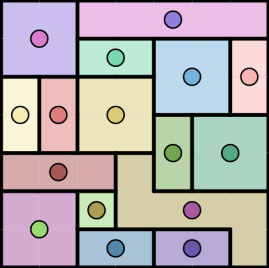
A completed galaxy puzzle. Each colored area has rotational symmetry
Finally, have you ever heard of Galaxy Puzzles? I hadn’t either, but you can find lots of them over on the wonderful puzzling site, krazydad. The puzzle begins with lots of dots, and your goal is to separate the dots by making enclosures that have 180 degree rotational symmetry. Print and play galaxy puzzles are available as well as an interactive online version. There are lots of other puzzles available as well, but I think Battleships is a pretty cool. You might give that a try too.
But wait, there’s more. With 5 Thursdays in a month, there’s just lots to share, so you also get some bonus stuff!


 The shape consists of overlapped color circles. Which two colors have their total visible areas equal? (click to enlarge)


 Math Munch