Tag Archives: building

Newroz, a Math Factory, and Flexagons

Welcome to this week’s Math Munch!

You’ve probably seen Venn diagrams before. They’re a great way of picturing the relationships among different sets of objects.

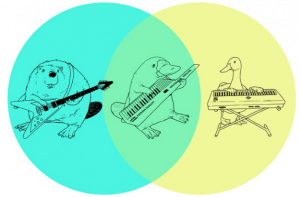
But I bet you’ve never seen a Venn diagram like this one!
Frank Ruskey

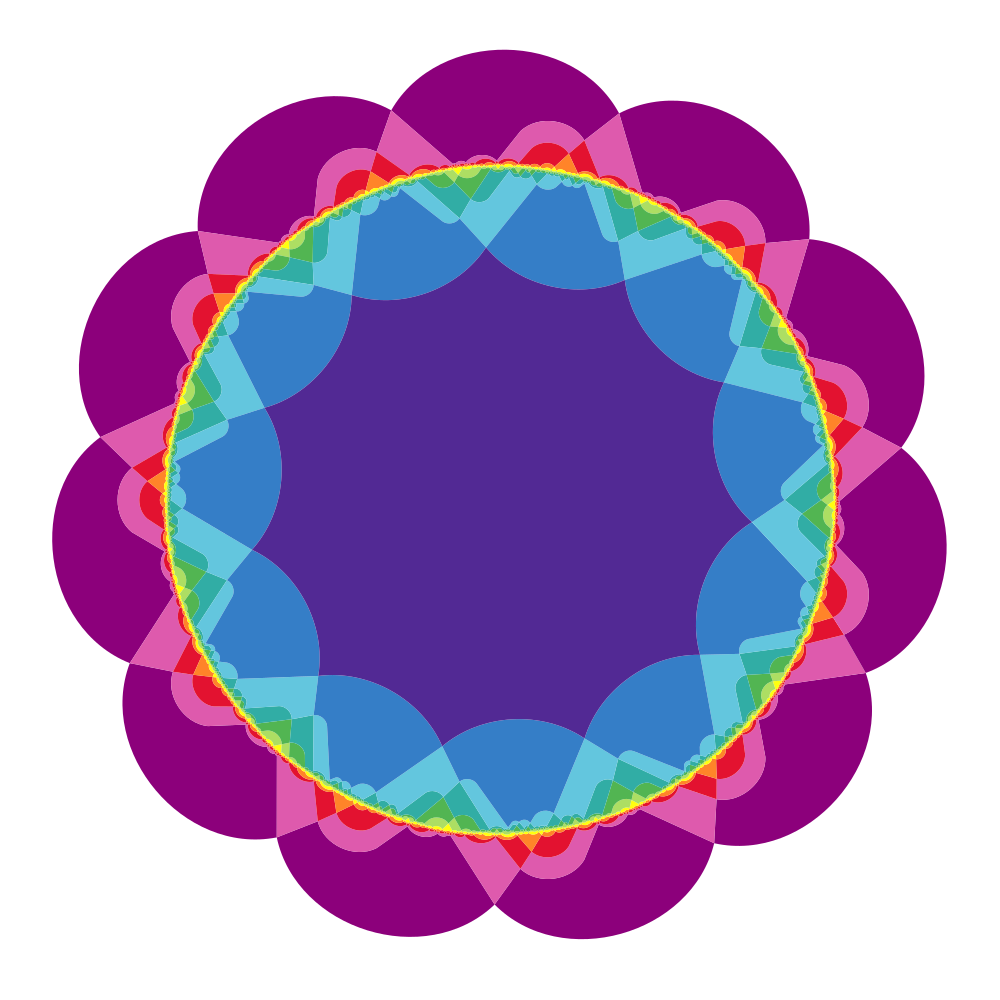
That’s because its discovery was announced only a few weeks ago by Frank Ruskey and Khalegh Mamakani of the University of Victoria in Canada. The Venn diagrams at the top of the post are each made of two circles that carve out three regions—four if you include the outside. Frank and Khalegh’s new diagram is made of eleven curves, all identical and symmetrically arranged. In addition—and this is the new wrinkle—the curves only cross in pairs, not three or more at a time. All together their diagram contains 2047 individual regions—or 2048 (that’s 2^11) if you count the outside.

Frank and Khalegh named this Venn diagram “Newroz”, from the Kurdish word for “new day” or “new sun”. Khalegh was born in Iran and taught at the University of Kurdistan before moving to Canada to pursue his Ph.D. under Frank’s direction.

Khalegh Mamakani

“Newroz” to those who speak English sounds like “new rose”, and the diagram does have a nice floral look, don’t you think?

When I asked Frank what it was like to discover Newroz, he said, “It was quite exciting when Khalegh told me that he had found Newroz. Other researchers, some of my grad students and I had previously looked for it, and I had even spent some time trying to prove that it didn’t exist!”

Khalegh concurred. “It was quite exciting. When I first ran the program and got the first result in less than a second I didn’t believe it. I checked it many times to make sure that there was no mistake.”

You can click these links to read more of my interviews with Frank and Khalegh.

I enjoyed reading about the discovery of Newroz in these articles at New Scientist and Physics Central. And check out this gallery of images that build up to Newroz’s discovery. Finally, Frank and Khalegh’s original paper—with its wonderful diagrams and descriptions—can be found here.

A single closed curve—or “petal”— of Newroz. Eleven of these make up the complete diagram.

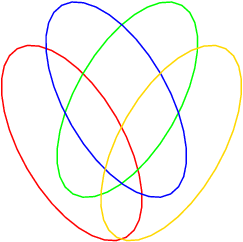
A Venn diagram made of four identical ellipses. It was discovered by John Venn himself!

For even more wonderful images and facts about Venn diagrams, a whole world awaits you at Frank’s Survey of Venn Diagrams.
On Frank’s website you can also find his Amazing Mathematical Object Factory! Frank has created applets that will build combinatorial objects to your specifications. “Combinatorial” here means that there are some discrete pieces that are combined in interesting ways. Want an example of a 5×5 magic square? Done! Want to pose your own pentomino puzzle and see a solution to it? No problem! Check out the rubber ducky it helped me to make!

A pentomino rubber ducky!

Finally, Frank mentioned that one of his early mathematical experiences was building hexaflexagons with his father. This led me to browse around for information about these fun objects, and to re-discover the work of Linda van Breemen. Here’s a flexagon video that she made.

And here’s Linda’s page with instructions for how to make one. Online, Linda calls herself dutchpapergirl and has both a website and a YouTube channel. Both are chock-full of intricate and fabulous creations made of paper. Some are origami, while others use scissors and glue.
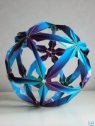
I can’t wait to try making some of these paper miracles myself!

Bon appetit!
Music Box, FatFonts, and the Yoshimoto Cube

Welcome to this week’s Math Munch!

The Whitney Music Box

Jim Bumgardner

Solar Beat

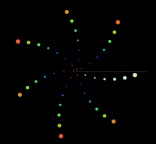
With the transit of Venus just behind us and the summer solstice just ahead, I’ve got the planets and orbits on my mind. I can’t believe I haven’t yet shared with you all the Whitney Music Box. It’s the brainchild of Jim Bumgardner, a man of many talents and a “senior nerd” at Disney Interactive Labs. His music box is one of my favorite things ever–so simple, yet so mesmerizing.

It’s actually a bunch of different music boxes–variations on a theme. Colored dots orbit in circles, each with a different frequency, and play a tone when they come back to their starting points. In Variation 0, for instance, within the time it takes for the largest dot to orbit the center once, the smallest dot orbits 48 times. There are so many patterns to see–and hear! There are 21 variations in all. Go nuts! In this one, only prime dots are shown. What do you notice?

You can find a more astronomical version of this idea at SolarBeat.

Above you’ll find a list of the numerals from 1 to 9. Or is it 0 to 9?

Where’s the 0 you ask? Well, the idea behind FatFonts is that the visual weight of a number is proportional to its numerical size. That would mean that 0 should be completely white!

FatFonts can also be nested. The first number below is 64. Can you figure out the second?

This is 64 in FatFonts.

What number is this?
Click to zoom!

FatFonts was developed by the team of Miguel NacentaUta Hinrichs, and Sheelagh Carpendale. You can see some uses that FatFonts has been put to on their Gallery page, and even download FatFonts to use in your word processor. Move over, Times New Roman!

This past week, Paul pointed me to this cool video by George Hart about interlocking complementary polyhedra that together form a cube. It reminded me of something I saw for the first time a few years ago that just blew me away. You have to see the Yoshimoto Cube to believe it:

In addition to its more obvious charms, something that delights me about the Yoshimoto Cube is how it was found so recently–only in 1971, by Naoki Yoshimoto.  (That other famous cube was invented in 1974 by Ernő Rubik.) How can it be that simple shapes can be so inexhaustible? If you’re feeling inspired, Make Magazine did a short post on the Yoshimoto Cube a couple of years that includes a template for making a Yoshimoto Cube out of paper. Edit: These template and instructions aren’t great. See below for better ones!

Since it’s always helpful to share your goals to help you stick to them, I’ll say that this week I’m going to make a Yoshimoto Cube of my own. Begone, back burner! Later in the week I’ll post some pictures below. If you decide to make one, share it in the comments or email us at

MathMunchTeam@gmail.com

We’d love to hear from you.

Bon appetit!

Update:

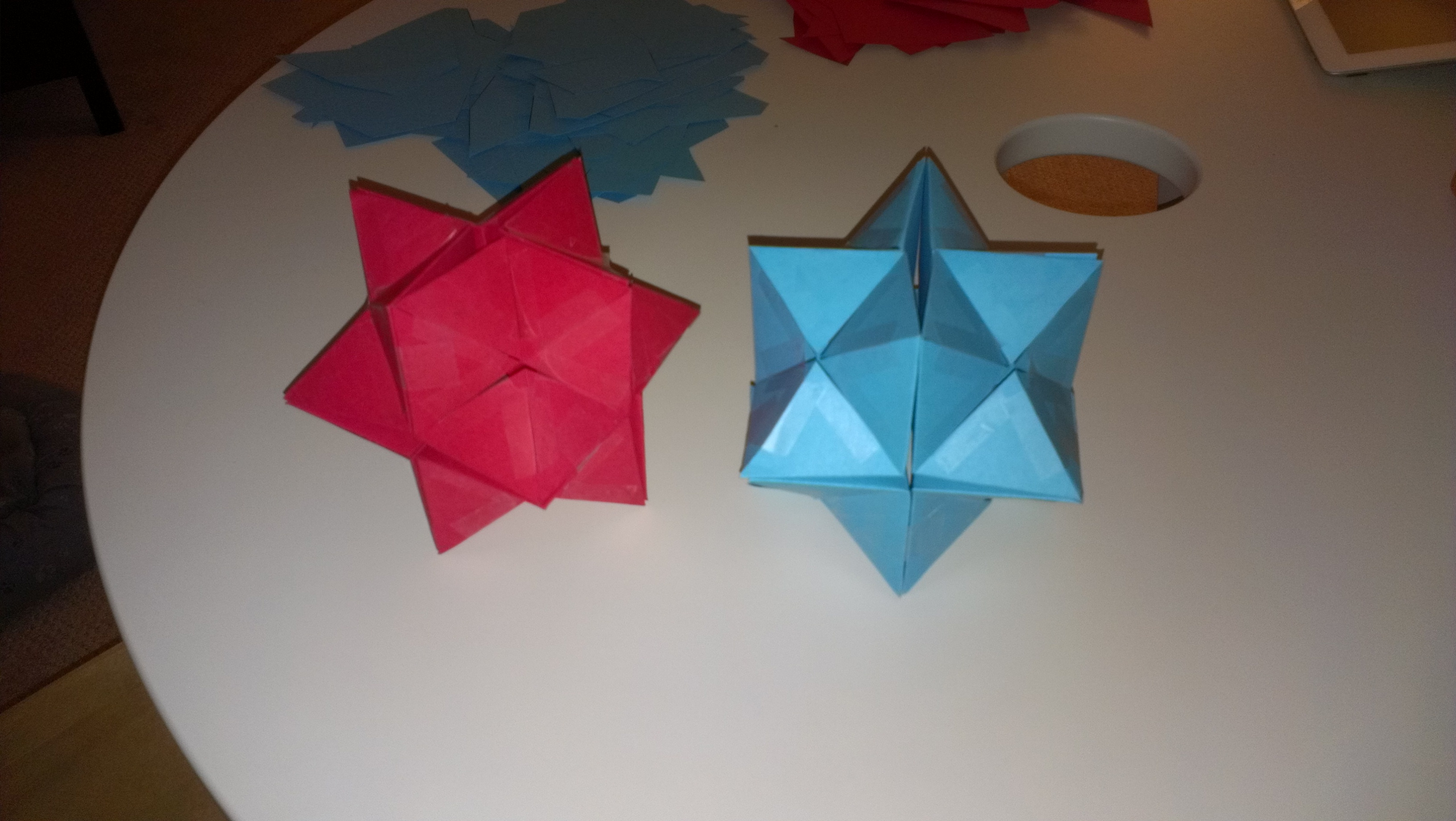
Here are the two stellated rhombic dodecahedra that make the Yoshimoto Cube that Paul and I made! Templates, instructions, and video to follow!

Here are two different templates for the Yoshimoto cubelet. You’ll need eight cubelets to make one star.

And here’s how you tape them together:

A Sweater, Paper Projects, and Math Art Tools

Sondra Eklund and her Prime Factorization Sweater

Welcome to this week’s Math Munch!

Check out Sondra Eklund and her awesome prime factorization sweater! Sondra is a librarian and a writer who writes a blog where she reviews books. She also is a knitter and a lover of math!

Each number from two to one hundred is represented in order on the front of Sondra’s sweater. Each prime number is a square that’s a different color; each composite number has a rectangle for each of the primes in its prime factorization. This number of columns that the numbers are arranged into draws attention to different patterns of color. For instance, you can see a column that has a lot of yellow in it on the front of the sweater–these are all number that contain five as a factor.

You can read more about Sondra and her sweater on her blog. Also, here’s a response and variation to Sondra’s sweater by John Graham-Cumming.

Next up, do you like making origami and other constructions out of paper? Then you’ll love the site made by Laszlo Bardos called CutOutFoldUp.

Laszlo Bardos

A Rhombic Spirallohedron

A decagon slide-together

Laszlo is a high school math teacher and has enjoyed making mathematical models since he was a kid. On CutOutFoldUp you’ll find gobs of projects to try out, including printable templates. I’ve made some slide-togethers before, but I’m really excited to try making the rhombic spirallohedron pictured above! What is your favorite model on the site?

Last up, Paul recently discovered a great mathematical art applet called Recursive Drawing. The tools are extremely simple. You can make circles and squares. You can stretch these around. But most importantly, you can insert a copy of one of your drawings into itself. And of course then that copy has a copy inside of it, and on and on. With a very simple interface and very simple tools, incredible complexity and beauty can be created.

Recursive Drawing was created by Toby Schachman, an artist and programmer who graduated from MIT and now lives in New York City and attends NYU.  You can watch a demo video below.

Recursive Drawing is one of the first applets on our new Math Art Tools page. We’ll be adding more soon. Any suggestions? Leave them in the comments!

Bon appetit!