Tag Archives: games

Light Bulbs, Lanterns, and Lights Out

Welcome to this week’s Math Munch!
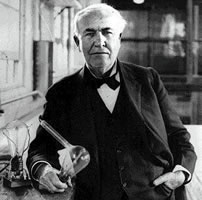
thomas-edison

Edison with his light bulb.

On this day in 1880, Thomas Edison was given a patent for his most famous bright idea—the light bulb.

Edison once said, “Genius is one per cent inspiration, ninety-nine per cent perspiration”—a good reminder that putting in some work is important both in math and in life. He also said, “We don’t know a millionth of one percent about anything.” A humbling thought. Also, based on that quote, it sounds like Edison might have had a use for permilles or even permyraids in addition to percents!
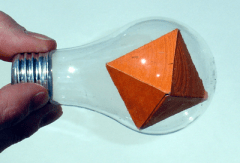
Mike's octahedron.

Mike’s octahedron-in-a-light-buld.

In celebration of this illustrious anniversary, I’d like to share some light mathematical fare relating to, well, light bulbs. For starters, J. Mike Rollins of North Carolina has created each of the Platonic solids inside of light bulbs, ship-in-a-bottle style. Getting just the cube to work took him the better part of twelve hours! Talk about perspiration. Mike has also made a number of lovely Escher-inspired woodcuts. Check ’em out!
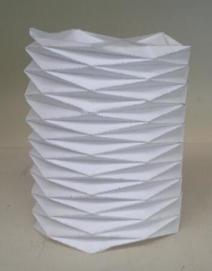
Evelyn's Schwartz lantern.

Evelyn’s Schwartz lantern.

Next up is a far-out example from calculus that’s also a good idea for an art project. It’s called the Schwartz lantern. I found out about this amazing object last fall when Evelyn Lamb tweeted and blogged about it.

The big idea of calculus is that we can find exact answers to tough problems by setting up a pattern of approximations that get better and better and then—zoop! take the process to its logical conclusion at infinity. But there’s a catch: you have to be careful about how you set up your pattern!
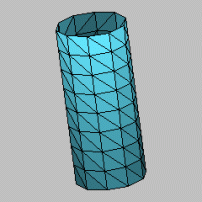
A "nicely" triangulated cylinder.

A “nicely” triangulated cylinder.

For example, if you take a cylinder and approximate its surface with a bunch of triangles carefully, you’ll end up with a surface that matches the cylinder in shape and size. But if you go about the process in a different way, you can end up with a surface that stays right near the cylinder but that has infinite area. That’s the Schwartz lantern, first proposed by Karl Hermann Amandus Schwarz of Cauchy-Schwartz fame. The infinite area happens because of all the crinkles that this devilish pattern creates. For some delightful technical details about the lantern’s construction, check out Evelyn’s post and this article by Conan Wu.

Maybe you’ll try folding a Schwartz lantern of your own. There’s a template and instructions on Conan’s blog to get you started. You’ll be glowing when you finish it up—especially if you submit a photo of it to our Readers’ Gallery. Even better, how about a video? You could make the internet’s first Schwartz lantern short film!
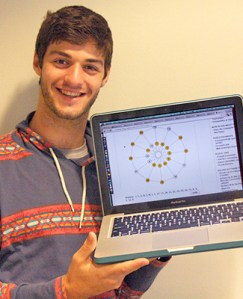
Robert Torrence and his Lights Out puzzle.

Robert and his Lights Out puzzle.

At the MOVES Conference last fall, Bruce Torrence of Randolf-Macon College gave a talk about the math of Lights Out. Lights Out is a puzzle—a close relative of Ray Ray—that’s played on a square grid. When you push one of the buttons in the grid it switches on or off, and its neighbors do, too. Bruce and his son Robert created an extension of this puzzle to some non-grid graphs. Here’s an article about their work and here’s an applet on the New York Times website where you can play Lights Out on the Peterson graph, among others. You can even create a Lights Out puzzle of your own! If it’s more your style, you can try a version of the original game called All Out on Miniclip.

The original Lights Out handheld game from 1995.

The original Lights Out handheld game from 1995.

There’s a huge collection of Lights Out resources on Jaap’s Puzzle Page (previously), including solution strategies, variations, and some great counting problems. Lights Out and Ray Ray are both examples of what’s called a “sigma-plus game” in the mathematical literature. Just as a bonus, there’s this totally other game called Light Up. I haven’t solved a single puzzle yet, but my limitations shouldn’t stop you from trying. Perspiration!

All this great math work might make you hungry, so…bon appetit!

Virtual Hyenas, Markov Chains, and Random Knights

Welcome to this week’s Math Munch!

It’s amazing how a small step can lead to a chain reaction of adventure.

Arend Hintze

Arend Hintze

Recently a reader named Nico left a comment on the Math Munch post where I shared the game Loops of Zen. He asked why the game has that name. Curious, I looked up Dr. Arend Hintze, whose name appears on the game’s title page. This led me to Arend’s page at the Adami Lab at Michigan State University. Arend studies how complex systems—especially biological systems—evolve over time.

Here is a video of one of Arend’s simulations. The black and white square is a zebra. The yellow ones are lions, the red ones are hyenas, and guess who’s hungry?

Arend’s description of the simulation is here. The cooperative behavior in the video—two hyenas working together to scare away a lion—wasn’t programmed into the simulation. It emerged out of many iterations of systems called Markov Brains—developed by Arend—that are based upon mathematical structures called Markov chains. More on those in a bit.

You can read more about how Arend thinks about his multidisciplinary work on biological systems here. Also, it turns out that Arend has made many more games besides Loops of Zen. Here’s Blobs of Zen, and Ink of Zen is coming out this month! Another that caught my eye is Curve, which reminds me of some of my favorite puzzle games. Curve is still in development; here’s hoping we’ll be able to play it soon.

Arend has agreed to do an interview with Math Munch, so share your questions about his work, his games, and his life below!

Eric Czekner

Eric Czekner

Arend’s simulations rely on Markov chains to model animal behavior. So what’s a Markov chain? It’s closely related to the idea of a random walk. Check out this video by digital artist, musician, and Pure Data enthusiast Eric Czekner. In the video, Eric gives an overview of what Markov chains are all about and shows how he uses them to create pieces of music.

http://www.youtube.com/watch?v=LzJiUYQXF58

On this page, Eric describes how he got started using Markov chains to make music, along with several of his compositions. It’s fascinating how he captures the feel of a song by creating a mathematical system that “generates new patterns based on existing probabilities.”

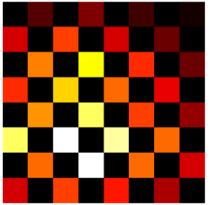
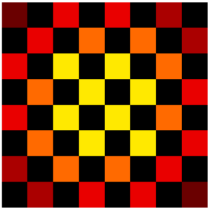
Now there’s a big idea: exploring something randomly can capture structures that might be hard to perceive otherwise. Here’s one last variation on the Markov chain theme that involves a pure math question. This blog post ponders the question: what happens when a knight takes a random walk—or random trot?—on a chessboard? It includes some colorful images of chessboards along the way.

How likely it is that a knight lands on each square after five moves, starting from b1.

How likely it is that a knight lands on each square after five moves, starting from b1.

The probabili

How likely it is that a knight lands on each square after 200 moves, starting from b1.

The blogger—Leonid Kovalev—shows in his analysis what happens in the long run: the number of times a knight will visit a square will be proportional to the number of moves that lead to that square. For instance, since only two knight moves can reach a corner square while eight knight moves can reach a central square, it’s four times as likely that a knight will finish on a central square after a long, long journey than on a corner square. This idea works because moving a knight around a chessboard is a “reversible Markov chain”—any path that a knight can trace can also be untraced. The author also wrote a follow-up post about random queens.

It’s amazing the things you can find by chaining together ideas or by taking a random walk. Thanks for the inspiration for this post, Nico. Keep those comments and questions coming, everyone—we love hearing from you.

Bon appetit!

Math Meets Art, Quarto, and Snow!

Welcome to this week’s Math Munch!

article-0-19F9E81700000578-263_634x286… And, if you happen to write the date in the European way (day/month/year), happy Noughts and Crosses Day! (That’s British English for Tic-Tac-Toe Day.) In Europe, today’s date is 11/12/13– and it’s the last time that the date will be three consecutive numbers in this century! We in America are lucky. Our last Noughts and Crosses Day was November 12, 2013 (11/12/13), and we get another one next year on December 13 (12/13/14). To learn more about Noughts and Crosses Day and find out about an interesting contest, check out this site. And, to our European readers, happy Noughts and Crosses Day!

p3p13Speaking of Noughts and Crosses (or Tic-Tac-Toe), I have a new favorite game– Quarto! It’s a mix of Tic-Tac-Toe and another favorite game of mine, SET, and it was introduced to me by a friend of mine. It’s quite tricky– you’ll need the full power of your brain to tackle it. Luckily, there are levels, since it can take a while to develop a strategy. Give it a try, and let us know if you like it!

BRUCKER-ICS-DARKRYE-SQUARE

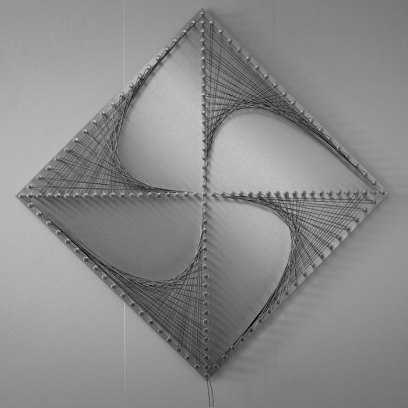
Looking to learn about some new mathematical artists? Check out this article, “When Math Meets Art,” from the online magazine Dark Rye. It profiles seven mathematical artists– some of whom we’ve written about (such as Erik and Martin Demaine, of origami fame, and Henry Segerman), and some of whom I’ve never heard of. The work of string art shown above is by artist Adam Brucker, who specializes in making “unexpected” curves from straight line segments.

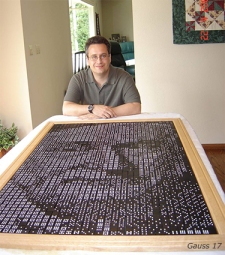
gauss17_smallAnother of my favorites from this article is the work of Robert Bosch. One of his specialities is making mosaics of faces out of tiles, such as dominoes. The article features his portrait of the mathematician Father Sebastien Truchet made out of the tiles he invented, the Truchet tiles. Clever, right? The mosaic to the left is of the great mathematician Gauss, made out of dominoes. Check out Robert’s website to see more of his awesome art.

Finally, it snowed in New York City yesterday. I love when it snows for the first time in winter… and that got me wanting to make some paper snowflakes to celebrate! Here’s a video by Vi Hart that will teach you to make some of the most beautiful paper snowflakes.

Hang them on your windows, on the walls, or from the ceiling, and have a very happy wintery day! Bon appetit!