Tag Archives: interactive puzzle

Folds, GIMPS, and More Billiards

Welcome to this week’s Math Munch!

First up, we’ve often featured mathematical constructions made of origami. (Here are some of those posts.) Origami has a careful and peaceful feel to it—a far cry from, say, the quick reflexes often associated with video games. I mean, can you imagine an origami video game?
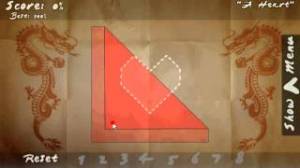
heartfolds

One of Fold’s many origami puzzles.

Well, guess what—you don’t have to, because Folds is just that! Folds is the creation of Bryce Summer, a 21-year-old game designer from California. It’s so cool. The goal of each level of its levels is simple: to take a square piece of paper and fold it into a given shape. The catch is that you’re only allowed a limited number of folds, so you have to be creative and plan ahead so that there aren’t any loose ends sticking out. As I’ve noted before, my favorite games often require a combo of visual intuition and careful thinking, and Folds certainly fits the bill. Give it a go!

Once you’re hooked, you can find out more about Bryce and how he came to make Folds in this awesome Q&A. Thanks so much, Bryce!

gimpsNext up, did you know that a new largest prime number was discovered less than a month ago? It’s very large—over 17 million digits long! (How many pages would that take to print or write out?) That makes it way larger than the previous record holder, which was “only” about 13 million digits long. Here is an article published on the GIMPS website about the new prime number and about the GIMPS project in general.

What’s GIMPS you ask? GIMPS—the Great Internet Mersenne Primes Search—is an example of what’s called “distributed computing”. Testing whether a number is prime is a simple task that any computer can do, but to check many or large numbers can take a lot of computing time. Even a supercomputer would be overwhelmed by the task all on its own, and that’s if you could even get dedicated time on it. Distributed computing is the idea that a lot of processing can be accomplished by having a lot of computers each do a small amount of work. You can even sign up to help with the project on your own computer. What other tasks might distributed computing be useful for? Searching for aliens, perhaps?

GIMPS searches only for a special kind of prime called Mersenne primes. These primes are one less than a power of two. For instance, 7 is a Mersenne prime, because it’s one less that 8, which is the third power of 2. For more on Mersenne primes, check out this video by Numberphile.

Finally, we’ve previously shared some resources about the math of billiards on Math Munch. Below you’ll find another take on bouncing paths as Michael Moschen combines the math of billiards with the art of juggling.

So lovely. For more on this theme, here’s a second video to check out.

Bon appetit!

Slides and Twists, Life in Life, and Star Art

Welcome to this week’s Math Munch!

I ran across the most wonderful compendium of slidey and twisty puzzles this past week when sharing the famous 15-puzzle with one of my classes.  It’s called Jaap’s Puzzle Page and it’s run by a software engineer from the Netherlands named Jaap Scherphuis. Jaap has been running his Puzzle Page since 1999.


Jaap Scherphuis
and some of his many puzzles

Jaap first encountered hands-on mathematical puzzles when he was given a Rubik’s Cube as a present when he was 8 or 9. He now owns over 700 different puzzles!

Jaap’s catalogue of slidey and twisty puzzles is immense and diverse. Each puzzle is accompanied by a picture, a description, a mathematical analysis, and–SPOILER ALERT–an algorithm that you can use to solve it!

On top of this, all of the puzzles in Jaap’s list with asterisks (*) next to them have playable Java applets on their pages–for instance, you can play Rotascope or Diamond 8-Ball. Something that’s especially neat about Jaap’s applets is that you can sometimes customize their size/difficulty. If you find the 15-puzzle daunting, you can start with the 8-puzzle or even the 3-puzzle instead. The applets also have a built in solver. I really enjoy watching the solver crank through solving a puzzle–it’s so relentless, and sometimes you can see patterns emerge.

Over ten solves, I found that the autosolve for the 15-puzzle averaged 7.1 seconds. How long do you think on average the 63-puzzle would take to solve?

You can read more about Jaap in this interview on speedcubing.com or on his about page.

puzzle

The 15-puzzle

Rotascope

Diamond 8-ball

Next, I recently read about an amazing feat: Brice Due created a copy of Conway’s Game of Life inside of a Game of Life! This video shows you what it’s all about. It starts zoomed in on some activity, following the rules of Life. The it zooms out to show that this activity conspires to make a large unit cell that is “turned on.” This large cell was dubbed a “OTCA metapixel” by its creator, where OTCA stands for Outer Totalistic Cellular Automata.

Finally, the video zooms out even more to show that this cell and others around it interact according to the rules of Life! The activity at the meta-level that is shown at the end exactly corresponds to the activity on the micro-level that we began with.  Check it out!

This metapixel idea has been around since 2006, but the video was created just recently by Philip Bradbury. It was made using Golly, a cellular automata explorer that is one of my favorite mathematical tools.

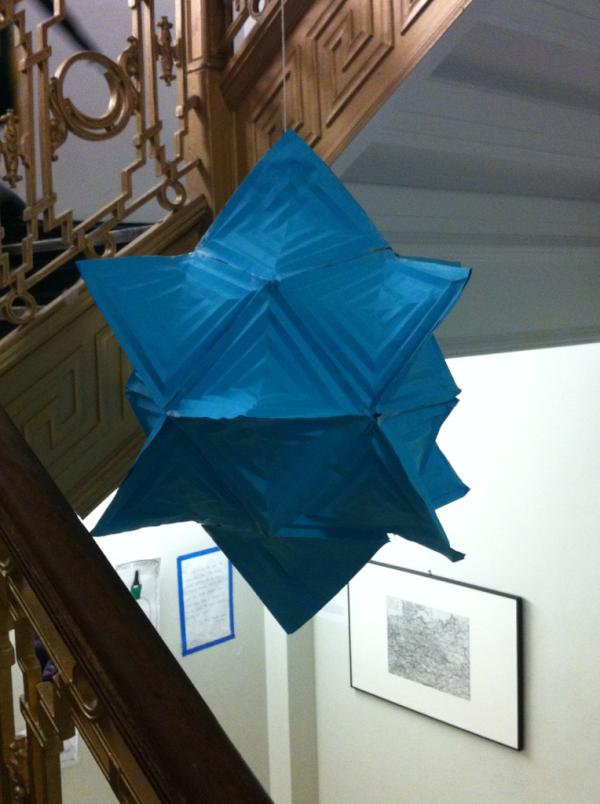
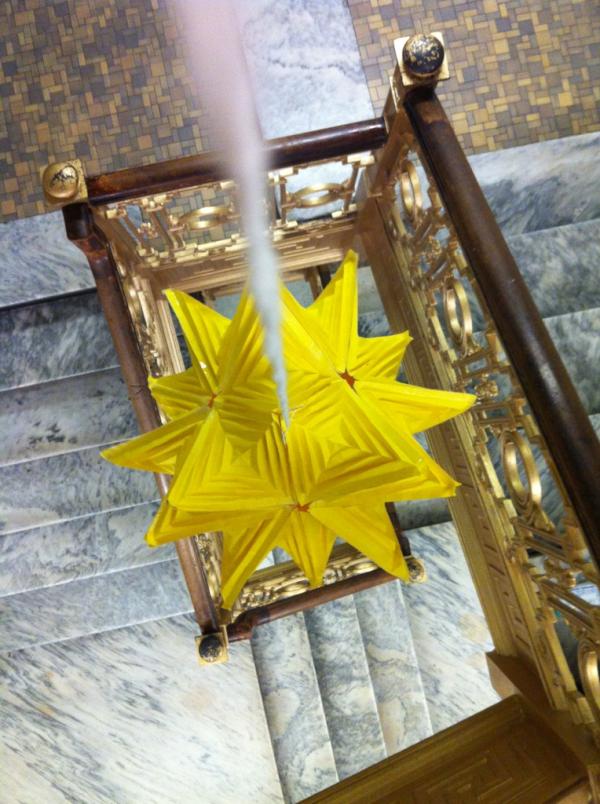
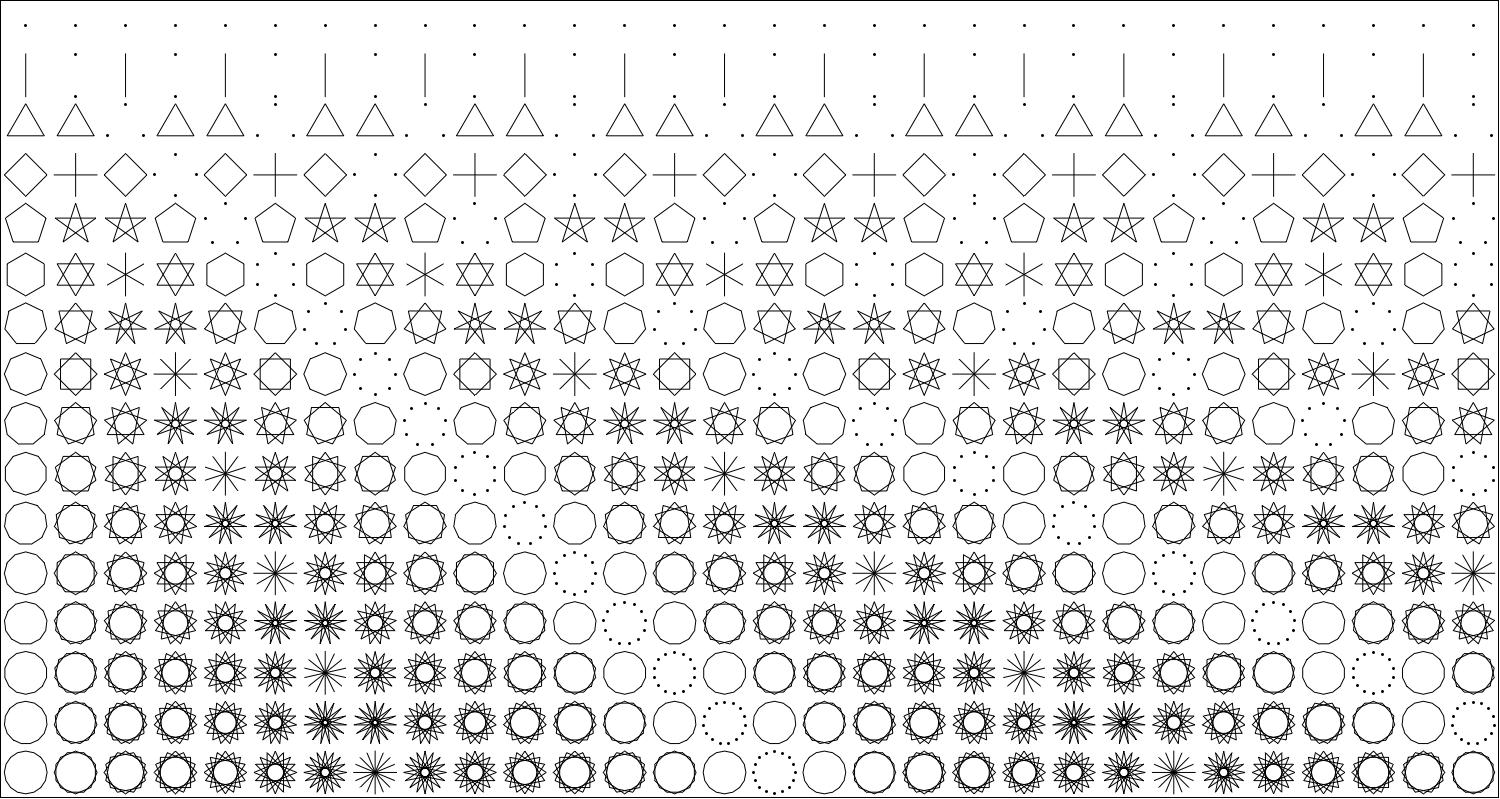
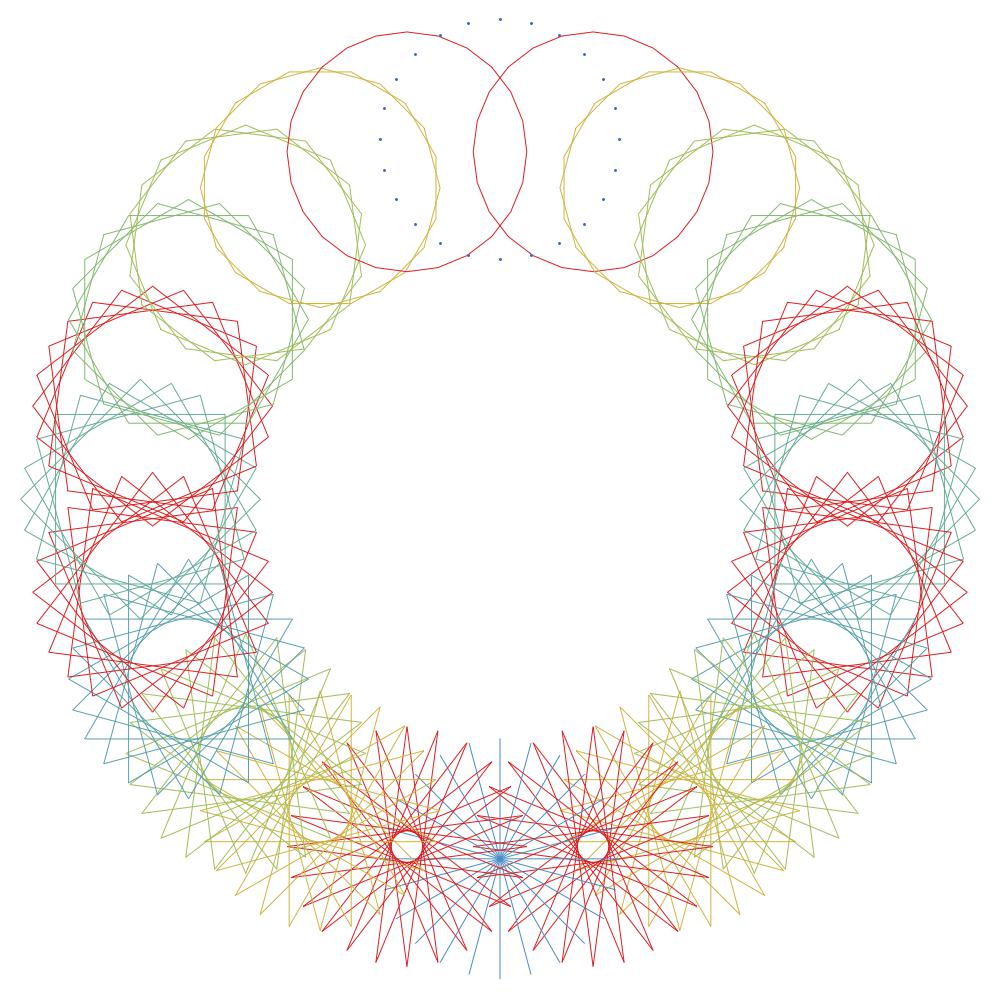
Last up, some star art! (STart? STARt? st-art?)  It turns out that the Math Munch team members all converged toward doing some StArT this semester as a part of our mathematical art (MArTH) seminar. Here is some of our work, for your viewing pleasure. Bon appetit!

by Anna Weltman

by Anna Weltman

Stars of the Mind’s Sky
by Paul Salomon

Star Ring 24
by Paul Salomon

300 Stars in Orbit
by Paul Salomon

by Justin Lanier

Scott Kim, Puzzles, and Games

Welcome to this week’s Math Munch!

Scott Kim

Meet Scott Kim.  He’s loved puzzles ever since he was a kid, so these days he designs puzzles for a living.  He’s been writing puzzles for Discover Magazine for years in a monthly column called “The Boggler.”  Click that link to look through some of his Boggler archives.  Here’s a cool one he wrote in 2002 about hypercubes and the 4th dimension.

Ambigram

In his 11-minute TED talk, Scott tells the story of his career and shares some of his favorite puzzles, games, and ambigrams.  It’s also completely clear how much he really loves what he does (as do I.)

Knights on Horseback – M.C. Escher

I’ve always loved “figure/ground” images, where the leftover space from one shape creates another recognizable shape.  M.C. Escher created some of the most famous and well-known examples of figure/ground art, but Scott Kim took the idea a step further – making an interactive puzzle game based on the ideas.  Naturally, the game is called “Figure Ground,” and it’s delightfully tricky.  You can even create your own levels.  Scott has a whole page of web games.  Go play!

Symmetrical Alphabet – Ambigram by Scott Kim

Still hungry for more Scott Kim?  He gave a presentation for the Museum of Math‘s lecture series, Math Encounters.  You can watch the full-length video here.  You can also watch an interview he did with Vi Hart by clicking here.

Finally, after you read a Math Munch (or right in the middle) do you ever have a question you wish someone could answer or something you want explained?  Or do you ever wish we could help you find more of something you liked in the post?  Well we can do that!  Just leave a comment on the bottom of the page, and the Math Munch team will be very happy to answer.  We’d love to hear from our readers.

Bon appetit!