Tag Archives: origami

Music Box, FatFonts, and the Yoshimoto Cube

Welcome to this week’s Math Munch!
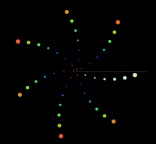
The Whitney Music Box

Jim Bumgardner

Solar Beat

With the transit of Venus just behind us and the summer solstice just ahead, I’ve got the planets and orbits on my mind. I can’t believe I haven’t yet shared with you all the Whitney Music Box. It’s the brainchild of Jim Bumgardner, a man of many talents and a “senior nerd” at Disney Interactive Labs. His music box is one of my favorite things ever–so simple, yet so mesmerizing.

It’s actually a bunch of different music boxes–variations on a theme. Colored dots orbit in circles, each with a different frequency, and play a tone when they come back to their starting points. In Variation 0, for instance, within the time it takes for the largest dot to orbit the center once, the smallest dot orbits 48 times. There are so many patterns to see–and hear! There are 21 variations in all. Go nuts! In this one, only prime dots are shown. What do you notice?

You can find a more astronomical version of this idea at SolarBeat.

Above you’ll find a list of the numerals from 1 to 9. Or is it 0 to 9?

Where’s the 0 you ask? Well, the idea behind FatFonts is that the visual weight of a number is proportional to its numerical size. That would mean that 0 should be completely white!

FatFonts can also be nested. The first number below is 64. Can you figure out the second?

This is 64 in FatFonts.

What number is this?
Click to zoom!

FatFonts was developed by the team of Miguel NacentaUta Hinrichs, and Sheelagh Carpendale. You can see some uses that FatFonts has been put to on their Gallery page, and even download FatFonts to use in your word processor. Move over, Times New Roman!

This past week, Paul pointed me to this cool video by George Hart about interlocking complementary polyhedra that together form a cube. It reminded me of something I saw for the first time a few years ago that just blew me away. You have to see the Yoshimoto Cube to believe it:

In addition to its more obvious charms, something that delights me about the Yoshimoto Cube is how it was found so recently–only in 1971, by Naoki Yoshimoto.  (That other famous cube was invented in 1974 by Ernő Rubik.) How can it be that simple shapes can be so inexhaustible? If you’re feeling inspired, Make Magazine did a short post on the Yoshimoto Cube a couple of years that includes a template for making a Yoshimoto Cube out of paper. Edit: These template and instructions aren’t great. See below for better ones!

Since it’s always helpful to share your goals to help you stick to them, I’ll say that this week I’m going to make a Yoshimoto Cube of my own. Begone, back burner! Later in the week I’ll post some pictures below. If you decide to make one, share it in the comments or email us at

MathMunchTeam@gmail.com

We’d love to hear from you.

Bon appetit!

Update:
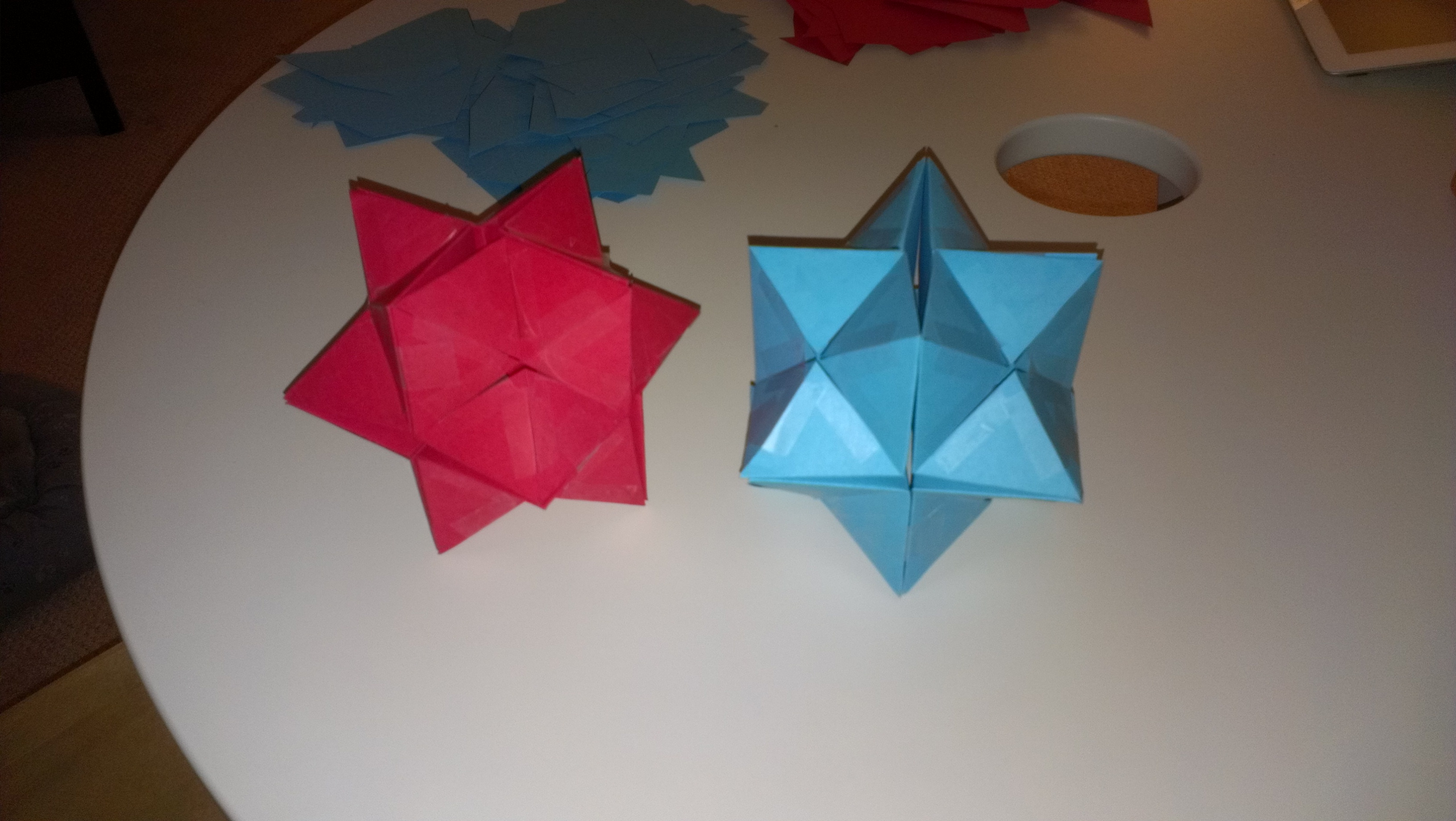
Here are the two stellated rhombic dodecahedra that make the Yoshimoto Cube that Paul and I made! Templates, instructions, and video to follow!

Here are two different templates for the Yoshimoto cubelet. You’ll need eight cubelets to make one star.

And here’s how you tape them together:

Polyominoes, Rubix, and Emmy Noether

Welcome to this week’s Math Munch!

Check out the Pentomino Project, a website devoted to all things about polyominoes by students and teachers from the K. S. O. Glorieux Ronse school in Belgium.

Their site is full of lots of useful information about polyominoes, such as what the different polyominoes look like and how they are formed.

In this puzzle, place the twelve pentominoes as "islands in a sea" so that the area of the sea is a small as possible. The pentominoes can't touch, even at corners. Here's a possible solution.

Even more awesome, though, is their collection of polyomino puzzles – about dissections, congruent pieces, tilings, and more!  They have a contest every year  – and people from around the world are encouraged to participate!  If you solve a puzzle, you can send them your solution and they might post it on their site.

Next, have you ever thought to yourself, “Gee, I wonder if I can make my own Rubix Cube?”  Well, sixth grader August did just that.  And, after several days of searching for patterns and working hard with paper, scissors, string, and tape, August succeeded!  His 2-by-2 Rubix Cube works just like any other, is fun to play with, and – even better – was fun to make.

Try it yourself:

Finally, ever heard of Emmy Noether?  It’s not surprising if you haven’t, because, according a New York Times article about her, “few can match in the depths of her perverse and unmerited obscurity….”  But, she was one of the most influential mathematicians and scientists of the 20th century – and was named by Albert Einstein the most “significant” and “creative” woman mathematician of all time.  You can read about Emmy’s influential theorem, and her struggles to become accepted in the mathematical community as a Jewish woman, in this article.

Want to learn more about women mathematicians throughout history?  Check out this site of biographies from Agnes Scott College.

Bon appetit!

Origami, Games, and the Huang Twins

Welcome to this week’s Math Munch!

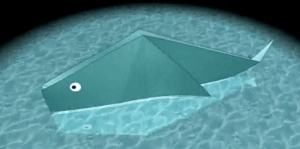
Origami Whale

We’ve had a few posts (like this, this, and this) that included paper folding, but this week we really focus on doing it yourself.  Check out Origamiplayer.com, a terrific website that doesn’t just show you origami models.  It has an animator that folds them in front of you and waits for you to fold along with it.  I really like this origami pentagon, but there’s lots of designs and you can even sort them by type or difficulty.  You can change the speed or click around to different steps, so find a model you like and get folding!

Up next, meet the Huang Twins, 14-year old brothers from California.  Mike and Cary have been working as a team to design and program all kinds of great web stuff.  They actually have their own orgami animator to fold polyhedra.  But my favorite thing of theirs is The Scale of the Universe 2, an incredible applet that let’s you compare the sizes of all kinds of things big and small.  It uses scientific notation to describe the sizes, so if you’ve never seen that before, you might want to read up.  It’s genius.

They’ve also written several excellent games, which we’ve added to our Math Games page.  Cube Roll has a familiar format with a twist; The cube has to land on the correct side.  I really like that one.  No Walking, No Problem is another neat little puzzler.  Use the objects to move side to side, because you can’t walk!  Lastly, (though the Huangs didn’t write it) we’ve added Morpion Solitaire, a tough little game you can play online or on paper.

Bon appetit!

Cube Roll

No Walking, No Problem

Morpion Solitaire