Tag Archives: origami

Cubes, Curves, and Geometric Romance

Welcome to this week’s Math Munch!

If you like Rubik’s Cubes, then check out Oskar van Deventer’s original Rubik’s cube-type puzzles!  Oskar is a Dutch scientist who has been designing puzzles since he was 12 years old.  He makes many of his puzzles using a 3D printer, with a company called Shapeways.

Oskar has posted a number of videos of himself explaining his creations.  Here’s him demonstrating the Oh Cube:

Next, take a look at these beautiful curved-crease sculptures made by MIT mathematician and origami artist Erik Demaine and his father, Martin Demaine.  Erik and Martin make these hyperbolic paraboloid structures by folding rings of creases in a circular piece of paper.  They have exhibits of their artwork in various museums and galleries, including in the MoMA permanent collection and the Guided By Invoices gallery in Chelsea, NYC.  So, if you live in NYC, then you could go see these!

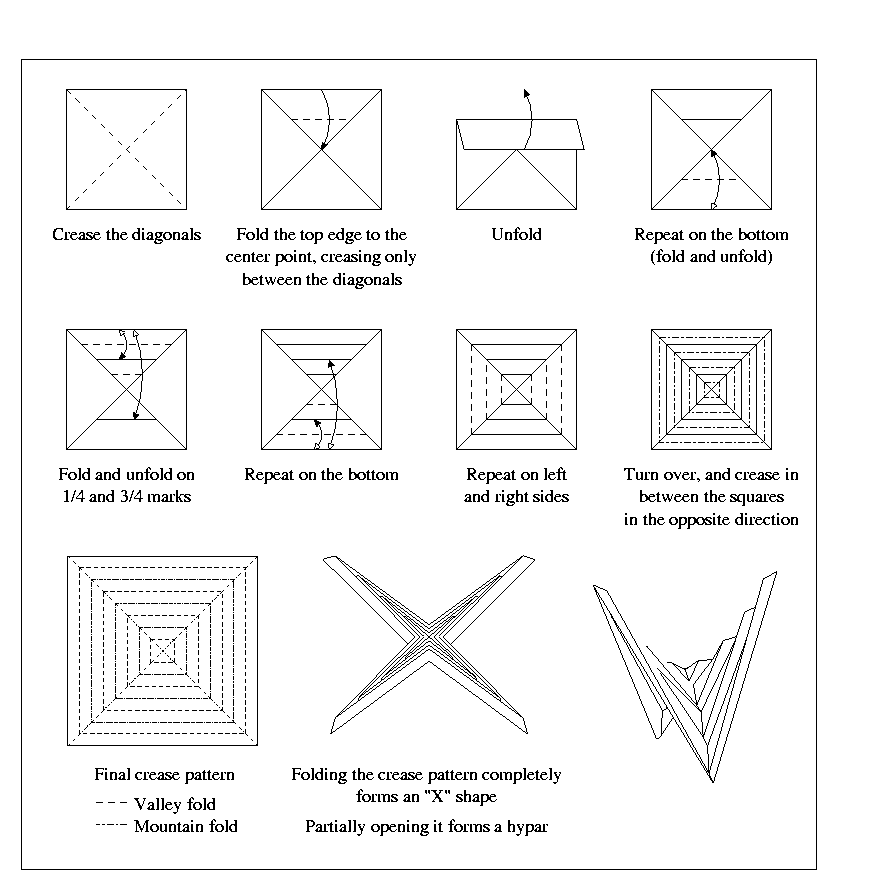
Want to learn how to fold your own hyperbolic paraboloid?  Erik has these instructions for making one out of a square piece of paper with straight folds.

Finally, here is a wonderful video made of Norton Juster’s picture book, The Dot and the Line.  Enjoy!

Bon appetit!
Math Craft, Philippa Fawcett, and Mandelbrot

Welcome to this week’s Math Munch!

Math Craft is a supersweet website where members submit their mathematically inspired art and instructions about how to make your own.  I love the polyhedra made out of pennies in the masthead, these curve stitches, and these polyhedral pumpkins!  Here is a link to Math Craft’s welcome page, authored by admin Cory Poole.  Cory is a math and physics teacher at University Preparatory School in California. The welcome page includes some instructions for creating some great paper polyhedra. Math Craft is just starting up; I’m sure there will be many more great project to be found there in the future!

Philippa Fawcett, who broke the glass ceiling of Cambridge mathematics

An article recently appeared on the Past Imperfect blog on Smithsonian.com about the compelling story of Philippa Fawcett. Fawcett was the first and only woman to make the highest score on the Cambridge tripos mathematical exam.  She did so during an age when the predominant opinion was that women were incapable and weak and certainly couldn’t excel at mathematics.  Fawcett’s performance on this exam did much to dispel this prejudice.  The article not only relates an interesting chapter from history, but also give an inspiring account of a person’s drive to success despite enormous obstacles.

Finally, by request, a journey through the Mandelbrot set:

[youtube http://www.youtube.com/watch?v=F_nfHY61T-U&feature=related]

Benoit Mandelbrot, the father of fractal geometry, passed away about a year ago. You can listen to his outstanding TED talk about his life’s work here. I love his enthusiasm and curiosity, as well as how he can find marvels in the seemingly ordinary.  Also, how much fun is the way he pronounces “cauliflower”?!  You can find a memorial to Benoit Mandelbrot in last November’s edition of Peer Points.

Bon appetit!

Pennies, Knights, and Origami Mazes

Welcome to this week’s Math Munch!

How many pennies do you think this is? Click to find out.

Big numbers are sometimes hard to get a feel for.  A billion is a lot, but so is a million.  The MegaPenny Project is a cool attempt at making the difference between large numbers easier to grasp.  Would 1,000,000 pennies fill a football field or would you need a billion pennies for that?  MegaPenny can help you figure it out.

The first kixote puzzle

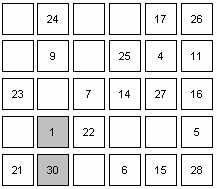
Next up, we have kixote, a puzzle in the spirit of Sudoku and Ken-Ken, but involving knight’s moves.  Dan Mackinnon–its creator–has a blog called mathrecreation that he says, “helps me go a little further in my mathematical recreations, helps me understand things better, and sometimes connects me to other people who share similar interests. I hope that it might encourage you to play with math too.”  I’m sure we’ll be linking to more of Dan’s posts in the future!

Finally, since the mazes and paper-folding were so popular last week, we thought that this week we would share some paper-folding mazes! Here is a clip of MIT professor Erik Demaine talking about how he has created origami mazes, preceded by a discussion of origami robots that fold themselves!  The clip is a part of a lecture about origami that Erik gave last spring in New York City for the Math Encounters series put on by the Museum of Mathematics.  You can watch Erik’s entire origami lecture from the beginning by clicking here.

frame from lecture video

Eric Demaine with a sheet of origami cubes

You can also check out Erik’s Maze Folder applet–but if you try it out, take his warning and start with a small maze!

Bon appetit!