
This past week the Math Munch team got to attend the Bridges 2012. Bridges is a mathematical art conference, the largest one in the world. This year it was held at Towson University outside of Baltimore, Maryland. The idea of the conference is to build bridges between math and the arts.
Participants gave lectures about their artwork and the math that inspired or informed it. There were workshop sessions about mathematical poetry and chances to make baskets and bead bracelets involving intricate patterns. There was even a dance workshop about imagining negative-dimensional space! There were also some performances, including two music nights (which included a piece that explored a Fibonacci-like sequence called Narayana’s Cows) and a short film festival (here are last year’s films). Vi Hart and George Hart talked about the videos they make and world-premiered some new ones. And at the center of it all was an art exhibition with pieces from around the world.
 The Zen of the Z-Pentomino by Margaret Kepner |
 Does this piece by Bernhard Rietzl |
 5 Rhombic Screens by Alexandru Usineviciu |
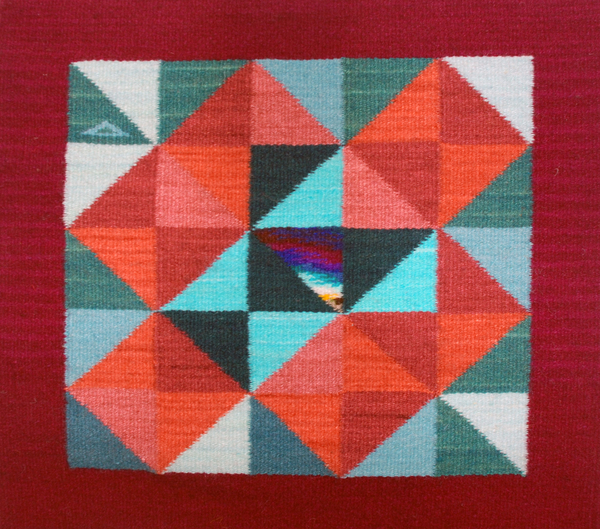 Pythagorean Proof by Donna Loraine |
To see more, you should really just browse the Bridges online gallery.

A shot of the gallery exhibition
I know that Paul, Anna, and I will be sharing things with you that we picked up at Bridges for months to come. It was so much fun!

David Chappell
One person whose work and presentation I loved at Bridges is David Chappell. David is a professor of astronomy at the University of La Verne in California.
David shared some thinking and artwork that involve meander patterns. “Meander” means to wander around and is used to describe how rivers squiggle and flow across a landscape. David uses some simple and elegant math to create curve patterns.
Instead of saying where curves sit in the plane using x and y coordinates, David describes them using more natural coordinates, where the direction that the curve is headed in depends on how far along the curve you’ve gone. This relationship is encoded in what’s called a Whewell equation. For example, as you walk along a circle at a steady rate, the direction that you face changes at a contant rate, too. That means the Whewell equation of a circle might look like angle=distance. A smaller circle, where the turning happens faster, could be written down as angle=2(distance).

Look at how the Cauto River “meanders” across the Cuban landscape.
In his artwork, David explores curves whose equations are more complicated—ones that involve multiple sine functions. The interactions of the components of his equations allow for complex but rhythmic behavior. You can create meander patterns of your own by tinkering with an applet that David designed. You can find both the applet and more information about the math of meander patterns on David’s website.

David Chappell’s Meander #6
Make your own here!
When I asked David about how being a scientist affects his approach to making art, and vice versa, he said:
My research focuses on nonlinear dynamics and pattern formation in fluid systems. That is, I study the spatial patterns that arise when fluids are agitated (i.e. shaken or stirred). I think I was attracted to this area because of my interest in the visual arts. I’ve always been interested in patterns. The science allows me to study the underlying physical systems that generate the patterns, and the art allows me to think about how and why we respond to different patterns the way we do. Is there a connection between how we respond to a visual image and the underlying “rules” that produced the image? Why to some patterns look interesting, but others not so much?
For more of my Q&A with David, click here. In addition, David will be answering questions in the comments below, so ask away!
Since bridges and meandering rivers are both water-related, I thought I’d round out this post with a couple of interesting links about water sports and the Olympics. My springboard was a site called Maths and Sport: Countdown to the Games.

Arrangements of rowers that are “wiggle-less”
Here’s an article that explores different arrangements of rowers in a boat, focusing on finding ones where the boat doesn’t “wiggle” as the rowers row. It’s called Rowing has its Moments.
Next, here’s an article about the swimming arena at the 2008 Beijing games, titled Swimming in Mathematics.

Paul used to be a competitive diver, and he says there’s an interesting code for the way dives are numbered. For example, the “Forward 1 ½ Somersaults in Tuck Position” is dive number 103C. How does that work? You can read all about it here. (Degree of difficulty is explained as well.)
Finally, enjoy these geometric patterns inspired by synchronized swimming!
Stay cool, and bon appetit!




 Math Munch
