Tag Archives: polyhedra

Music Box, FatFonts, and the Yoshimoto Cube

Welcome to this week’s Math Munch!
The Whitney Music Box

Jim Bumgardner

Solar Beat

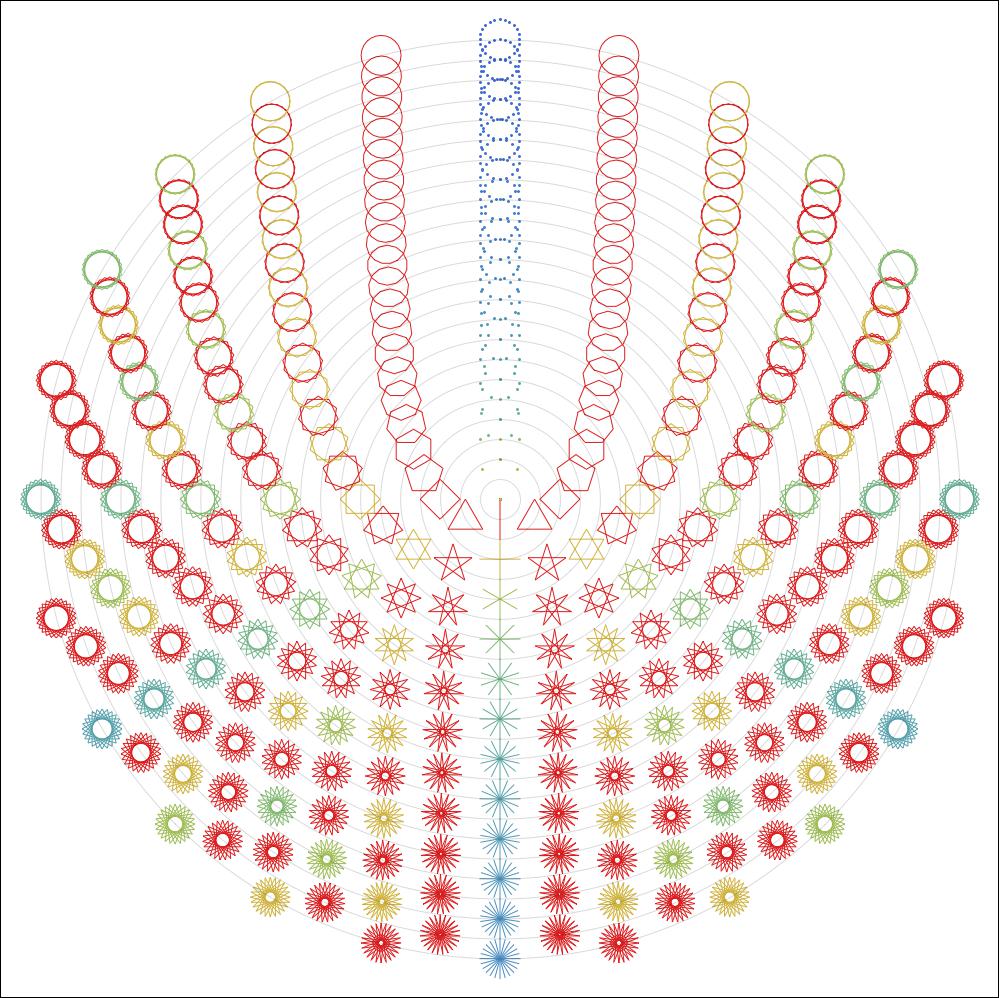
With the transit of Venus just behind us and the summer solstice just ahead, I’ve got the planets and orbits on my mind. I can’t believe I haven’t yet shared with you all the Whitney Music Box. It’s the brainchild of Jim Bumgardner, a man of many talents and a “senior nerd” at Disney Interactive Labs. His music box is one of my favorite things ever–so simple, yet so mesmerizing.

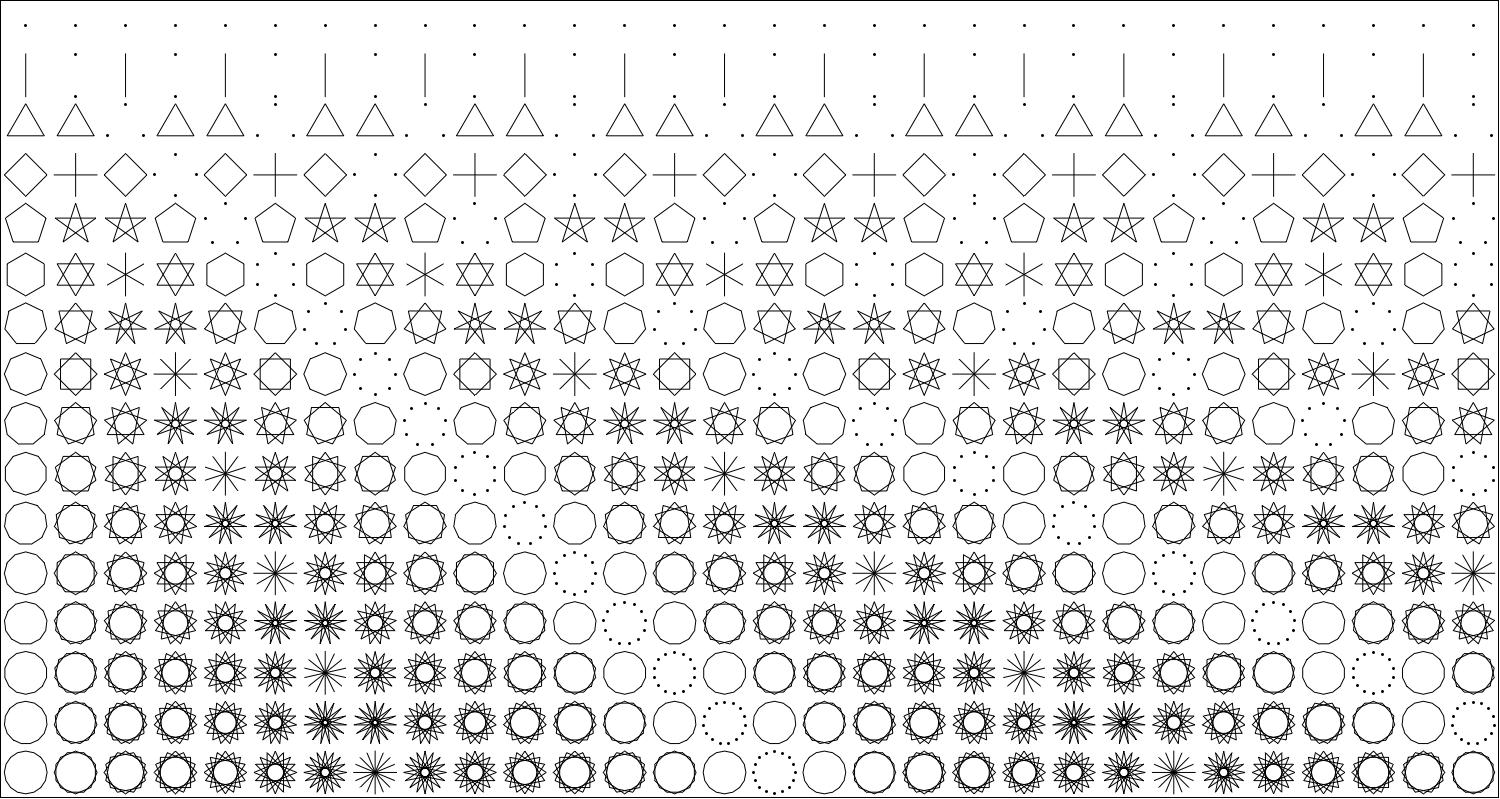
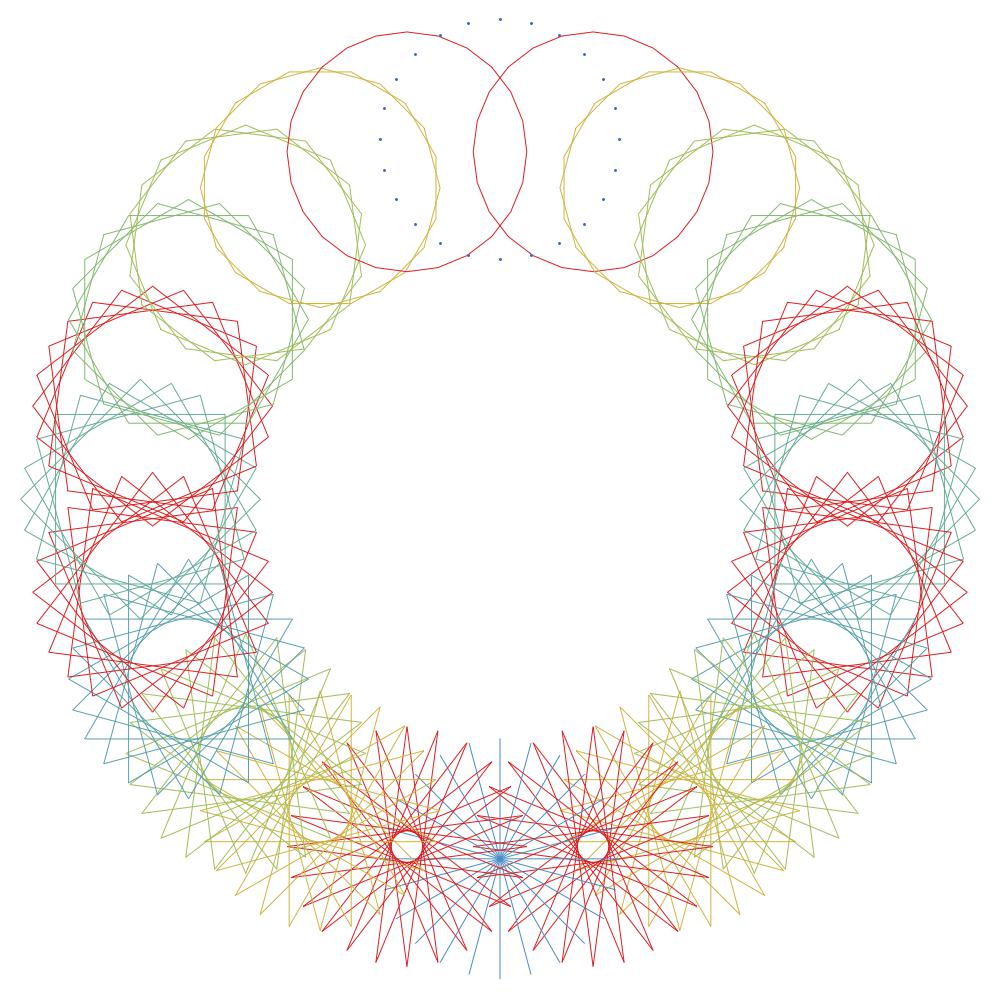
It’s actually a bunch of different music boxes–variations on a theme. Colored dots orbit in circles, each with a different frequency, and play a tone when they come back to their starting points. In Variation 0, for instance, within the time it takes for the largest dot to orbit the center once, the smallest dot orbits 48 times. There are so many patterns to see–and hear! There are 21 variations in all. Go nuts! In this one, only prime dots are shown. What do you notice?

You can find a more astronomical version of this idea at SolarBeat.

Above you’ll find a list of the numerals from 1 to 9. Or is it 0 to 9?

Where’s the 0 you ask? Well, the idea behind FatFonts is that the visual weight of a number is proportional to its numerical size. That would mean that 0 should be completely white!

FatFonts can also be nested. The first number below is 64. Can you figure out the second?

This is 64 in FatFonts.

What number is this?
Click to zoom!

FatFonts was developed by the team of Miguel NacentaUta Hinrichs, and Sheelagh Carpendale. You can see some uses that FatFonts has been put to on their Gallery page, and even download FatFonts to use in your word processor. Move over, Times New Roman!

This past week, Paul pointed me to this cool video by George Hart about interlocking complementary polyhedra that together form a cube. It reminded me of something I saw for the first time a few years ago that just blew me away. You have to see the Yoshimoto Cube to believe it:

In addition to its more obvious charms, something that delights me about the Yoshimoto Cube is how it was found so recently–only in 1971, by Naoki Yoshimoto.  (That other famous cube was invented in 1974 by Ernő Rubik.) How can it be that simple shapes can be so inexhaustible? If you’re feeling inspired, Make Magazine did a short post on the Yoshimoto Cube a couple of years that includes a template for making a Yoshimoto Cube out of paper. Edit: These template and instructions aren’t great. See below for better ones!

Since it’s always helpful to share your goals to help you stick to them, I’ll say that this week I’m going to make a Yoshimoto Cube of my own. Begone, back burner! Later in the week I’ll post some pictures below. If you decide to make one, share it in the comments or email us at

MathMunchTeam@gmail.com

We’d love to hear from you.

Bon appetit!

Update:
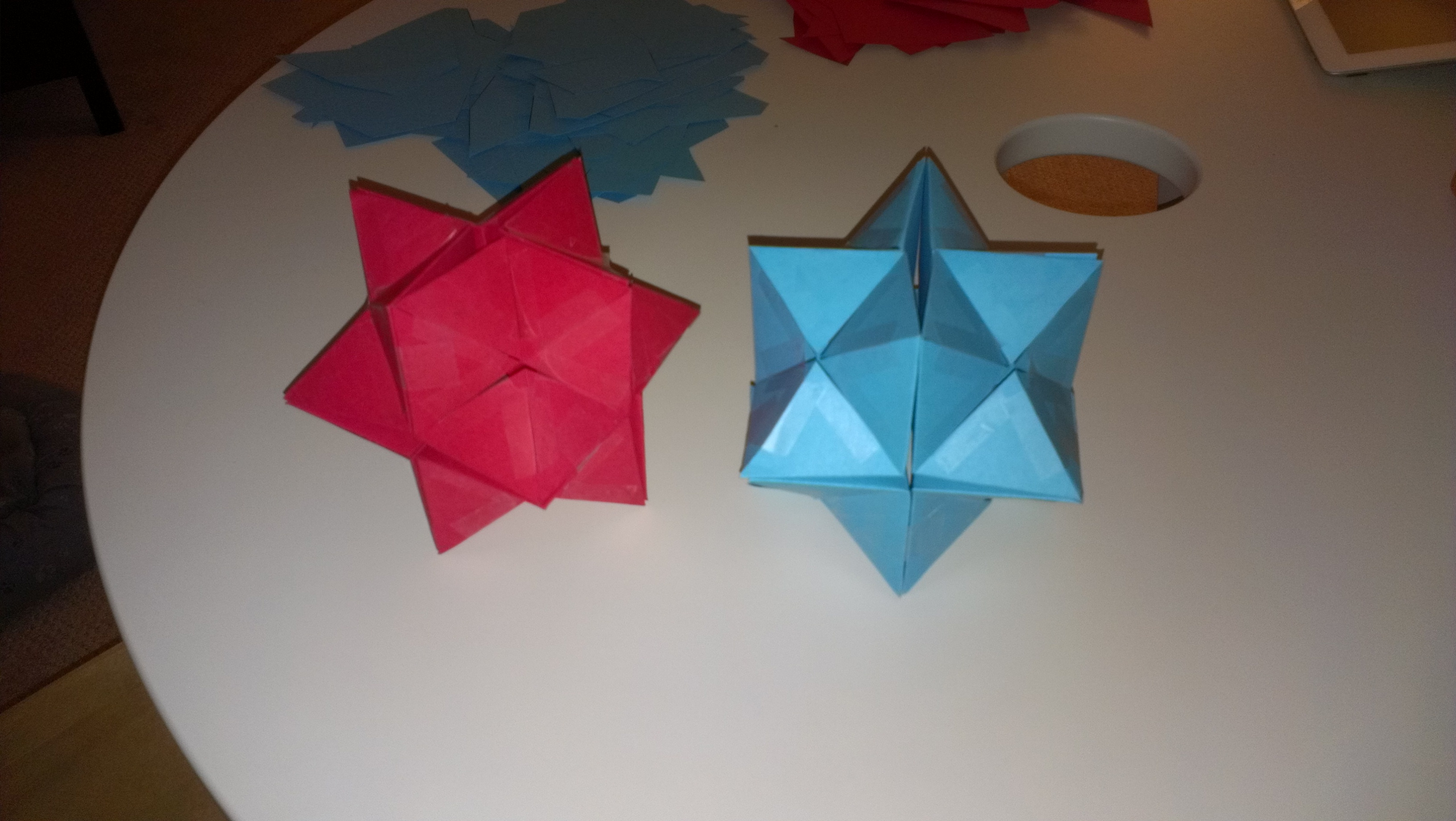
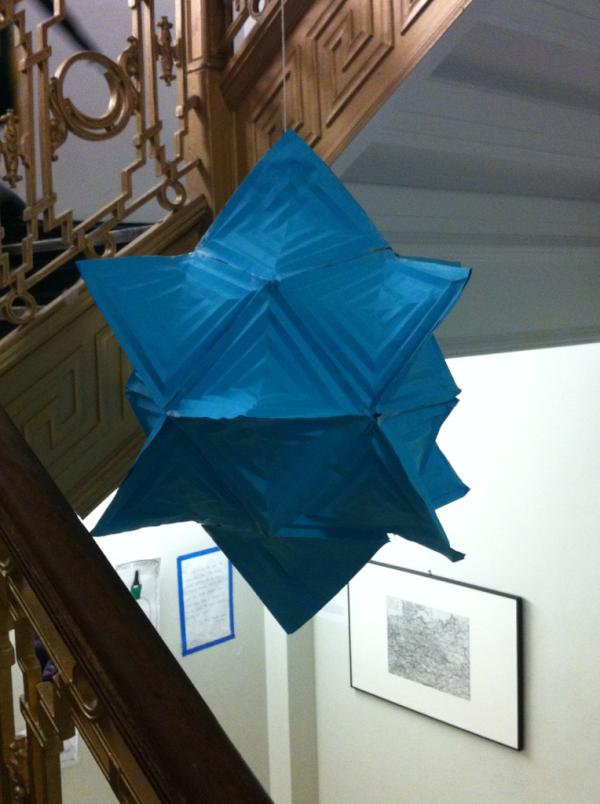
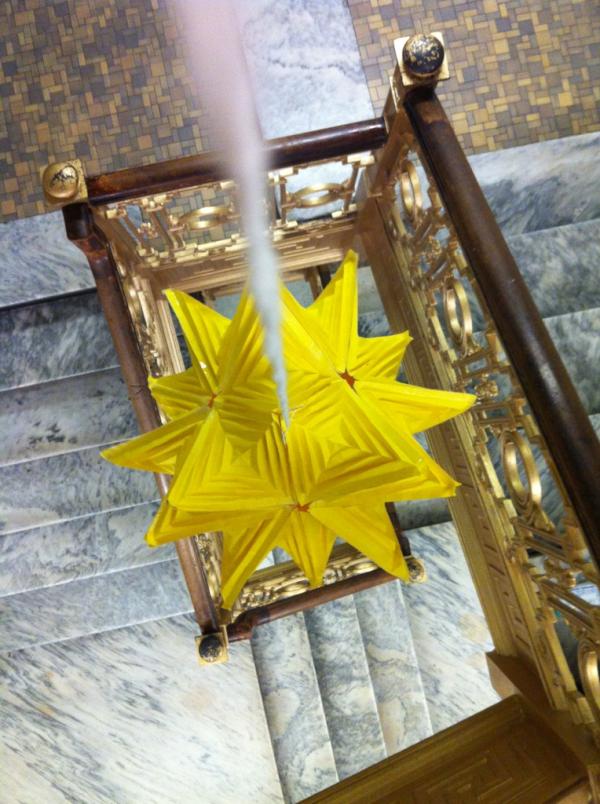
Here are the two stellated rhombic dodecahedra that make the Yoshimoto Cube that Paul and I made! Templates, instructions, and video to follow!

Here are two different templates for the Yoshimoto cubelet. You’ll need eight cubelets to make one star.

And here’s how you tape them together:

Slides and Twists, Life in Life, and Star Art

Welcome to this week’s Math Munch!

I ran across the most wonderful compendium of slidey and twisty puzzles this past week when sharing the famous 15-puzzle with one of my classes.  It’s called Jaap’s Puzzle Page and it’s run by a software engineer from the Netherlands named Jaap Scherphuis. Jaap has been running his Puzzle Page since 1999.


Jaap Scherphuis
and some of his many puzzles

Jaap first encountered hands-on mathematical puzzles when he was given a Rubik’s Cube as a present when he was 8 or 9. He now owns over 700 different puzzles!

Jaap’s catalogue of slidey and twisty puzzles is immense and diverse. Each puzzle is accompanied by a picture, a description, a mathematical analysis, and–SPOILER ALERT–an algorithm that you can use to solve it!

On top of this, all of the puzzles in Jaap’s list with asterisks (*) next to them have playable Java applets on their pages–for instance, you can play Rotascope or Diamond 8-Ball. Something that’s especially neat about Jaap’s applets is that you can sometimes customize their size/difficulty. If you find the 15-puzzle daunting, you can start with the 8-puzzle or even the 3-puzzle instead. The applets also have a built in solver. I really enjoy watching the solver crank through solving a puzzle–it’s so relentless, and sometimes you can see patterns emerge.

Over ten solves, I found that the autosolve for the 15-puzzle averaged 7.1 seconds. How long do you think on average the 63-puzzle would take to solve?

You can read more about Jaap in this interview on speedcubing.com or on his about page.

puzzle

The 15-puzzle

Rotascope

Diamond 8-ball

Next, I recently read about an amazing feat: Brice Due created a copy of Conway’s Game of Life inside of a Game of Life! This video shows you what it’s all about. It starts zoomed in on some activity, following the rules of Life. The it zooms out to show that this activity conspires to make a large unit cell that is “turned on.” This large cell was dubbed a “OTCA metapixel” by its creator, where OTCA stands for Outer Totalistic Cellular Automata.

Finally, the video zooms out even more to show that this cell and others around it interact according to the rules of Life! The activity at the meta-level that is shown at the end exactly corresponds to the activity on the micro-level that we began with.  Check it out!

This metapixel idea has been around since 2006, but the video was created just recently by Philip Bradbury. It was made using Golly, a cellular automata explorer that is one of my favorite mathematical tools.

Last up, some star art! (STart? STARt? st-art?)  It turns out that the Math Munch team members all converged toward doing some StArT this semester as a part of our mathematical art (MArTH) seminar. Here is some of our work, for your viewing pleasure. Bon appetit!

by Anna Weltman

by Anna Weltman

Stars of the Mind’s Sky
by Paul Salomon

Star Ring 24
by Paul Salomon

300 Stars in Orbit
by Paul Salomon

by Justin Lanier

(Beat, Beat, Beat…)

Welcome to this week’s Math Munch!

What could techno rhythms, square-pieces dissections, and windshield wipers have in common?

Animation in which progressively smaller square tiles are added to cover a rectangle completely.

The Euclidean Algorithm!

Say what?  The Euclidean Algorithm is all about our good friend long division and is a great way of finding the greatest common factor of two numbers. It relies on the fact that if a number goes into two other numbers evenly, then it also goes into their difference evenly.  For example, 5 goes into both 60 and 85–so it also goes into their difference, 25.  Breaking up big objects into smaller common pieces is a big idea in mathematics, and the way this plays out with numbers has lots of awesome aural and visual consequences.

Here’s the link that prompted this post: a cool applet where you can create your own unique rhythms by playing different beats against each other.  It’s called “Euclidean Rhythms” and was created by Wouter Hisschemöller, a computer and audio programmer from the Netherlands.

(Something that I like about Wouter’s post is that it’s actually a correction to his original posting of his applet.  He explains the mistake he made, gives credit to the person who pointed it out to him, and then gives a thorough account of how he fixed it.  That’s a really cool and helpful way that he shared his ideas and experiences.  Think about that the next time you’re writing up some math!)

For your listening pleasure, here’s a techno piece that Wouter composed (not using his applet, but with clear influences!)

Breathing Pavement

Here’s an applet that demonstrates the geometry of the Euclidean Algorithm.  If you make a rectangle with whole-number length sides and continue to chop off the biggest (non-slanty) square that you can, you’ll eventually finish.  The smallest square that you’ll chop will be the greatest common factor of the two original numbers.  See it in action in the applet for any number pair from 1 to 100, with thanks to Brown mathematics professor Richard Evan Schwartz, who maintains a great website.

Holyhedron, layer three

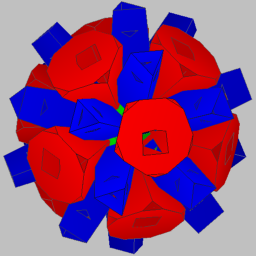
One more thing, on an entirely different note: Holyhedron! A polyhedron where every face contains a hole. The story is given briefly here. Pictures and further details can be found on the website of Don Hatch, finder of the smallest known holyhedron.  It’s a mathematical discovery less than a decade old–in fact, no one had even asked the question until John Conway did so in the 1990s!

Have a great week! Bon appétit!