Tag Archives: video

Talk Like a Computer, Infinite Hotel, and Video Contest

01010111 01100101 01101100 01100011 01101111 01101101 01100101 00100000 01110100 01101111 00100000 01110100 01101000 01101001 01110011 00100000 01110111 01100101 01100101 01101011 00100111 01110011 00100000 01001101 01100001 01110100 01101000 00100000 01001101 01110101 01101110 01100011 01101000 00100001

Or, if you don’t speak binary, welcome to this week’s Math Munch!

Looking at that really, really long string of 0s and 1s, you might think that binary is a really inefficient way to encode letters, numbers, and symbols. I mean, the single line of text, “Welcome to this week’s Math Munch!” turns into six lines of digits that make you dizzy to look at. But, suppose you were a computer. You wouldn’t be able to talk, listen, or write. But you would be made up of lots of little electric signals that can be either on or off. To communicate, you’d want to use the power of being able to turn signals on and off. So, the best way to communicate would be to use a code that associated patterns of on and off signals with important pieces of information– like letters, numbers, and other symbols.

That’s how binary works to encode information. Computer scientists have developed a code called ASCII, which stands for American Standard Code for Information Interchange, that matches important symbols and typing communication commands (like tab and backspace) with numbers.

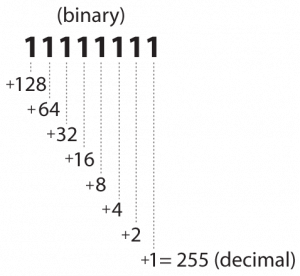
To use in computing, those numbers are converted into binary. How do you do that? Well, as you probably already know, the numbers we regularly use are written using place-value in base 10. That means that each digit in a number has a different value based on its spot in the number, and the places get 10 times larger as you move to the left in the number. In binary, however, the places have different values. Instead of growing 10 times larger, each place in a binary number is twice as large as the one to its right. The only digits you can use in binary are 0 and 1– which correspond to turning a signal on or leaving it off.

But if you want to write in binary, you don’t have to do all the conversions yourself. Just use this handy translator, and you’ll be writing in binary 01101001 01101110 00100000 01101110 01101111 00100000 01110100 01101001 01101101 01100101 00101110

Next up, check out this video about a classic number problem: the Infinite Hotel Paradox. If you find infinity baffling, as many mathematicians do, this video may help you understand it a little better. (Or add to the bafflingness– which is just how infinity works, I guess.)

I especially like how despite how many more people get rooms at the hotel (so long as the number of people is countable!), the hotel manager doesn’t make more money…

Speaking of videos, how about a math video contest? MATHCOUNTS is hosting a video contest for 6th-8th grade students. To participate, teams of four students and their teacher coach choose a problem from the MATHCOUNTS School Handbook and write a screenplay based on that problem. Then, make a video and post it to the contest website. The winning video is selected by a combination of students and adult judges– and each member of the winning team receives a college scholarship!

Here’s last year’s first place video.

01000010 01101111 01101110 00100000 01100001 01110000 01110000 01100101 01110100 01101001 01110100 00100001  (That means, Bon appetit!)

Linking Newspaper Rings, Pascal’s Colors, and Poetry of Math

Welcome to this week’s Math Munch!

Here’s something that sounds impossible: turn a single newspaper page into two rings, linked together, using only scissors and folding. No tape, no glue– just folding and a few little cuts.

Want to know how to do it? Check out this video by Mariano Tomatis:

On his website, Mariano calls himself the “Wonder Injector,” a “writer of science with the mission of the magician.” And that video certainly looked like magic! I wonder how the trick works…

Mariano’s website is full of fun videos involving mathe-magical tricks. I like watching them, being completely baffled, and then figuring out how the trick works. Here’s another one that I really like, about a fictional plane saved from crashing. It’s a little creepy.

How does this trick work???

Next up is one of my favorite number pattern — Pascal’s Triangle. Pascal’s Triangle appears all over mathematics– from algebra to combinatorics to number theory.

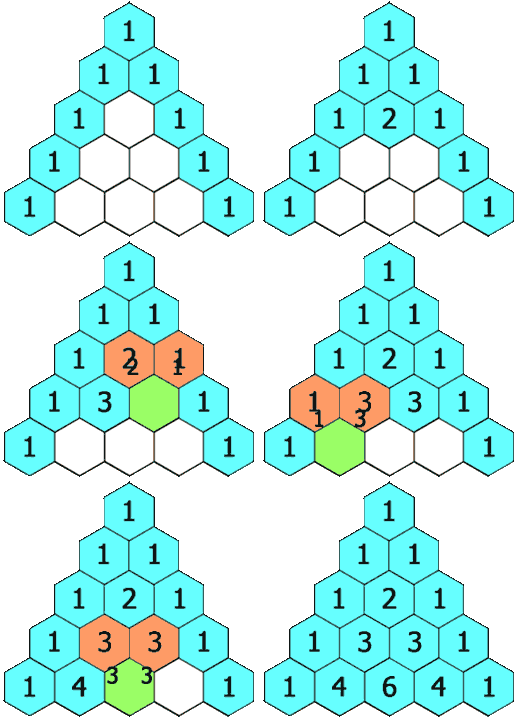
Pascal’s Triangle always starts with a 1 at the top. To make more rows, you add together two numbers next to each other and put their sum between them in the row below. For example, see the two threes beside each other in the fourth row? They add to 6, which is placed between them in the fifth row.

Pascal’s Triangle is full of interesting patterns (what can you find?)– but my favorite patterns appear when you color the numbers according to their factors.

That’s just what Brent Yorgey, computer programmer and author of the blog “The Math Less Travelled,” did! Here’s what you get if you color all of the numbers that are multiples of 2 gray and all of the numbers that aren’t multiples of 2 blue.

Recognize that pattern? It’s a Sierpinski triangle fractal!

If you thought that was cool, check out this one based on what happens if you divide all the numbers in the triangle by 5. The multiples of 5 are gray; the numbers that leave a remainder of 1 when divided by 5 are blue, remainder 2 are red, remainder 3 are yellow, and remainder 4 are green. And here’s one based on what happens if you divide all the numbers in the triangle by 6.

See the yellow Sierpinski triangle below the blue, red, green, and purple pattern? Why might the pattern for multiples of two appear in the triangle colored based on multiples of 6?

If you want to learn more about how Brent made these images and want to see more of them, check out his blog post, “Visualizing Pascal’s Triangle Remainders.”

Finally, I just stumbled across this collection of mathematical poems written by students at Arcadia University, in a class called “Mathematics in Literature.” They’re the result of a workshop led by mathematician and poet Sarah Glaz, who I met this summer at the Bridges Mathematical Art Conference. Sarah gave the students this prompt:

Step1: Brainstorm three recent school or other situations in your

present life – you can just write a few words to reference them.

Step 2: List 10-20 mathematical words you’ve used in class in the
past month.

Step 3: Write about one of the previous situations using as many
of these words as possible. Try to avoid referencing the situation
directly. Write no more than seven words per line.

Here’s one that I like:

ASPARAGUS, by Sarah Goldfarb

An infinity of hunger within me
Dividing a bunch of green
Snap and sizzle,
Green parentheses in a pan
The aromatic property
Simplifying my want
Producing a need
Each fraction of a second
Dragging its feet impatiently as I wait
And when it is distributed on my plate
It is only a moment before zero
Units of nourishment remain.

Maybe you’ll try writing a poem of your own! If you do, we’d love to see it.

Bon appetit!

Virtual Hyenas, Markov Chains, and Random Knights

Welcome to this week’s Math Munch!

It’s amazing how a small step can lead to a chain reaction of adventure.

Arend Hintze

Arend Hintze

Recently a reader named Nico left a comment on the Math Munch post where I shared the game Loops of Zen. He asked why the game has that name. Curious, I looked up Dr. Arend Hintze, whose name appears on the game’s title page. This led me to Arend’s page at the Adami Lab at Michigan State University. Arend studies how complex systems—especially biological systems—evolve over time.

Here is a video of one of Arend’s simulations. The black and white square is a zebra. The yellow ones are lions, the red ones are hyenas, and guess who’s hungry?

Arend’s description of the simulation is here. The cooperative behavior in the video—two hyenas working together to scare away a lion—wasn’t programmed into the simulation. It emerged out of many iterations of systems called Markov Brains—developed by Arend—that are based upon mathematical structures called Markov chains. More on those in a bit.

You can read more about how Arend thinks about his multidisciplinary work on biological systems here. Also, it turns out that Arend has made many more games besides Loops of Zen. Here’s Blobs of Zen, and Ink of Zen is coming out this month! Another that caught my eye is Curve, which reminds me of some of my favorite puzzle games. Curve is still in development; here’s hoping we’ll be able to play it soon.

Arend has agreed to do an interview with Math Munch, so share your questions about his work, his games, and his life below!

Eric Czekner

Eric Czekner

Arend’s simulations rely on Markov chains to model animal behavior. So what’s a Markov chain? It’s closely related to the idea of a random walk. Check out this video by digital artist, musician, and Pure Data enthusiast Eric Czekner. In the video, Eric gives an overview of what Markov chains are all about and shows how he uses them to create pieces of music.

On this page, Eric describes how he got started using Markov chains to make music, along with several of his compositions. It’s fascinating how he captures the feel of a song by creating a mathematical system that “generates new patterns based on existing probabilities.”

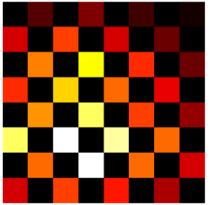
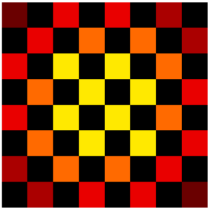
Now there’s a big idea: exploring something randomly can capture structures that might be hard to perceive otherwise. Here’s one last variation on the Markov chain theme that involves a pure math question. This blog post ponders the question: what happens when a knight takes a random walk—or random trot?—on a chessboard? It includes some colorful images of chessboards along the way.

How likely it is that a knight lands on each square after five moves, starting from b1.

How likely it is that a knight lands on each square after five moves, starting from b1.

The probabili

How likely it is that a knight lands on each square after 200 moves, starting from b1.

The blogger—Leonid Kovalev—shows in his analysis what happens in the long run: the number of times a knight will visit a square will be proportional to the number of moves that lead to that square. For instance, since only two knight moves can reach a corner square while eight knight moves can reach a central square, it’s four times as likely that a knight will finish on a central square after a long, long journey than on a corner square. This idea works because moving a knight around a chessboard is a “reversible Markov chain”—any path that a knight can trace can also be untraced. The author also wrote a follow-up post about random queens.

It’s amazing the things you can find by chaining together ideas or by taking a random walk. Thanks for the inspiration for this post, Nico. Keep those comments and questions coming, everyone—we love hearing from you.

Bon appetit!