Author Archives: Anna Weltman

Coasts, Clueless Puzzles, and Beach Math Art

summerAh, summertime. If it’s as hot where you are as it is here in New York, I bet this beach looks great to you, too. A huge expanse of beach all to myself sounds wonderful… And that makes me wonder – how much coastline is there in the whole world?

Interestingly, the length of the world’s coastline is very much up for debate. Just check out this Wikipedia page on coastlines, and you’ll notice that while the CIA calculates the total coastline of the world to be 356,000 kilometers, the World Resources Institute measures it to be 1,634,701! What???

Measuring the length of a coastline isn’t as simple as it might seem, because of something called the Coastline Paradox. This paradox states that as the ruler you use to measure a coastline gets shorter, the length of the coastline gets longer – so that if you used very, very tiny ruler, a coastline could be infinitely long! This excellent video by Veritasium explains the problem very well:

2000px-KochFlakeAs Vertitasium says, many coastlines are fractals, like the Koch snowflake shown at left – never-ending, infinitely complex patterns that are created by repeating a simple process over and over again. In this case, that simple process is the waves crashing against the shore and wearing away the sand and rock. If coastlines can be infinitely long when you measure them with the tiniest of rulers, how to geographers measure coastline? By choosing a unit of measurement, making some approximations, and deciding what is worth ignoring! And, sometimes, agreeing to disagree.

Need something to read at the beach, and maybe something puzzle-y to ponder? Check out this interesting article by four mathematicians and computer scientists, including James Henle, a professor in Massachusetts. They’ve invented a Sudoku-like puzzle they call a “Clueless Puzzle,” because, unlike Sudoku, their puzzle never gives any number clues.

Clueless puzzleHow does this work? These puzzles use shapes instead of numbers to provide clues. Here’s an example from the paper: Place the numbers 1 through 6 in the cells of the figure at right so that no digit appears more than once in a row or column AND so that the numbers in each region add to the same sum. The paper not only walks you through the solution to this problem, but also talks about how the mathematicians came up with the idea for the puzzles and studied them mathematically. It’s very interesting – I recommend you read it!

Finally, if you’re not much of a beach reader, maybe you’d like to make some geometrically-inspired beach art! Check out this land art by artist Andy Goldsworthy:

Andy Goldsworthy 1
Andy Goldsworthy 2

Or make one of these!

Happy summer, and bon appetit!

Natural Geometry, Hex, and Sacred Geometry

Welcome to this week’s Math Munch!

People can be skeptical when some mathematicians and scientists talk about mathematics as the “mysterious code” that “underpins the world.” I mean, the natural world is so chaotic! But then you run across this:

bees on honeycellsHoneycombs are remarkably symmetrical. Each little cell is a perfect hexagon – and all bees build this way. Why? Because of mathematics.

NPR’s Robert Krulwich wrote about this in a recent post on his excellent science blog, Krulwich Wonders. I think the explanation is an amazing example of how the natural world often follows mathematical rules perfectly. Thousands of years ago, an ancient Roman scholar named Marcus Terrentius Varro conjectured that the hexagon is the shape that most efficiently breaks flat space up into little units – making honeycombs that hold the most amount of honey while using the least amount of wax. He couldn’t prove his idea, though. It remained a conjecture until 1999 when a mathematician named Thomas Hales finally proved it! You can read a summary of his proof here. Or, watch this snippet about bees and their hexagonal honeycombs from the BBC.

Want to learn more about hexagons? Here’s a website devoted entirely to the geometry of hexagons!

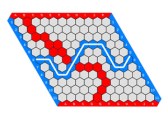
Hex-board-11x11-(2)Speaking of hexagons, have you ever played the game Hex? It’s a two-player game in which players take turns claiming hexagons on a hexagonally-tiled board, trying to create a connected path from one end of the board to the other. You can play it by hand using a sheet of hexagon graph paper, or you can play against a computer online, here. Enjoy!

WIKI-Sacred-Geometry-e1325031356204

This stained-glass church window is an example of sacred geometry.

Bees aren’t the only animals who use symmetry in the things they make. Humans do, too – especially for spiritual purposes.

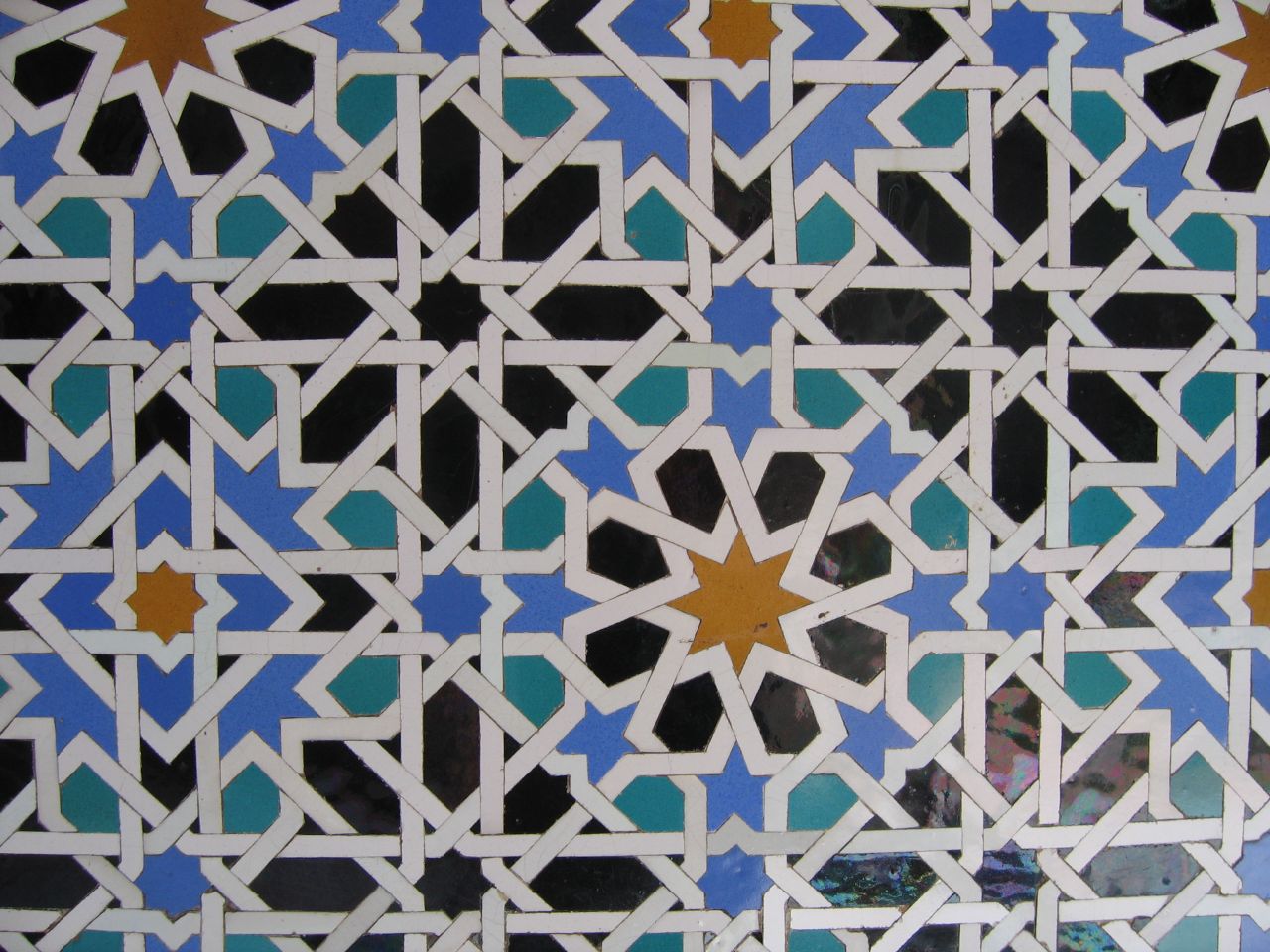
An Islamic tiling.

An Islamic tiling.

Humans have been in awe of the symmetrical laws that seem to govern the universe for thousands of years, and they’ve developed a type of artwork called  Sacred Geometry, a way of thinking that gives spiritual significance to geometric shapes. Sacred geometry can be found in religious artwork from many different cultures, and often uses tilings of regular polygons, the Platonic solids, and interlocking circles arranged in symmetric patterns.

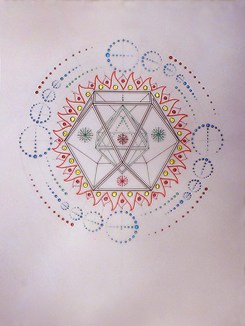
snub cubeMathematical artist Mark Golding has been making modern works of sacred geometry art of his own. His works are inspired by mandalas, Hindu and Buddhist spiritual symbols that represent the symmetry in the universe. The image to the right is called, “Inner Relationships.” It shows an octahedron, one of the Platonic solids, nested inside of a snub cube, which is made by chopping off the corners of a cube. I love how it demonstrates the symmetric relationships between these two shapes. If you’d like to see more of his work, check out this online gallery.

Bon appetit!

P.S. – You may have noticed a new link off to the right at the top of the page. The Math Munch Team is proud to announce that our TEDx NYED talk has been posted online!

We’re honored to have been invited to participate in this event with many other creative and accomplished educators – and we encourage you to watch the other talks from the day, too.

P.P.S. And if you’re in the mood for some more TED-style math inspiration, you might enjoy these miniTED talks about math by some of Justin’s seventh graders.

World’s Oldest Person, Graphing Challenge, and Escher Sketch

265282-jiroemon-kimura-the-world-s-oldest-living-man-celebrated-his-115th-birOn April 19th, Jiroeman Kimura celebrated his 116th birthday. He was – and still is – the world’s oldest person, and the world’s longest living man – ever. (As far as researchers know, that is. There could be a man who has lived longer that the public doesn’t know about.) The world’s longest living woman was Jeanne Calment, who lived to be 122 and a half!

Most people don’t live that long, and, obviously, only one person can hold the title of “Oldest Person in the World” at any given time. So, you may  be wondering… how often is there a new oldest person in the world? (Take a few guesses, if you like. I’ll give you the answer soon!)

stackSome mathematicians were wondering this, too, and they went about answering their question in the way they know best: by sharing their question with other mathematicians around the world! In April, a mathematician who calls himself Gugg, asked this question on the website Mathematics Stack Exchange, a free question-and-answer site that people studying math can use to share their ideas with each other. Math Stack Exchange says that it’s for “people studying math at any level.” If you browse around, you’ll see mathematicians asking for help on all kinds of questions, such as this tricky algebra problem and this problem about finding all the ways to combine coins to get a certain amount of money.  Here’s an entry from a student asking for help on trigonometry homework. You might need some specialized math knowledge to understand some of the questions, but there’s often one that’s both interesting and understandable on the list.

Anyway, Gugg asked on Math Stack Exchange, “How often does the oldest person in the world die?” and the community of mathematicians around the world got to work! Several mathematicians gave ways to calculate how often a new person becomes the oldest person in the world. You can read about how they worked it out on Math Stack Exchange, if you like, or on the Smithsonian blog – it’s a good example of how people use math to model things that happen in the world. Oh, and, in case you were wondering, a new person becomes the world’s oldest about every 0.65 years. (Is that around what you expected? It was definitely more often than I expected!)

advanced 4

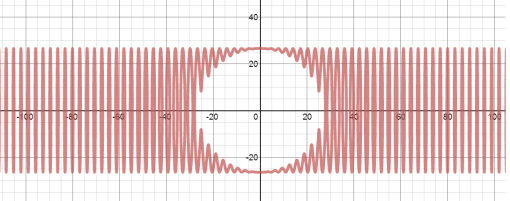
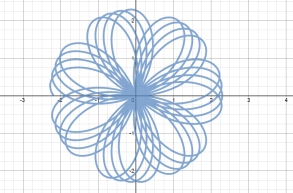
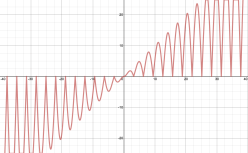
Next, check out this graph! Yes, that’s a graph – there is a single function that you can make so that when you graph it, you get that.  Crazy – and beautiful! This was posted by a New York City math teacher named Michael Pershan to a site called Daily Desmos, and he challenges you to figure out how to make it!  (He challenged me, too. I worked on this for days.)

qod0nxgctfMichael made this graph using an awesome free, online graphing program called Desmos. Michael and many other people regularly post graphing challenges on Daily Desmos. Some of them are very difficult (like the one shown above), but some are definitely solvable without causing significant amounts of pain. They’re marked with levels “Basic” and “Advanced.” (See if you can spot contributions from a familiar Math Munch face…)

30a2

Here are more that I think are particularly beautiful. If you’re feeling more creative than puzzle-solvey, try making a cool graph of your own! You can submit a graphing challenge of your own to Daily Desmos.

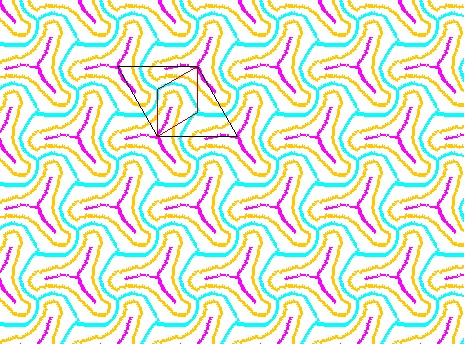
escher 3If you’ve got the creative bug, you could also check out a new MArTH tool that we just found called Escher Web Sketch. This tool was designed by three Swiss mathematicians, and it helps you to make intricate tessellations with interesting symmetries – like the ones made by the mathematical artist M. C. Escher. If you like Symmetry Artist and Kali, you’ll love this applet.

Be healthy and happy! Enjoy graphing and sketching! And, bon appetit!