Welcome to this week’s Math Munch!
Take a look at this beautiful line drawing: 

Jason Padgett
This is called, “Towards Pi 3.141552779 Hand-Drawn,” and it’s by mathematician and artist Jason Padgett. Jason wasn’t always a mathematician or an artist. In fact, it was only after a severe head injury that Jason suddenly found that he “saw” fractals and other geometric images in mathematical and scientific ideas. Jason is interested in limits. The picture above, for example, is Jason’s artistic interpretation of a limit that approaches pi. If you draw a circle with radius 1 and make polygons inside of it using secants for their sides, the areas of the polygons get closer and closer to pi as the number of sides increases – but always stay less than pi. If you take that same circle and make polygons around it using tangents for their sides, the areas of the polygons also get closer and closer to pi as the number of sides increases – but always stay larger than pi. Jason tried to draw the way that those sequences “trap pi” in this picture.
I think it’s really amazing that Jason draws these by hand. Here’s some more of Jason’s artwork, and a video of Jason drawing “Towards Pi 3.141552779 Hand-Drawn.”
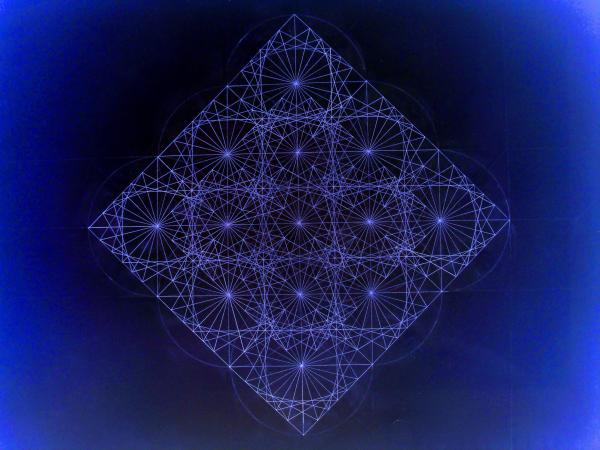 Space Time Sine Cosine and Tangent Waves |
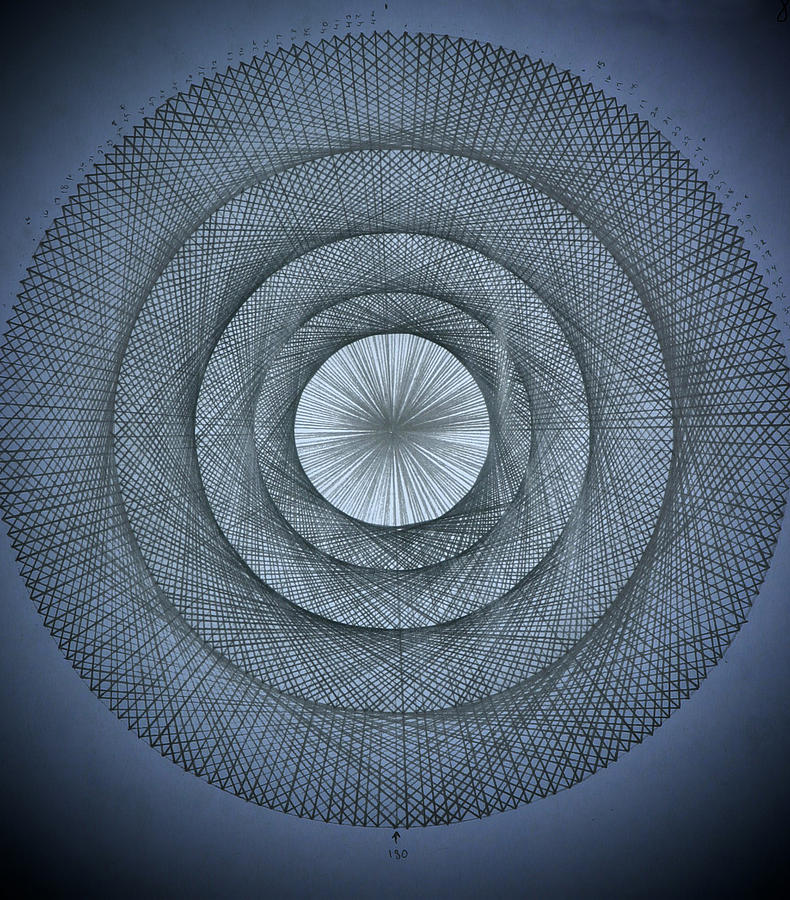 The Power of Pi |
 Wave Particle Duality |
Next, did you like Sondra Eklund’s sweater from last week? Did it inspire you to do some mathematical knitting of your own? If so, check out the website Woolly Thoughts.

 Woolly Thoughts is run by “mathekniticians” Pat Ashforth and Steve Plummer who love to do, teach, and share math with others through their knitting. They’ve designed many beautiful and mathematical afghan and pillow patterns, and some patterns for interesting math toys. Here are some of my favorites:
 The “Finite Field” afghan is a color-coded addition table using binary. |
 The “Fibo-Optic” afghan is made to look like a flying cube using side-lengths based on the Fibonacci sequence. |
 Finally, one of the programs featured in the new Math Art Tools link is TinkerCAD. TinkerCAD is a program you can use to make 3D designs – just because, or to print out with a 3D printer!
TinkerCAD has three parts: Discover, Learn, and Design. In the Discover section, you can browse things that other tinkerers have made and download them to print yourself. There are some really cool things out there, like this Father’s Day mug made by Fabricatis and this sail boat made by Klyver Boys.


Next, in the Learn section, you can play different “quests” to hone your TinkerCAD skills. Finally, in the Design section, you can make your own thing! TinkerCAD is really intuitive to use. The TinkerCAD tutorial video is really helpful if you want to learn how to use TinkerCAD – as are the quests.
Stay tuned for pictures of some TinkerCAD things made by friends of Math Munch!
Bon appetit!


 Math Munch