Author Archives: Anna Weltman

Pi Digits, Pi-oetry, and Anti-Pi

This week’s Math Munch is brought to you by the number pi, because Wednesday (March 14th) is Pi Day!
 

Pi is an irrational number – meaning that it cannot be written as a ratio of integers.  Consequently, it’s decimal expansion goes on and on forever without any repeats.  But, that doesn’t mean people haven’t tried to list as many digits of pi as they can!  This site lists the first million digits of pi.  This site sings many of them – the tune is rather catchy.  And here you can search for strings of numbers in the decimal expansion for pi!  I searched for my birthday, 10/01/87 – it occurs 885,826 digits after the decimal point!

Remember the alphametics puzzle creator, Mike Keith?  Well, he writes poems and short stories in what he calls “Pilish,” in which the lengths of successive words represent successive digits of pi.  Here’s an explanation of the different forms of Pilish.  Mike holds the world record for the longest and second longest texts written in Pilish – they are his book, Not A Wake, and a short story, “Cadaeic Cadenza.”

Finally, as we celebrate pi on Wednesday, we should do so with some skepticism.  In the opinion of some mathematicians, pi is the wrong constant.  Inspired by this article by mathematician Bob Palais, some people have been speaking up in favor of the constant tau, which is double pi.  Here’s our favorite Vi Hart on the issue of pi:

You’ve heard what pi sounds like.  Want to know what tau sounds like?

Bon appetit!

Cubes, Curves, and Geometric Romance

Welcome to this week’s Math Munch!

If you like Rubik’s Cubes, then check out Oskar van Deventer’s original Rubik’s cube-type puzzles!  Oskar is a Dutch scientist who has been designing puzzles since he was 12 years old.  He makes many of his puzzles using a 3D printer, with a company called Shapeways.

Oskar has posted a number of videos of himself explaining his creations.  Here’s him demonstrating the Oh Cube:

Next, take a look at these beautiful curved-crease sculptures made by MIT mathematician and origami artist Erik Demaine and his father, Martin Demaine.  Erik and Martin make these hyperbolic paraboloid structures by folding rings of creases in a circular piece of paper.  They have exhibits of their artwork in various museums and galleries, including in the MoMA permanent collection and the Guided By Invoices gallery in Chelsea, NYC.  So, if you live in NYC, then you could go see these!

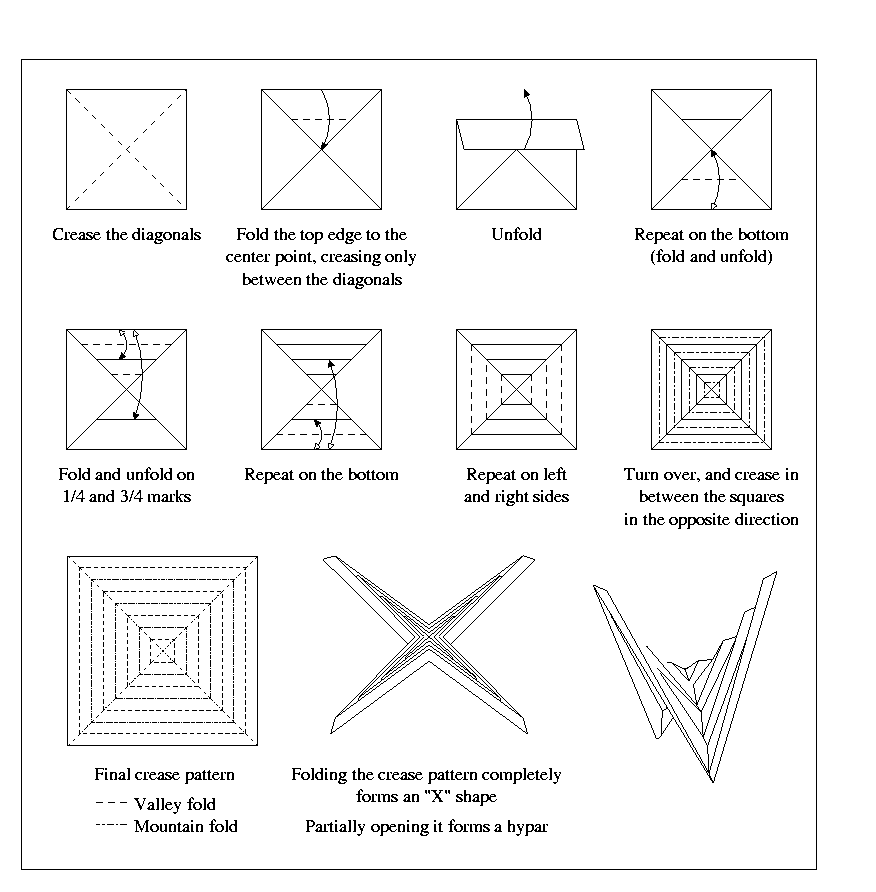
Want to learn how to fold your own hyperbolic paraboloid?  Erik has these instructions for making one out of a square piece of paper with straight folds.

Finally, here is a wonderful video made of Norton Juster’s picture book, The Dot and the Line.  Enjoy!

Bon appetit!

Noodles, Flowsnake, and Symmetry

Welcome to this week’s Math Munch!

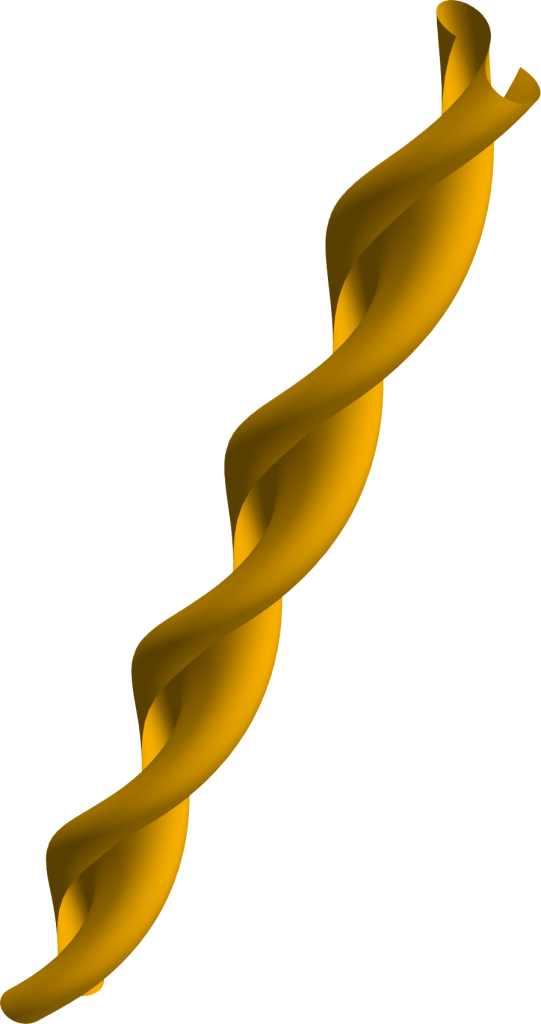
Gemelli, by Sander Huisman

Gemelli, by Sander Huisman

How much do you like pasta?  Well, these mathematicians and scientists from around the world like pasta so much that they’ve been studying its shape mathematically!  Check out this New York Times article about Sander Huisman, a graduate student in physics from the Netherlands, and Marco Guarnieri and George L. Legendre, two architects from London, who have all taken up making graphs of and equations for pasta shapes.  Sander posts his pasta-graphs on his blog.  Legendre wrote this book about math and pasta, called Pasta By Design.  Legendre has even invented a new type of pasta, shaped like a Mobius strip (see last week’s Math Munch for lots of cool things with Mobius strips), which he named after his baby daughter, Ioli!

Some of Legendre’s pasta plots

Next, here comes the flowsnake.  Wait – don’t run away!  The flowsnake is not a terrifying monster, despite it’s ominous name.  It is a space-filing curve, meaning that the complete curve covers every single point in a part of two-dimensional space.  So if you were to try to draw a flowsnake on a piece of paper, you wouldn’t be able to see any white when you were done.  It’s named flowsnake because it resembles a snowflake.

The flowsnake curve

A single piece of the flowsnake curve.

Units of flowsnake fit together like puzzle pieces to fill the plane

Finally, check out this awesome online symmetry-sketcher, called Symmetry Artist!  Here, you can make doodles of all kinds and then choose how you want to reflect and rotate them.  Fun!

Bon appetit!