Author Archives: Anna Weltman

Origami Stars, Tessellation Stars, and Chaotic Stars

Welcome to this week’s star-studded Math Munch!
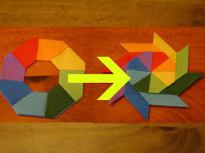
downloadModular origami stars have taken the school I teach in by storm in recent months! We love making them so much that I thought I’d share some instructional videos with you. My personal favorite is this transforming eight-pointed star. It slides between a disk with a hole the middle (great for throwing) and a gorgeous, pinwheel-like eight-pointed star. Here’s how you make one:

Another favorite is this lovely sixteen-pointed star. You can make it larger or smaller by adding or removing pieces. It’s quite impressive when completed and not that hard to make. Give it a try:
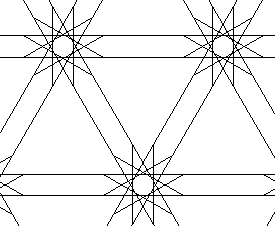
type6thContinuing on our theme of stars, check out these beautiful star tessellations. They come from a site made by Jim McNeil featuring oh-so-many things you can do with polygons and polyhedra. On this page, Jim tells you all about tessellations, focusing on a category of tessellations called star and retrograde tessellations.
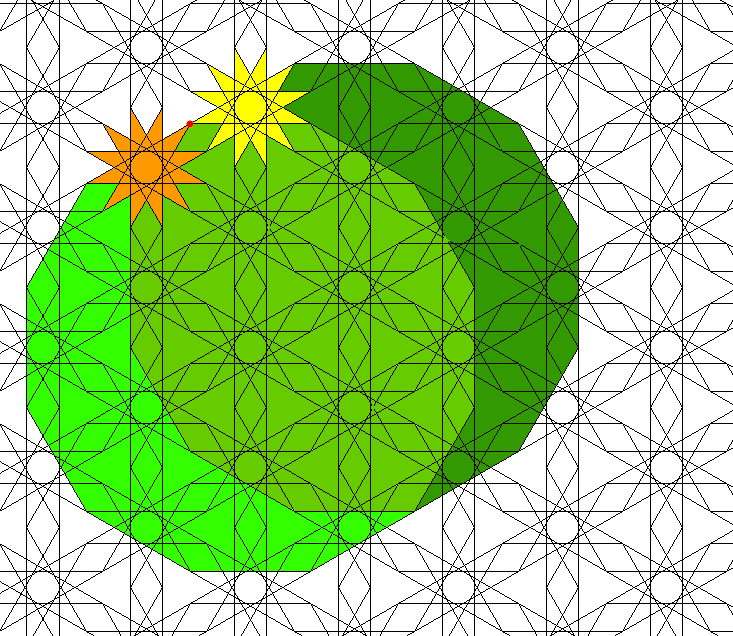
type3b400px-Tiling_Semiregular_3-12-12_Truncated_Hexagonal.svgTake, for example, this beautiful star tessellation that he calls the Type 3. Jim describes how one way to make this tessellation is to replace the dodecagons in a tessellation called the 12.12.3 tessellation (shown to the left) with twelve-pointed stars. He uses the 12/5 star, which is made by connecting every fifth dot in a ring of twelve dots. Another way to make this tessellation is in the way shown above. In this tessellation, four polygons are arranged around a single point– a 12/5 star, followed by a dodecagon, followed by a 12/7 star (how is this different from a 12/5 star?), and, finally, a 12/11-gon– which is exactly the same as a dodecagon, just drawn in a different way.

I think it’s interesting that the same pattern can be constructed in different ways, and that allowing for cool shapes like stars and different ways of attaching them can open up crazy new worlds of tessellations! Maybe you’ll want to try drawing some star tessellations of your own after seeing some of these.
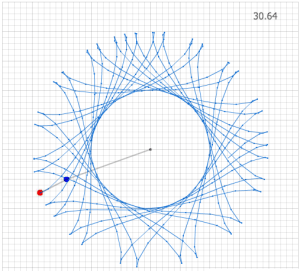
Screenshot 2014-05-12 10.48.46Finally, to finish off our week of everything stars, check out the star I made with this double pendulum simulator.  What’s so cool about the double pendulum? It’s a pendulum– a weight attached to a string suspended from a point– with a second weight hung off the bottom of the first. Sounds simple, right? Well, the double pendulum actually traces a chaotic path for most sizes of the weights, lengths of the strings, and angles at which you drop them. This means that very small changes in the initial conditions cause enormous changes in the path of the pendulum, and that the path of the pendulum is not a predictable pattern.

Using the simulator, you can set the values of the weights, lengths, and angles and watch the path traced on the screen. If you select “star” under the geometric settings, the simulator will set the parameters so that the pendulum traces this beautiful star pattern. Watch what happens if you wiggle the settings just a little bit from the star parameters– you’ll hardly recognize the path. Chaos at work!

Happy star-gazing, and bon appetit!
Truchet, Truchet, Truchet!

Welcome to this week’s Math Munch!

Why all the excitement about Truchet? And what (or who?) is Truchet, anyway? Great questions, both. I only recently learned about the fascinating world of Truchet and his tiles. I first got hooked on the beautiful patterns you can make with Truchet tiles. So, read on– and maybe you’ll get hooked, too.

Truchet tiling 1

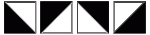
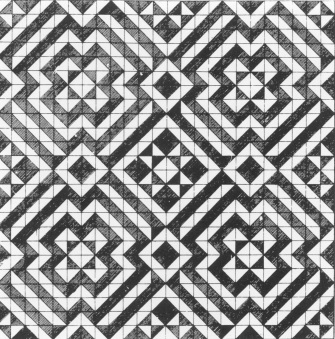
This beautiful pattern is made out of Truchet tiles, deceptively simple square pieces that can fit together to make patterns with enormous complexity. There’s really just one Truchet tile– the square with a triangular half of it colored it– but it can be oriented in four ways.

Truchet tileThere are ten different ways to put two next to each other– or, at least, that’s what Sebastien Truchet discovered when he started working with these tiles way back in the late 1600s. Truchet was a scientist and inventor, but he also dabbled in math. He became interested in the ways of combining these simple tiles while looking at decorations made from ceramic tiles. He started trying to figure out all the different patterns he could make– first with two tiles, then with sequences of them– and soon realized that he was the first person to study this! So, he wrote a little book about his discoveries, which he called “Memoir sur les Combinasions.”

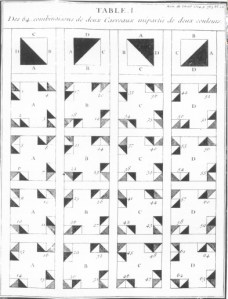
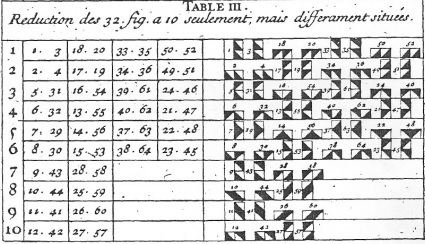
Truchet's chartTranslations of this book are hard to come by (unless you read French), but I found a great site that shows all the images Truchet included in the book. One of my favorites is this chart, in which Truchet shows all the possible ways of combining two tiles. Maybe you’ve noticed that there are way more than ten different combinations on this chart. That’s because this chart is just Truchet brainstorming– drawing everything he can think of. In a later chart, Truchet groups pairs of tiles that he thinks are the same in some really basic way.

Can you see how Truchet grouped the tiles in this chart? Each row corresponds to one of his ten different tiles. Do his categories make sense?

Truchet's equivalences 2Truchet tiling 5Want to try making a beautiful Truchet tiling of your own? You could just start drawing (maybe graph paper would be useful). Or you could try this great Scratch program! You can have it make a random Truchet tiling. Or, you can use a four-digit code, using only the digits 1 through 4, to tell it what pattern to make. Each digit corresponds to a tile with a dark triangle in a different corner. I had fun thinking of a code and then trying to guess what pattern the program would make. Or, you could try to figure out the code for one of your favorite of Truchet’s patterns!

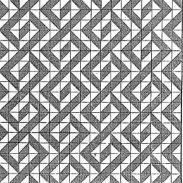
In recent years, mathematicians have starting experimenting with Truchet tiles in new ways. The mathematician and scientist Cyril Stanley Smith was one of the first to do this. He began to introduce curved lines into the tiles and to place them randomly, instead of according to a pattern. These changes make some really interesting results– like this maze made from Truchet-like tiles.

Want to make your own maze from tiles inspired by Truchet? Check out this site with instructions for how to make Truchet mazes! You can use a computer or a more low-tech tool to create an intricate, unique maze.

Bon appetit!


Making Pi, Transcending Pi, and Cookies

Welcome to this week’s Math Munch– and happy Pi Day!

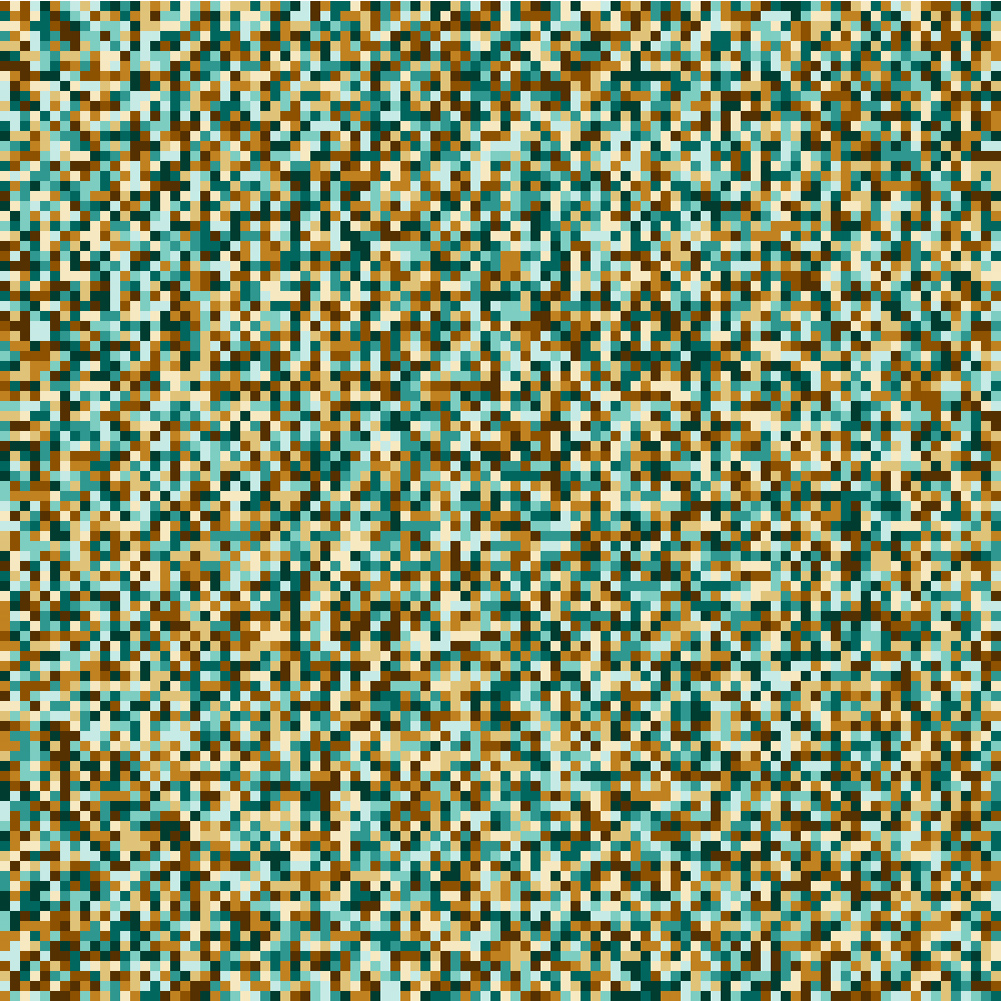
What does pi look like? The first 10,000 digits of pi, each digit 0 through 9 assigned a different color.

You probably know some pretty cool things about the number pi. Perhaps you know that pi has quite a lot to do with circles. Maybe you know that the decimal expansion for pi goes on and on, forever and ever, without repeating. Maybe you know that it’s very likely that any string of numbers– your birthday, phone number, all the birthdays of everyone you know listed in a row, followed by all their phone numbers, ANYTHING– can be found in the decimal expansion of pi.

But did you know that pi can be approximated by dropping needles on a piece of paper? Well, it can! If you drop a needle again and again on a lined piece of paper, and the needle is the same length as the distance between the lines, the probably that the needle lands on a line is two divided by pi. This experiment is called Buffon’s needle, after the French naturalist Buffon.

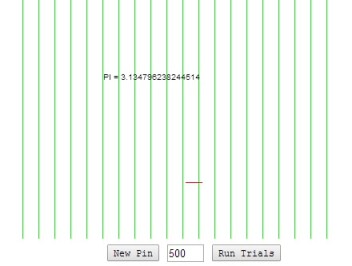
If the angle the needle makes with the lines is in the gray area (like the red needle’s angle is), it will cross the line. If the angle isn’t, it won’t. The possible angles trace out a circle. The closer the center of the needle (or center of the circle) is to the line, the larger the gray area– and the higher the probability of the needle hitting the line.

This may seem strange to you– but if you think about how the needle hitting a line has a lot to do with the distance between the middle of the needle and the nearest line and the angle it makes with the lines, maybe you’ll start to think about circles… and then you’ll get a clue about the connection between this experiment and pi. Working out this probability exactly requires some pretty advanced mathematics. (Feeling ambitious? Read about the calculation here.) But, you can get some great experimental results using this Buffon’s needle applet.

Click on the picture to try the applet.

Click on the picture to try the applet.

I had the applet drop 500 needles. Then, the applet used the fact that the probability of the needle hitting a line should be two divided by pi and the probability it measured to calculate an approximation for pi. It got… well, you can see in the picture. Pretty close, right?

Here’s another thing you might not know: pi is a transcendental number. Sounds trippy– but, like some other famous numbers with letter names, like e, pi can never be the solution to an algebraic equation involving whole numbers. That means that no matter what equation you give me– no matter how large the exponent, how many negatives you toss in, how many times you multiply or divide by a whole number– pi will never, ever be a solution. Maybe this doesn’t sound amazing to you. If not, check out this video from Numberphile about transcendental numbers. Numbers like pi and e don’t do mathematical things we’re used to numbers doing… and it’s pretty weird.

Still curious about transcendental numbers? Here’s a page listing the fifteen most famous transcendental numbers. My favorite? Definitely the fifth, Liouville’s number, which has a 1 in each consecutive factorial numbered place.

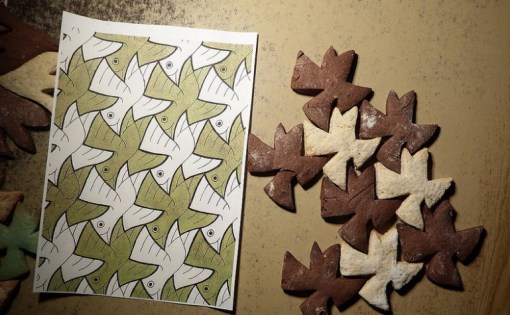
Escher cookies 1Finally, maybe you don’t like pi. Maybe you like cookies instead. Lucky for you, you can do many mathematical things with cookies, too. Like make cookie tessellations! This mathematical artist and baker made cookie cutters in the shapes of tiles from Escher tessellations and used them to make mathematical cookie puzzles. Beautiful, and certainly delicious.

If you happen to have a 3D printer, you can make your own Escher cookie cutters. Here’s a link to print out the lizard cutter. If you don’t have a 3D printer, you could try printing out a 2D image of an Escher tessellation and tracing a tile onto a sheet of paper. Cut out the tile, roll out your dough, and slice around the outside of the tile to make your cookies. If you do it right, you shouldn’t have to waste any dough…

Here’s hoping you eat some pi or cookies on pi day! Bon appetit!