Author Archives: Justin Lanier

Virtual Hyenas, Markov Chains, and Random Knights

Welcome to this week’s Math Munch!

It’s amazing how a small step can lead to a chain reaction of adventure.

Arend Hintze

Arend Hintze

Recently a reader named Nico left a comment on the Math Munch post where I shared the game Loops of Zen. He asked why the game has that name. Curious, I looked up Dr. Arend Hintze, whose name appears on the game’s title page. This led me to Arend’s page at the Adami Lab at Michigan State University. Arend studies how complex systems—especially biological systems—evolve over time.

Here is a video of one of Arend’s simulations. The black and white square is a zebra. The yellow ones are lions, the red ones are hyenas, and guess who’s hungry?

Arend’s description of the simulation is here. The cooperative behavior in the video—two hyenas working together to scare away a lion—wasn’t programmed into the simulation. It emerged out of many iterations of systems called Markov Brains—developed by Arend—that are based upon mathematical structures called Markov chains. More on those in a bit.

You can read more about how Arend thinks about his multidisciplinary work on biological systems here. Also, it turns out that Arend has made many more games besides Loops of Zen. Here’s Blobs of Zen, and Ink of Zen is coming out this month! Another that caught my eye is Curve, which reminds me of some of my favorite puzzle games. Curve is still in development; here’s hoping we’ll be able to play it soon.

Arend has agreed to do an interview with Math Munch, so share your questions about his work, his games, and his life below!

Eric Czekner

Eric Czekner

Arend’s simulations rely on Markov chains to model animal behavior. So what’s a Markov chain? It’s closely related to the idea of a random walk. Check out this video by digital artist, musician, and Pure Data enthusiast Eric Czekner. In the video, Eric gives an overview of what Markov chains are all about and shows how he uses them to create pieces of music.

On this page, Eric describes how he got started using Markov chains to make music, along with several of his compositions. It’s fascinating how he captures the feel of a song by creating a mathematical system that “generates new patterns based on existing probabilities.”

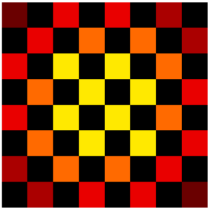
Now there’s a big idea: exploring something randomly can capture structures that might be hard to perceive otherwise. Here’s one last variation on the Markov chain theme that involves a pure math question. This blog post ponders the question: what happens when a knight takes a random walk—or random trot?—on a chessboard? It includes some colorful images of chessboards along the way.
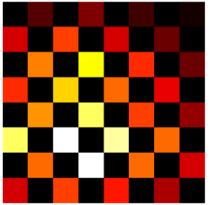
How likely it is that a knight lands on each square after five moves, starting from b1.

How likely it is that a knight lands on each square after five moves, starting from b1.

The probabili

How likely it is that a knight lands on each square after 200 moves, starting from b1.

The blogger—Leonid Kovalev—shows in his analysis what happens in the long run: the number of times a knight will visit a square will be proportional to the number of moves that lead to that square. For instance, since only two knight moves can reach a corner square while eight knight moves can reach a central square, it’s four times as likely that a knight will finish on a central square after a long, long journey than on a corner square. This idea works because moving a knight around a chessboard is a “reversible Markov chain”—any path that a knight can trace can also be untraced. The author also wrote a follow-up post about random queens.

It’s amazing the things you can find by chaining together ideas or by taking a random walk. Thanks for the inspiration for this post, Nico. Keep those comments and questions coming, everyone—we love hearing from you.

Bon appetit!
A Periodic Table, Linkages, and Dance Squared

Welcome to this week’s Math Munch!

Screen Shot 2013-11-14 at 10.14.36 PM

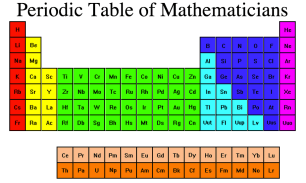
I like finding new ways of organizing information. That’s part of why I enjoy this Periodic Table of Mathematicians.

The letters in the table are the abbreviations of the chemical elements—like gold, helium, and iron—that are found on the usual periodic table. With a little creativity, they can also be abbreviations for the names of a bunch of celebrated mathematicians. Clicking on a square brings up the mathematician’s biography. I like guessing who might pop up!

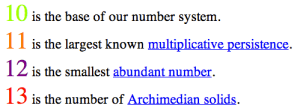
The table was created by Erich Friedman, a mathematician who works at Stetson University in Florida. We’ve previously shared Erich’s holiday puzzles (here) and weight puzzles (here) and monthly research contest (here), but there’s even more to explore on his site. I’m partial to his Packing Center, which shows the best ways that have been found to pack shapes inside of other shapes. You might also enjoy his extensive listing of What’s Special About This Number?—a project in the same spirit as Tanya Khovanova’s Number Gossip.

A dense packing of 26 squares within a square that Erich discovered.

A dense packing of 26 squares within a square that Erich discovered.

whats

I wonder what a multiplicative persistence is?

ttree_q150x150autoNext up, another Erik—Erik Demaine, whose work we’ve also often featured. What does he have for us this time? Some fantastic uncurling linkages, that’s what!

In 2000, Erik worked with Robert Connelly and Günter Rote to show that any wound-up 2D shape made of hinged sticks can be unwound without breaking, crossing, or lifting out of the plane. In the end, the shape must be convex, so that it doesn’t have any dents in it. For a while Erik and his colleagues thought that some linkages might be “locked” and unwinding some of the examples they created took months. You can find some great animations shared on the webpage that describes their result that locked linkages don’t in fact exist.

One thing that amazes me about Erik’s mathematical work is how young the problems are that he works on and solves. You might think a problem that can be put in terms of such simple ideas would have been around for a while, but in fact this problem of unwinding linkages was first posed only in the 1970s! It just goes to show that there are new simple math problems just waiting to be invented all the time.

Finally, I was so glad to run across this short film called Dance Squared. It was made by René Jodoin, a Canadian director and producer. Check out how much René expresses with just a simple square!

There’s a wonderful celebration of René titled When I Grow Up I Want To Be René Jodoin—written back in 2000 when René was “only” 80 years old. Now here’s 92! Making math is for people of all ages. You might also enjoy watching René’s Notes on a Triangle.

Bon appetit!

Reflection Sheet – A Periodic Table, Linkages, and Dance Squared

Numenko, Turning Square, and Toilet Paper

Welcome to this week’s Math Munch!

Have you ever played Scrabble or Bananagrams? Can you imagine versions of these games that would use numbers instead of letters?

Meet Tom Lennett, who imagined them and then made them!

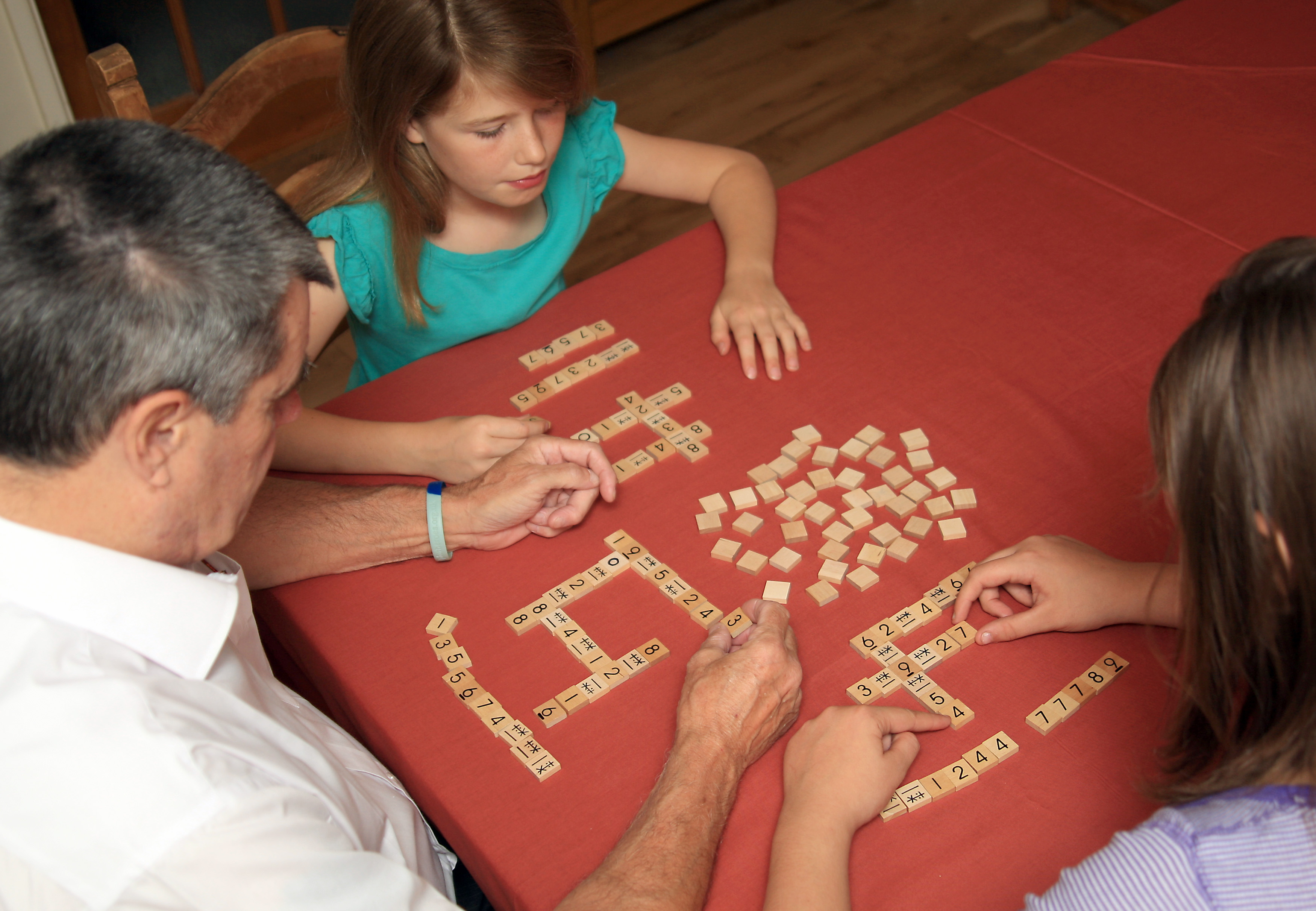
Tom playing Numenko with his grandkids.

Tom playing Numenko with his grandkids.

Numemko is a crossnumber game. Players build up number sentences, like 4×3+8=20, that cross each other like in a crossword puzzle. There is both a board game version of Numenko (like Scrabble) and a bag game version (like Banagrams). Tom invented the board game years ago to help his daughter get over her fear of math. He more recently invented the bag game for his grandkids because they wanted a game to play where they didn’t have to wait their turn!

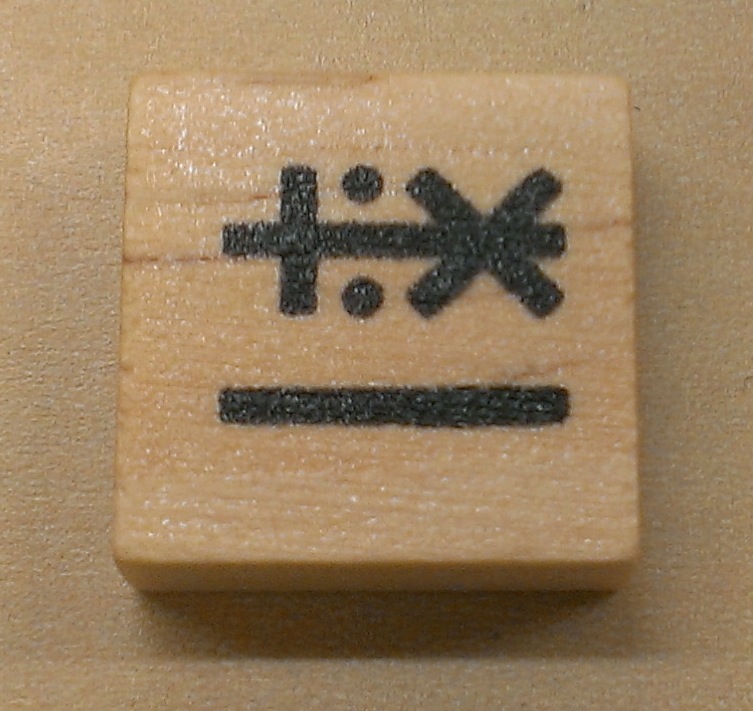
The Multichoice tile.

The Multichoice tile.

One important feature of Numenko is the Multichoice tile. Can you see how it can represent addition, subtraction, multiplication, division, or equality?

How would you like to have a Numenko set of your own? Well, guess what—Tom holds weekly Numenko puzzle competitions with prizes! You can see the current puzzle on this page, as well as the rules. Here’s the puzzle at the time of this post—the week of November 3, 2013.

Can you replace the Multichoice tiles to create a true number sentence?

Challenge: replace the Multichoice tiles to create a true number sentence.

I can assure you that it’s possible to win Tom’s competitions, because one of my students and I won Competition 3! I played my first games of Numenko today and really enjoyed them. I also tried making some Numenko puzzles of my own; see the sheet at the bottom of this post to see some of them.

Tom in 1972.

Tom in 1972.

In emailing with Tom I’ve found that he’s had a really interesting life. He grew up in Scotland and left school before he turned 15. He’s been a football-stitcher, a barber, a soldier, a distribution manager, a paintball site operator, a horticulturist, a property developer, and more. And, of course, also a game developer!

Do you have a question you’d like to ask Tom? Send it in through the form below, and we’ll try to include it in our upcoming Q&A!

leveledit

The level editor.

Say, do you like Bloxorz? I sure do—it’s one of my favorite games! So imagine my delight when I discovered that a fan of the game—who goes by the handle Jz Pan—created an extension of it where you can make your own levels. Awesome, right? It’s called Turning Square, and you can download it here.

(You’ll need to uncompress the file after downloading, then open TurningSquare.exe. This is a little more involved than what’s usual here on Math Munch, but I promise it’s worth it! Also, Turning Square has only been developed for PC. Sorry, Mac fans.)

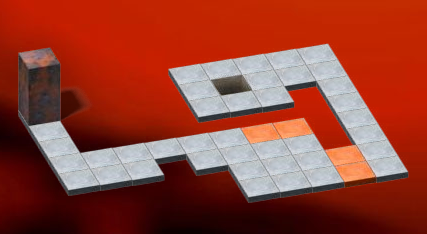
The level!

The level I made!

But wait, there’s more! Turning Square also introduces new elements to Bloxorz, like slippery ice and pyramids you can trip over. It has a random level generator that can challenge you with different levels of difficulty. Finally, Turning Square includes a level solver—it can determine whether a level that you create is possible or not and how many steps it takes to complete.

Jz Pan is from China and is now a graduate student at the Chinese Academy of Sciences, majoring in mathematics and studying number theory. Jz Pan made Turning Square in high school, back in 2008.

Jz Pan has agreed to answer some of your questions! Use the form below to send us some.

If you make a level in Turning Square that you really like, email us the .box file and we can share it with everyone through our new Readers’ Gallery! Here is my level from above, if you want to try it out.

Jz Pan has also worked on an even more ambitious extension of Bloxorz called Turning Polyhedron. The goal is the same, but like the game Dublox, the shape that you maneuver around is different. Turning Polyhderon features several different shapes. Check out this video of it being played with a u-polyhedron!

And if you think that’s wild, check out this video with multiple moving blocks!

Last up this week, have you ever heard that it’s impossible to fold a piece of paper in half more than eight times? Or maybe it’s seven…? Either way, it’s a “fact” that seems to be common knowledge, and it sure seems like it’s true when you try to fold up a standard sheet of paper—or even a jumbo sheet of paper. The stack sure gets thick quickly!

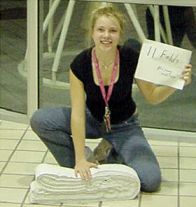
Britney Gallivan and her 11th fold.

Britney and her 11th fold.

Well, here’s a great story about a teenager who decided to debunk this “fact” with the help of some math and some VERY big rolls of toilet paper. Her name is Britney Gallivan. Back in 2001, when she was a junior in high school, Britney figured out a formula for how much paper she’d need in order to fold it in half twelve times. Then she got that amount of paper and actually did it!

Due to her work, Britney has a citation in MathWorld’s article on folding and even her own Wikipedia article. After high school, Britney went on to UC Berkeley where she majored in Environmental Science. I’m trying to get in touch with Britney for an interview—if you have a question for her, hold onto it, and I’ll keep you posted!

EDIT: I got in touch with Britney, and she’s going to do an interview!

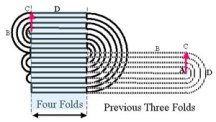
A diagram that illustrates how Britney derived her equation.

A diagram that illustrates how Britney derived her equation.

The best place to read more about Britney’s story in this article at pomonahistorical.org—the historical website of Britney’s hometown. Britney’s story shows that even when everyone else says that something’s impossible, that doesn’t mean you can’t be the one to do it. Awesome.

I hope you enjoy trying some Numenko puzzles, tinkering with Turning Square, and reading about Britney’s toilet paper adventure.

Bon appetit!

PS Want to see a video of some toilet-paper folding? Check out the very first “family math” video by Mike Lawler and his kids.

Reflection Sheet – Numenko, Turning Square, and Toilet Paper