Author Archives: Justin Lanier

MOVES, the Tower of Hanoi, and Mathigon

Welcome to this week’s Math Munch!

MOVESThe Math Munch team just wrapped up attending the first MOVES Conference, which was put on by the Museum of Math in NYC. MOVES is a recreational math conference and stands for Mathematics of Various Entertaining Subjects. Anna coordinated the Family Activities track at the conference and Paul gave a talk about his imbalance problems. I was just there as an attendee and had a blast soaking up wonderful math from some amazing people!
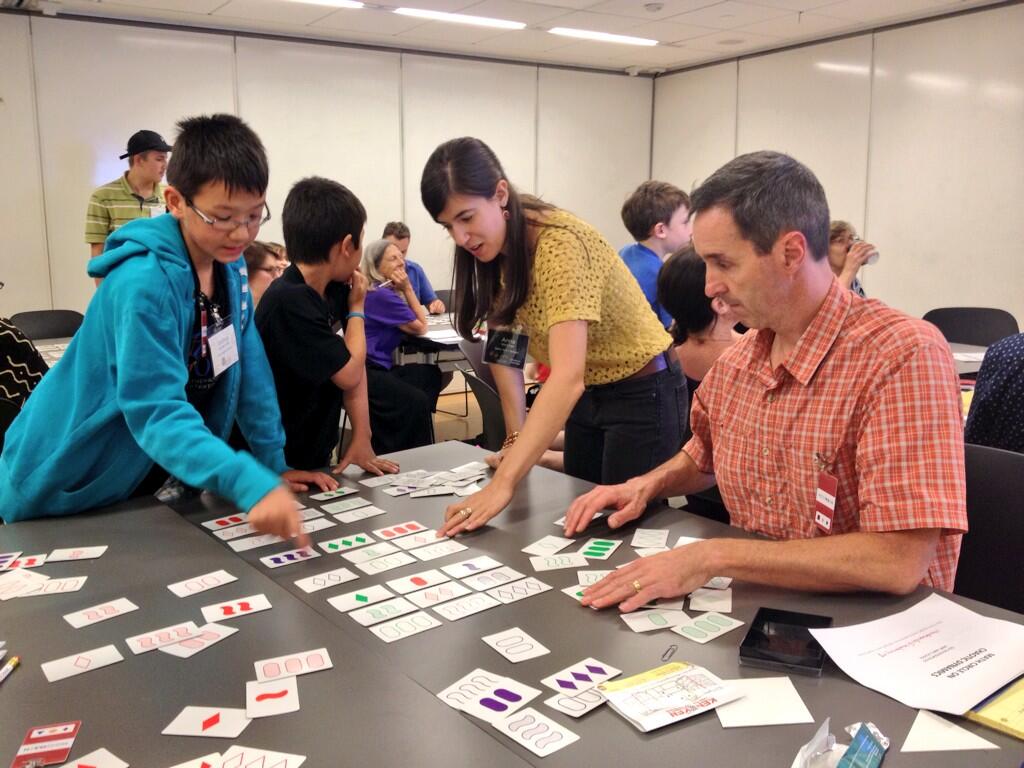
AnnaMOVES PaulMOVES JustinMOVES

Who all was there? Some of our math heroes—and familiar faces on Math Munch—like Erik Demaine, Tanya Khovanova, Tim and Tanya Chartier, and Henry Segerman, just to name just a few. I got to meet and learn from many new people, too! Even though I know it’s true, it still surprises me how big and varied the world of math and mathematicians is.
SuMOVES

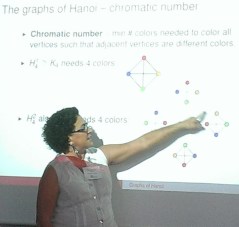
Suzanne Dorée at MOVES.

One of my favorite talks at MOVES was given by Suzanne Dorée of Augsburg College. Su spoke about research she did with a former student—Danielle Arett—about the puzzle known as the Tower of Hanoi. You can try out this puzzle yourself with this online applet. The applet also includes some of the puzzle’s history and even some information about how the computer code for the applet was written.

danielle

Danielle Arett

A pice of a Tower of Hanoi graph with three pegs and four disks.

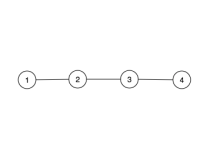
A piece of a Tower of Hanoi graph with three pegs and four disks.

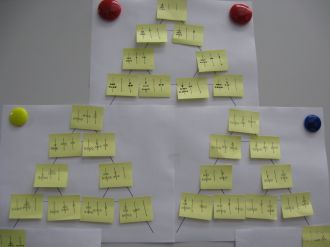
But back to Su and Danielle. If you think of the different Tower of Hanoi puzzle states as dots, and moving a disk as a line connecting two of these dots, then you can make a picture (or graph) of the whole “puzzle space”. Here are some photos of the puzzle space for playing the Tower of Hanoi with four disks. Of course, how big your puzzle space graph is depends on how many disks you use for your puzzle, and you can imagine changing the number of pegs as well. All of these different pictures are given the technical name of Tower of Hanoi graphs. Su and Danielle investigated these graphs and especially ways to color them: how many different colors are needed so that all neighboring dots are different colors?
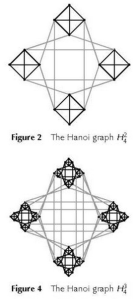
Images from Su and Danielle's paper. Towers of Hanoi graphs with four pegs.

Images from Su and Danielle’s paper. Tower of Hanoi graphs with four pegs.


Su and Danielle showed that even as the number of disks and pegs grows—and the puzzle graphs get very large and complicated—the number of colors required does not increase quickly. In fact, you only ever need as many colors as you have pegs! Su and Danielle wrote up their results and published them as an article in Mathematics Magazine in 2010.

Today Danielle lives in North Dakota and is an analyst at Hartford Funds. She uses math every day to help people to grow and manage their money. Su teaches at Ausburg College in Minnesota where she carries out her belief “that everyone can learn mathematics.”

Do you have a question for Su or Danielle—about their Tower of Hanoi research, about math more generally, or about their careers? If you do, send them to us in the form below for an upcoming Q&A!

UPDATE: We’re no longer accepting questions for Su and Danielle. Their interview will be posted soon! Ask questions of other math people here.

MathigonLast up, here’s a gorgeous website called Mathigon, which someone shared with me recently. It shares a colorful and sweeping view of different fields of mathematics, and there are some interactive parts of the site as well. There are features about graph theory—the field that Su and Danielle worked in—as well as combinatorics and polyhedra. There’s lots to explore!

Bon appetit!

Lincoln, Blinkin’, and Fraud

Welcome to this week’s Math Munch!

Lincoln problem

Abraham Lincoln, figuring out a word problem.
Can you decipher his steps?

About a month ago I ran across an article about Abraham Lincoln and math. Lincoln is often celebrated as a self-made frontiersman who had little formal education. The article describes how two professors from Illinois State University recently discovered two new pages of math schoolwork done by Lincoln, which may show that he had somewhat more formal schooling than was previously believed. The sheet shows the young Abe figuring problems like, “If 4 men in 5 days eat 7 lb. of bread, how much will be sufficient for 16 men in 15 days?” Here are some further details about the manuscript’s discovery from the Illinois State University website and a high-quality scan of Lincoln’s figuring from the Harvard University Library.

Lincoln is also known for his study of Euclid’s Elements—that great work of mathematics from ancient times. Lincoln began to read the Elements when he was a young lawyer interested in what exactly it means to “prove” something. Euclid’s work even made a brief appearance in the recent movie about Lincoln. Thinking about Lincoln and math got me to wondering about how our presidents in general have interacted with the subject. Certainly they must all have had some kind of experience with math! In my searching and remembering, I’ve run across these tidbits about Ulysses S. Grant, James Garfield, and President Obama. Still, my searches haven’t turned up so very much. Maybe you’ll keep your eyes open for further bits of mathy presidential trivia?

481121_466454960066144_511840398_nNext up, check out these math problems about blinking on a wonderful online resource called Bedtime Math. Every day, the site posts a few math problems that parents and children can share and ponder at bedtime—just like families often do with storybooks. Bedtime Math was founded by Laura Bilodeau Overdeck. She is involved with several math-related nonprofits and is the mother of three kids. Bedtime Math grew out of the way that Laura shared math problems with her own children. A few of my favorite Bedtime Math posts are “You Otter Know” and “Booking Down the Hall“.

Today’s Bedtime Math is titled “Space Saver” and contains some problems about hexagon tilings and our mathematical chum, the honeybee. Here is today’s “big kid” problem: If a bee builds 5 hexagons flush in a horizontal row, how many total sides did the bee make, given the shared sides? I hope you find some problems to enjoy at Bedtime Math. You can sign up to receive their daily email of problems on the righthand side of the Bedtime Math frontpage.

Zome inventor Paul Hildebrand and a PCMI Fourth of July float!

Zome inventor Paul Hildebrandt and
a mathy PCMI Fourth of July float!

Did you know that people blink differently when they lie? I’ve been thinking a lot these past few weeks about frauds and fakes as I’ve worked with some teacher friends on this year’s PCMI problem sets. PCMI—the Park City Math Institute—is a math event held each summer that gathers math professors, math teachers, and college math students to do mathematics together for three weeks. It all happens in beautiful Park City, Utah. The first week of PCMI coincides with the Fourth of July, and the PCMI crew always makes a mathy entry in the local Independence Day Parade!

The theme of the high school teachers’ program this year is “Probability, Randomization, and Polynomials”. The first problem set introduces the following conundrum:

Suppose you were handed two lists of 120 coin flips, one real and
one fake. Devise a test you could use to decide which was which.
Be as precise as possible.

Which is real? Which is fake?

Which is real? Which is fake?

If you understand what this problem is all about, then you can understand my recent fascination with frauds! Over to the left I’ve shared two sequences I concocted. One I made by actually flipping a coin, while the other I made up out of my head. Can you tell which is which?

For more sleuthing fun, check out this applet on Khan Academy, which challenges you to distinguish lists of coin flips. Some are created by a fair coin, others are made by an unfair coin, and still others are made by human guesses. This coin-flipping challenge is a part of Khan Academy’s Journey into Cryptography series. You should also know that the PCMI problem sets from previous years are all online, filed by years under “Class Notes”. They are rich with fantastic, brain-teasing problems that are woven together in expert fashion.

And finally, to go along with your Bedtime Math, how about a little bedtime poetry? Check out the video below.

Sweet dreams, and bon appetit!

Prime Gaps, Mad Maths, and Castles

Welcome to this week’s Math Munch!

It has been a thrilling last month in the world of mathematics. Several new proofs about number patterns have been announced. Just to get a flavor for what it’s all about, here are some examples.

I can make 15 by adding together three prime numbers: 3+5+7. I can do this with 49, too: 7+11+31. Can all odd numbers be written as three prime numbers added together? The Weak Goldbach Conjecture says that they can, as long as they’re bigger than five. (video)

11 and 13 are primes that are only two apart. So are 107 and 109. Can we find infinitely many such prime pairs? That’s called the Twin Prime Conjecture. And if we can’t, are there infinitely many prime pairs that are at most, say, 100 apart? (video, with a song!)

Harald Helfgott

Harald Helfgott

Yitang "Tom" Zhang

Yitang “Tom” Zhang

People have been wondering about these questions for hundreds of years. Last month, Harald Helfgott showed that the Weak Goldbach Conjecture is true! And Yitang “Tom” Zhang showed that there are infinitely many prime pairs that are at most 70,000,000 apart! You can find lots of details about these discoveries and links to even more in this roundup by Evelyn Lamb.

What’s been particularly fabulous about Tom’s result about gaps between primes is that other mathematicians have started to work together to make it even better. Tom originally showed that there are an infinite number of prime pairs that are at most 70,000,000 apart. Not nearly as cute as being just two apart—but as has been remarked, 70,000,000 is a lot closer to two than it is to infinity! That gap of 70,000,000 has slowly been getting smaller as mathematicians have made improvements to Tom’s argument. You can see the results of their efforts on the polymath project. As of this writing, they’ve got the gap size narrowed down to 12,006—you can track the decreasing values down the page in the H column. So there are infinitely many pairs of primes that are at most 12,006 apart! What amazing progress!

Two names that you’ll see in the list of contributors to the effort are Andrew Sutherland and Scott Morrison. Andrew is a computational number theorist at MIT and Scott has done research in knot theory and is at the Australian National University. They’ve improved arguments and sharpened figures to lower the prime gap value H. They’ve contributed by doing things like using a hybrid Schinzel/greedy (or “greedy-greedy”) sieve. Well, I know what a sieve is and what a greedy algorithm is, but believe me, this is very complicated stuff that’s way over my head. Even so, I love getting to watch the way that these mathematicians bounce ideas off each other, like on this thread.

Andrew Sutherland

Andrew Sutherland

Click through to see Andrew next to an amazing Zome creation!

Andrew. Click this!

Scott Morrison

Scott Morrison

Andrew and Scott have agreed to answer some of your questions about their involvement in this research about prime gaps and their lives as mathematicians. I know I have some questions I’m curious about! You can submit your questions in the form below:

I can think of only two times in my life where I was so captivated by mathematics in the making as I am by this prime gaps adventure. Andrew Wiles’s proof of Fermat’s Last Theorem was on the fringe of my awareness when it came out in 1993—its twentieth anniversary of his proof just happened, in fact. The result still felt very new and exciting when I read Fermat’s Enigma a couple of years later. Grigori Perelman’s proof of the Poincare Conjecture made headlines just after I moved to New York City seven years ago. I still remember reading a big article about it in the New York Times, complete with a picture of a rabbit with a grid on it.

This work on prime gaps is even more exciting to me than those, I think. Maybe it’s partly because I have more mathematical experience now, but I think it’s mostly because lots of people are helping the story to unfold and we can watch it happen!

fig110u2bNext up, I ran across a great site the other week when I was researching the idea of a “cut and slide” process. The site is called Mad Maths and the page I landed on was all about beautiful dissections of simple shapes, like circles and squares. I’ve picked out one that I find especially charming to feature here, but you might enjoy seeing them all. The site also contains all kinds of neat puzzles and problems to try out. I’m always a fan of congruent pieces problems, and these paper-folding puzzles are really tricky and original. (Or maybe, origaminal!) You’ll might especially like them if you liked Folds.

Christian's applet displaying the original four-room castle.

Christian’s applet displaying the original four-room castle.

Finally, we previously posted about Matt Parker’s great video problem about a princess hiding in a castle. Well, Christian Perfect of The Aperiodical has created an applet that will allow you to explore this problem—plus, it’ll let you build and try out other castles for the princess to hide in. Super cool! Will I ever be able to find the princess in this crazy star castle I designed?!

Crazy star castle!

My crazy star castle!

And as summer gets into full swing, the other kind of castle that’s on my mind is the sandcastle. Take a peek at these photos of geometric sandcastles by Calvin Seibert. What shapes can you find? Maybe Calvin’s creations will inspire your next beach creation!

Bon appetit!

167739151_ec142bbfe8 3342635687_f847918e0e 5945114420_c950231830