Welcome to this week’s Math Munch!

A ghost diagram composed of two different tiles.
“An organism is more than the sum of its organs. When the organs are fitted together, the organism becomes something more. This surprising something more we call “spirit” or “ghost”. Ghost Diagrams finds the ghosts implicit in simple sets of tiles.”
So writes Paul Harrison, creator of the amazing Ghost Diagram applet. Paul creates all kinds of free software and has his Ph.D. in Computer Science. I found his Ghost Diagram applet through this huge list of links about generative art.
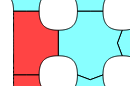
A ‘111-‘ tile connected to a ‘1aA1’ tile.
Given a collection of tile types, the applet tries to find a way to connect them so that no tile has any loose ends. A tile type is specified through a string of letters, numbers, and dashes. Each of these specifies an edge. You can think of a four-character tile as being a modified square and a six-character tile as being a modified hexagon. Two tiles can connect if they have edges that match. Number edges match with themselves—1 matches with 1—while letter edges match with the same letter with opposite capitalization—a matches with A.
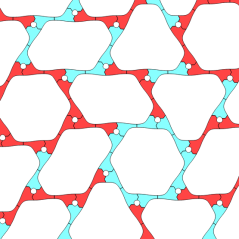
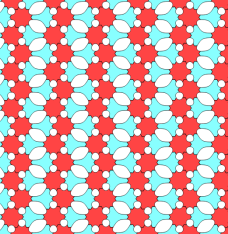
It’s amazing the variety of patterns that can emerge out of a few simple tiles. Here are a couple of ghost diagrams that I created. You can click them to see live versions in the applet. There are many other nice ghost diagrams that Paul has compiled on the site. Also, be sure to check out the random button—it’s a great way to get started on making a pattern of your own. I hope you enjoy tinkering with the ghost diagram applet as much as I have.
 |
 |
 |
 |
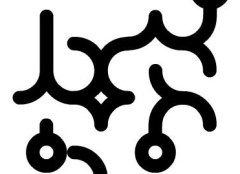 And now for some more fun: three new games! When I ran across Loops of Zen, I had ghost diagrams on my mind. I think they have a similar feel to them. The goal in each level of Loops of Zen is to orient the paths and loops so that they connect up without any loose edges. I feel like this game—like good mathematics—requires both a big-picture, intuitive grasp of the playing field and detailed, logical thinking. Put another way, you need both global strategy and local tactics. Also, if you like playing Entanglement, then I bet you’ll like Loops of Zen, too.

Last week we wrote about Flatland. This book and the movies it inspired describe what it might be like if creatures of different dimensionality were to meet each other. The game Z-Rox puts you in the shoes of a Flatlander. Mystery shapes pass through your field of vision a slice at a time, and it’s up to you to identify what they are. It’s a tricky task that requires a good imagination.
Hat tip to Casual Girl Gamer for both of these great mathy games.

Steppin’ Stones
Steppin’ Stones is a fun little spatial puzzle game I recently came across. You should definitely check it out. It also provides a nice segue to our last mathy item for the week, because a Steppin’ Stones board looks a lot like a Scrabble board. Scrabble, of course, is a word game. Aside from the arithmetic of keeping score, there isn’t much mathematics involved in playing it. In addition, the universe of Scrabble—the English dictionary—is not particularly elegant from a math standpoint. However, it’s the amazing truth that even in arenas that don’t seem very mathematical, math can often be applied in useful ways.

From a comic about Prime Scrabble on Spiked Math.
In Re-evaluating the values of the tiles in Scrabble™, the author—who goes by DTC and is a physics graduate student at Cornell—wonders whether the point values assigned to letters in Scrabble are correctly balanced. The basic premise is that the harder a letter is to play, the more it should be worth. DTC does what any good mathematician does—lays out assumptions clearly, reasons from them to make a model, critiques the arguments of others, and of course makes lots of useful calculations. One tool DTC uses is the Monte Carlo method. In the end, DTC finds that the current Scrabble point values are very close to what the model would assign.
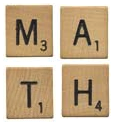 I really enjoyed the article, and I hope you will, too. And since Scrabble is a “crossword game”, I think I’ll leave you with a couple of “crossnumber” puzzles. Here are some straightforward ones, while these require a little more thinking.
Have a great week, and bon appetit!
P.S. I can’t resist sharing this video as a bonus: a cellular automaton of rock-paper-scissors! Blue beats green, green beats red, and red beats blue. Hooray for non-transitive swirls!
 All of the doomsday talk did get me researching the Mayan calendar and number system. Check out