With Valentine’s Day this Thursday, let’s take a look at some mathy Valentine stuff. If you’re searching for the perfect card design for your valentine, search no more. Math Munch has you covered!
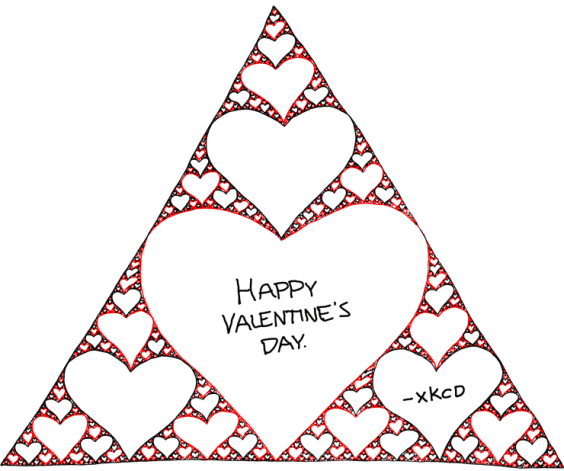
Sierpinski Valentine
xkcd creator Randall Munroe
Above you can see a clever twist on the classic Sierpinski Triangle, which I found on xkcd, a wonderfully mathematical webcomic. You can read more about xkcd creator Randall Munroe in this interview from the Sept. 2012 issue of Math Horizons. (pdf version)
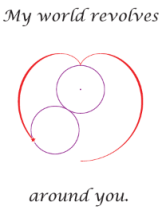
Ron Doerfler designed another math-insprired Valentine’s Day card, which you can check out here. The image to the left is only part of it. Don’t get it? Well it’s a reference to a mathematical curve called the cardioid (from the Greek word for “heart”). Look what happens if you follow a point on one circle as it rolls around another. You’ll have to imagine it tipped the other way so it’s oriented like a typical heart, but that curve is a cardioid. The second animation was created by the amazing and previously featured Matt Henderson. If you have a compass, then you can make the second one at home.
A cardioid generated by one circle rolling around another
A completely different way to generate a cardioid
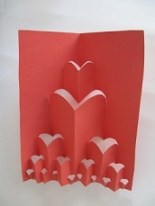
Pop-up Sierpinski Heart Card
Really though, nothing says “I Love you” like a Möbius strip. Am I right? Here’s a quick little project you can do to make a pair of linked Möbius hearts. You can find directions here on a blog called 360, or you can watch the video below. Oh, and as if that wasn’t enough great stuff, here’s one more project from the 360 blog, a pop-up version of the Sierpinski Heart!
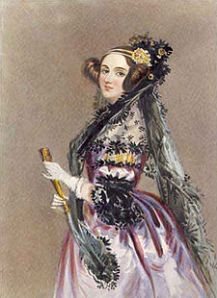
Up first, are you enjoying the technology you’re reading this on? Well you can thank Ada Lovelace for that. She’s the 19th century mathematician that worked on the first computing machines with Charles Babbage and is often called “the first computer scientist.” There’s no better day to thank her than today, since it’s Ada’s 197th birthday. Justin found a great little comic dramatizing her life and work. It’s called “2D Goggles or The Thrilling Adventures of Lovelace and Babbage.” It’s also available as a free iPad app called Lovelace & Babbage, in case you have one of those.
Ada Lovelace hard at work in comic book form
Bertrand Russell from Logicomix
I can also recommend one other math comic. It’s a graphic novel called Logicomix: An Epic Search for Truth detailing the life and research of English logician Bertrand Russell, a personal hero of mine. You can buy it here.
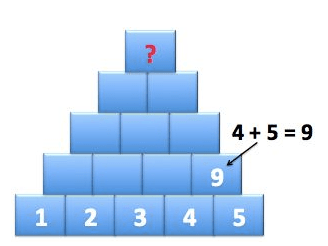
Up next, I found a nice little web resource lately called A+ Click. It’s basically just a collection of math tests, but they have them for every level, and the problems are actually pretty great. Give it a try, and don’t feel like you have to stick to your grade. There’s bound to be tough ones and easier ones in every set. You can actually learn a lot by working on new kinds of problems you’ve never even heard of. You just have to figure out what the words mean, so here’s an illustrated mathematical glossary to help you out, or this maths dictionary for kids. And here’s a sample problem I like:
Add the adjacent numbers together and write their sum in the block above them. What is the number at the top of the pyramid?
I wonder if there was a way to predict the answer without filling in all the boxes. And what if the pyramid had 1,2,3,4,5,… all the way up to 10? Hmmmm. Any readers have any ideas? Just leave us a comment.
Finally, Plus Magazine’s website is full of really good math articles and things. For the holiday season, they’ve created a mathematical advent calendar. Each day, a new “door” can be opened which leads to further links and descriptions to neat math content. For example, on the 8th day we had Door #8: Women in Maths, including information about Ada Lovelace!
And here’s a little bonus video for you this week. For their recent music video, Lost Lander decided to illustrate the prime numbers as they build up. It’s quite nice, and not a bad song either.
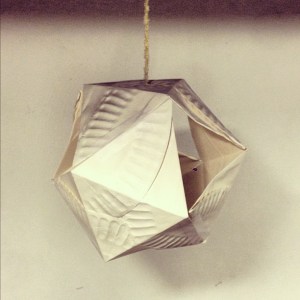
Icosahedron made from 4 paper plates. Click for instructions.
Big news this week, but first let’s have a look at some construction projects you can easily do at home using paper plates, paper clips, and some tape. They come to us from wholemovement.com, the website of Bradford Hansen-Smith. It’s not a stretch to say that Bradford is kind of cuckoo for circles, as you can probably tell form this introductory video. Naturally, the website is all about the amazing things you can do and learn from folding circles. Check out his gallery and you’ll see what I mean. Using these instructions and 4 paper plates I made the sculptures in these pictures. Above is an icosahedron with 4 of the 20 triangles left as empty space, and down below you can see the cuboctahedron of sorts. There’s even an instruction video for this one. So grab some cheap plates, fold ’em up, experiment, and send us your pictures.
Born 11.14.12
OK, now for the big news. Last Wednesday, my daughter was born!!! I’m so so so happy. In honor of Nora’s 0th birthday (you turn 1 on your 1st birthday, right?), let’s check out some birthday math. Here’s a cool little birthday number trick I found. It’s sort of magical, but it actually works because that tangle of arithmetic actually just multiplies the month by 10,000, the day by 100, and adds those together with the year. Hopefully you can see how this much simpler version works.
Here’s a well-known birthday problem: How many people need to be in a room before it’s likely that two of them share a birthday? If there’s 400 people in a room, then there’s definitely a birthday match, but if there’s 300 it’s almost certain as well. What’s the smallest crowd so that the probability of a match birthday is over 50%? For the answer and analysis, check out this Numberphile video on the subject featuring James Grime or this New York Times article, by Steven Strogatz, a wonderful mathematician and author.
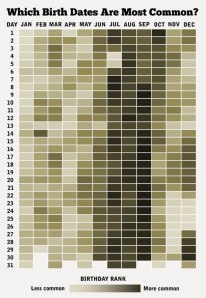
Both of these solutions are actually wrong! That’s because they make the false assumptions that each day has the same likelihood of being someone’s birthday. You can see in the graphs above that that’s not true at all! On the left, look how dark the summer months are, and look at how gray the days are around Thanksgiving and Christmas. You can click on the left image for an interactive version, or click on the right for more graphs and analysis.
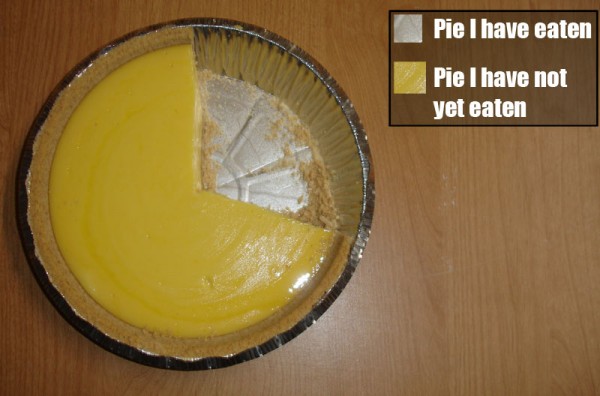
A Thanksgiving Pie Chart
Finally, I’m incredibly excited for Thanksgiving (my very favorite holiday), and in that spirit, I want to take a few lines to say “thank you” to you, dear reader. THANK YOU! Whether you’re a weekly muncher or a first time reader, it’s great to know you’re out there enjoying the math we share.
Obviously of course, Thanksgiving is also about the food. Delicious delicious food. Yummmmm! So, Vi Hart is making a series of Thanksgiving themed videos to showcase the math of the meal. Enjoy the videos, but be careful. You may get terribly hungry.