Welcome to this week’s Math Munch!
For this last Thursday of April, we’ll be taking a look at some recent posts from our facebook page. Craig Kaplan writes about “near miss” polyhedra, a Pythagorean gif takes us to an curious math blog, and we find a beautiful portrait of a great mathematician. Let’s go!
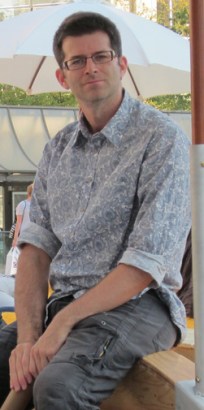
Craig Kaplan
First is an article from a wonderful mathematician and mathematical artist by the name of Craig Kaplan. His name has popped up on Math Munch before (1, 2 ,3), in case it sounds familiar. You can check out Craig’s stuff on his website, Isohedral, or download his really great game, “Good Fences,” which I have on my iPhone.
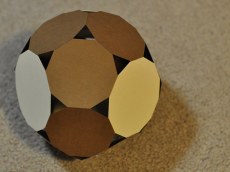 What I really wanted to share, however was Craig’s writing on “A New Near Miss.” This is a polyhedron that almost is… but just isn’t. It looks pretty good, but it can’t be. You’ll have to read to see what I mean.
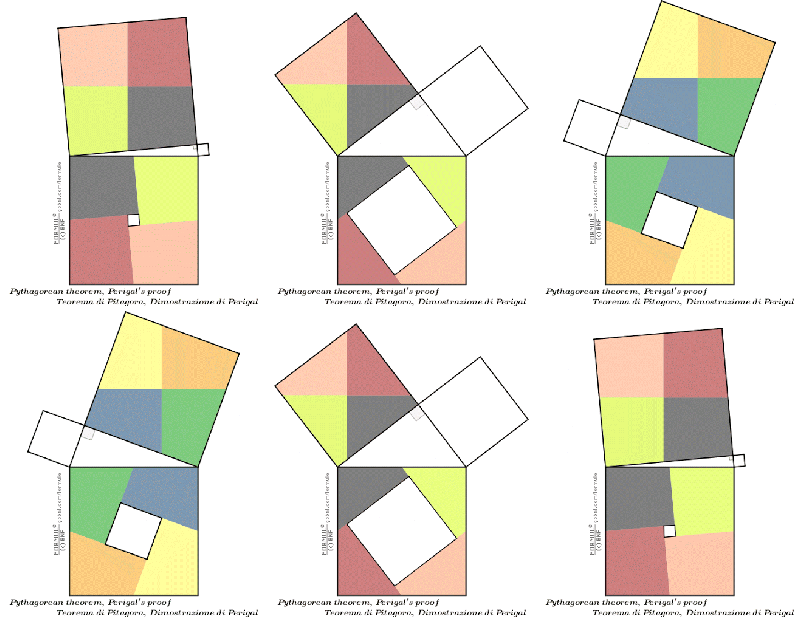 Up next, I found this little gif on our facebook page, and I absolutely loved it. It demonstrates the Pythagorean Theorem which says that as long as that’s a right triangle there, the big square on bottom is exactly as big as the two smaller squares combined. The animation shows you how to chop up the middle-sized square and recombine it with the small one to make the big one. I knew there were demonstrations/proofs like this, but this one opened my eyes to something I didn’t quite know before.
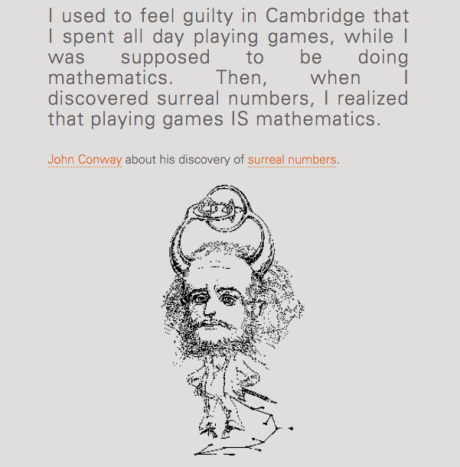
This gif sent me off on a journey through the internet to track down the source, and it led me to a site called Curiosa Mathematica. It’s a math blog featuring lots of random math goodies. There’s lots to see and get into (much like Math Munch). Here’s a quote I found there. I hope you find something you like too.
Finally, I was really taken by this piece of art (below). It’s a portrait of French mathematician Henri Poincaré, and it was drawn by Bill Sanderson. I can’t find much info on Bill, but WOW the piece is so cool. I love how he’s surrounded by his mathematical creations. I was hoping he had done more, and I did find a couple more (below), but not all I had hoped for.
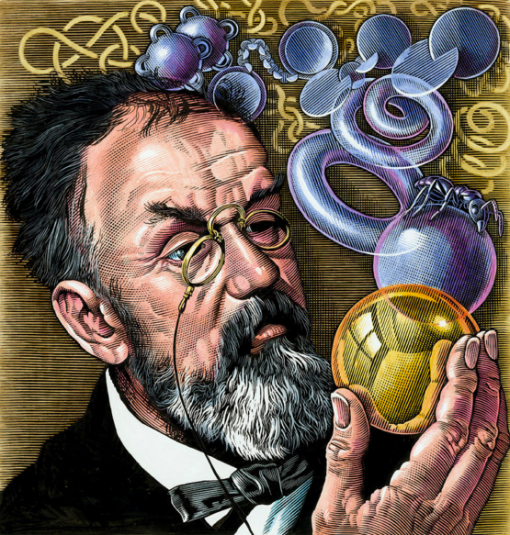
French Mathematician Henri Poincaré
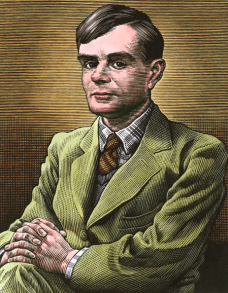 Alan Turing |
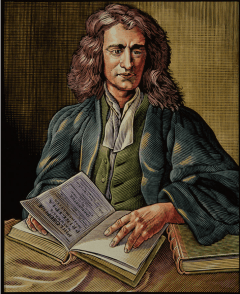 Isaac Newton |
Have some illustrative talent? I’d love to see your mathematician’s portrait. Feel free to send us something… anything.
I hope you enjoy your weekend and find something tasty out there in the mathematical interwebs. Bon appetit!


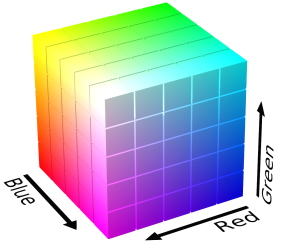 The primary colors of light (red, blue, and green) increase as you move in each of the three directions. This leaves white and black at opposite corners of the cube, and all the wonderful colors spread around throughout the cube, with the primary and secondary colors on the other corners. You can read more

 Math Munch
