Author Archives: Paul Salomon

Halving Fun, Self-Tiling Tile Sets, and Doodal

Welcome to this week’s Math Munch!
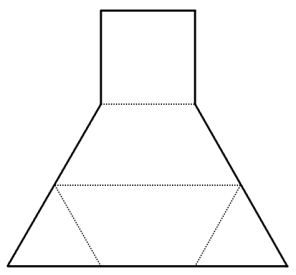
Print out two copies of this pattern, cut them out, and fold each along the dotted lines, making two identical solids. Then fit these two pieces together to make a regular tetrahedron.

Print out two copies of this pattern, cut them out, and fold each along the dotted lines, making two identical solids. Then fit these two pieces together to make a regular tetrahedron.

Our first bit of fun comes from a blog called Futility Closet (previously featured). It’s a neat little cut-and-fold puzzle. The shape to the right can be folded up to make a solid with 5 sides. Two of them can be combined to make a solid with only 4 sides, the regular tetrahedron. If you’d like, you can use our printable version, which has two copies on one sheet.

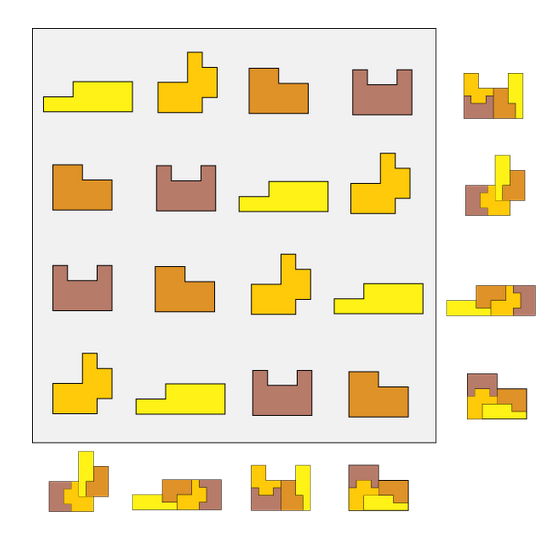
What do you know, I also found our second item on Futility Closet! Check out the cool family of tiles below. What do you notice?

A family of self-tiling tiles

A family of self-tiling tiles

Did you notice that the four shapes in the middle are the same as the four larger shapes on the outside? The four tiles in the middle can combine to create larger versions of themselves! They can make any and all of the original four!!

Lee Sallows

Recreational Mathematician, Lee Sallows

Naturally, I was reminded of the geomagic squares we featured a while back (more at geomagicsquares.com), and then I came to realize they were designed by the same person, the incredible Lee Sallows! (For another amazing one of Lee Sallows creations, give this incredible sentence a read.) You can also visit his website, leesallows.com.

reptile3

A family of 6 self-tiling tiles

For more self-tiling tiles (and there are many more amazing sets) click here. I have to point out one more in particular. It’s like a geomagic square, but not quite. It’s just wonderful. Maybe it ought to be called a “self-tiling latin square.”

And for a final item this week, we have a powerful drawing tool. It’s a website that reminds me a lot of recursive drawing, but it’s got a different feel and some excellent features. It’s called Doodal. Basically, whatever you draw inside of the big orange frame will be copied into the blue frames.  So if there’s a blue frame inside of an orange frame, that blue frame gets copied inside of itself… and then that copy gets copied… and then that copy…!!!

To start, why don’t you check out this amazing video showing off some examples of what you can create. They go fast, so it’s not really a tutorial, but it made me want to figure more things out about the program.

I like to use the “delete frame” button to start off with just one frame. It’s easier for me to understand if its simpler. You can also find instructions on the bottom. Oh, and try using the shift key when you move the blue frames. If you make something you like, save it, email it to us, and we’ll add it to our readers’ gallery.

Start doodaling!

Make something you love. Bon appetit!
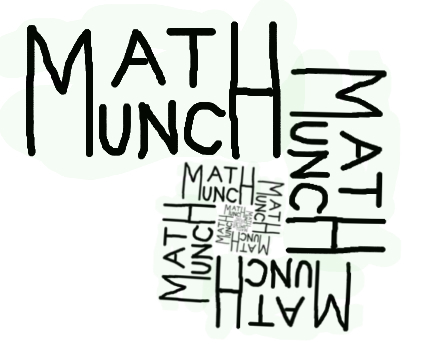
A fractal Math Munch Doodal

A fractal Math Munch Doodal
Havel-Hakimi, Temari, and more GIFS

Welcome to this week’s Math Munch!  We’ve got another great game for you, a followup with Temari artist Carolyn Yackel, and some mind-blowing math gifs.

Havel-Hakimi

Havel-Hakimi

First up, a nice little graph theory game created by Jacopo Notarstefano.  The game is about whether or not sets of numbers meet the conditions for being “graphical.”  Maybe the best way to understand what that means is to start playing.  If you can beat a level, then the starting number set is graphical.  Go play Havel-Hakimi.

In 1960, mathematicians Paul Erdös and Tibor Gallai proved a theorem about what number sets were graphical.  The name of the game refers to an algorithm you can use to solve the game.  You might figure it out just by playing the game, but here’s a (pretty dry) video explaining how the Havel-Hakimi algorithm works.

Jacopo’s website has a few other nice projects.  See if you can figure out Who Killed the Duke of Densmore, or try Four-Coloring the Dodecahedron.

Temari 1 Temari 2 Temari 3
Carolyn Yackel

Carolyn Yackel

Up next, remember Carolyn Yackel.  We wrote about Carolyn and her mathematical art a while back.  Well we finally got around to doing a little Q&A.  Give it a read to learn about Carolyn and her love of math.

Carolyn’s art (which can be seen here) is called temari, the japanese art of embroidered spheres. Since our post about Carolyn we found out that a now 93-year old grandmother posted a lifetime of temari on flickr.  These beautiful objects have symmetry that mimic various polyhedra, which I just love.  Read Carolyn’s Q&A to hear about how you make them.

Grandmother's temari work

A Grandmother’s Temari Work

Finally, a while back we shared some mathematical gif animations created by Bees and Bombs.  It’s time once again to look at some amazing animations.  This time they’re created by David Pope.  Here’s the complete archive of animations.  I’ll post some of my very favorites below, but there are dozens of dozens of good animations. (A dozen dozens is gross!)

Have a great week.  Bon appetit!

Full gallery of mathematical gifs

Pyramid

Pyramid

Rolling Prisms

Rolling Prisms

Sphere

Sphere

Spinning Octahedra

Spinning Octahedra

2048, 2584, and variations on a theme

Welcome to this week’s Math Munch! It’s a week of mathematical games, including a devilish little game and variations on the theme.

2048

2048

First up, check out this simple little game called 2048. Really, you must go try that game before reading on.

Gabriele Cirulli

Gabriele Cirulli

2048 was created by Gabriele Cirulli, a 20-year old who lives in northern Italy. He was inspired by a couple of very similar games called 1024 and threes, and he wanted to see if he could code a game from scratch. Nice work, Gabriele! (Stay tuned for a Q&A with Gabriele. Coming soon.)

The first time I played, I thought randomly moving the pieces around would work as well as anything, but wow was I wrong. Give it a try and see how far you get. Now watch how this AI (artificial intelligence) computer program plays 2048. You’ll probably notice some patterns that will help you play on your own.

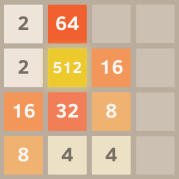
A beautiful chain of powers of two.

A beautiful chain of powers of two.  Can you solve from here?

Did you notice that the smallest tiles are 2’s, and you can only combine matching tiles to create their double? This makes all of the tile values powers of two! (e.g. 2048=2^11) These are the place values for the binary number system! (Did you see our recent post binary?) This has something to do with the long chains that are so useful in solving the game. It’s just like this moment in the marble calculator video.

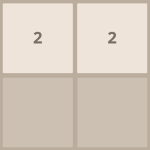
4, a silly, but interesting little variation

4, a silly, but interesting little variation

If you’re finding 2048 a bit too hard, here’s an easier version.  It’s called 4. It’s a little silly, but it’s also quite interesting. After you make the 4 tile (tying the world record for fewest moves), click “keep going” and see how far you can get. I’ve never been able to get past the 16 tile. Can anyone make the 32? What’s the largest possible tile that can be made in the original 2048 game? Amazingly, someone actually made a 16384 tile!!!

2584, the Fibonacci variant of 2048

2584, the Fibonacci version of 2048

Silly versions aside, there are lots and lots of ways you could alter 2048 to make an interesting game. I wondered about a version where three tiles combined instead of two, but I couldn’t quite figure out how it would work. Can you? (See below.) When I thought about different types of numbers that could combine, I thought of the perfect thing. The Fibonacci numbers!!! 1, 1, 2, 3, 5, 8, 13, 21, … The great thing is that someone else had the same idea, and the game already exists! Take some time now to play 2584, the Fibonacci version of 2048.

2048 and 2584 might seem like very similar games at first, (they’re only 536 apart), but there are some really sneaky and important differences. In the Fibonacci version, a tile doesn’t combine with itself. It has two different kinds of tiles it can match with. I think this makes the game a little easier, but the website says 2584 is more difficult than the original. What do you think?

I have a few more 2048 variations to share with you, as if you didn’t have enough already. These are my favorites:

I hope you dig into some of these games this week. Really think and analyze. If you come up with clever strategies or methods to solve these puzzles, please let us know in the comments. Have a great week, and bon appetit!