Author Archives: Paul Salomon

Byrne’s Euclid, Helen Friel, and PolygonJazz

Welcome to this week’s Math Munch! We’ve got geometry galore, starting with a series of historical math diagrams and a color update to Euclid’s Elements. Then it’s onto modern day paper artist Helen Friel, and finally a nifty new app that makes music from polygons. Let’s get into it.

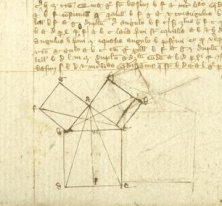
Euclid’s “Elements” was written around 300BC. It was the first great compilation of geometric knowledge, broken into 13 books, and it is one of the most influential books of all time. Euclid’s proof of the Pythagorean Theorem may be his most famous proof from the book (and all of mathematics for that matter), and in the pictures below you can see three diagrams of the proof, spanning seven centuries.

Nasir al-Din al-Tusi's 13th century arabic translation of Euclid's proof.

Persian mathematician Nasir al-Din al-Tusi‘s 13th century arabic translation of Euclid’s proof.

Late 14th century English manuscript

A late 14th century English manuscript of Euclid’s “Elements.”

The idea in each picture is that the area of the top two squares adds up exactly to the area of the bottom square. In the picture below, we see the big square broken up into blue and yellow pieces, whose areas are the same as the squares above them.

Oliver Byrne's 1871 color edition

Oliver Byrne’s 1847 color edition.  Click the image for the full proof of the Pythagorean Theorem as presented by Oliver Byrne in 1847.

This color version comes from Oliver Byrne’s 1847 edition, “The First Six Books of the Elements of Euclid, with Coloured Diagrams and Symbols.” (completely available online). I find the diagrams really beautiful and charming. There’s something extremely modern about them (see De Stijl) though they’re more than 150 years old now. See if you can follow his Oliver Byrne’s version of Euclid’s proof. It’s quite short.

Paper Engineer Helen Friel


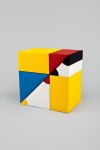
“They’re an absolutely beautiful piece of work and far ahead of their time,” said paper engineer Helen Friel. Helen lives in London, and and as part of a charity project, she designed paper sculptures of Oliver Byrne’s diagrams.

Euclid 2 Euclid 4 Euclid 3 Euclid 1

In an interview, she explained, “It’s a more visual and intriguing way to describe the geometry. I love anything that simplifies. I find it very appealing!” In the interview, Helen also talks a little about her attraction to math. “There’s order in straight lines and geometry. Although my job is creative, I use as much logical progression as possible in my work.”

It’s also cool to see Helen’s work side by side with Oliver Byrne‘s, so click for that.

Screen Shot 2014-02-05 at 11.46.00 PM

Click to send us a pic.  Yes, that is a paper camera Helen made.

Downloadable model

Downloadable model

Perhaps the best part in all of this, though, is that you can download Helen’s Pythagaorean Theorem model and make your own! There are plain white version as well as color. If you end up making one, definitely email us a picture, and we’ll show it off here on Math Munch.

Oh, and here’s a quick video documenting the many versions Helen decided not to use.  So cool.

https://vimeo.com/60412320

Now, on to our final bite.
PolygonJazz Recently, John Miller sent me an email showing off his new iPad app called PolygonJazz. In the app, you control the starting direction for a ball inside a polygon. Once you start it moving, the ball bounces off the walls, making a sound every time it hits a side. Check out the video below. I noticed something about the speed of the ball. Can you spot it? (PolygonJazz is available for $0.99 on the iTunes store.)

Speaking of bouncing around, here‘s a previous Math Munch featuring some billiards, and here‘s another bouncy post that features one of my favorite juggling routines. Michael Moschen built a gigantic equilateral triangle and juggles silicon balls inside and off of it. As with the app, Michael is utilizing the sound and geometry of the collisions to make something beautiful. It’s quite mesmerizing.

Have a bouncy week, and bon appetit!

Platonic Terrariums, Geometric Decor, and Multiplying Polyhedra

Welcome to this week’s Math Munch! We’ve got some beautiful geometric objects meant to house a plant or decorate your home, as well as a really clever kind of “multiplication chart” relating the Platonic solids to each other.

Icosahedron Terrarium

Icosahedron Terrarium

First up, let’s take a look at some gorgeous glass terrarium models of the Platonic solids. We don’t usually share products here on Math Munch, because we want to make sure you can enjoy the math for free, but these are so beautiful I just had to show you. I’m a sucker for spherical symmetry!

The Turning Triangles Terrarium actually sits on my mantle at home. It’s 20 pieces of triangular glass (with one hinged pane) coming together to make an icosahedron home for a little plant.

Octahedron Terrariums

Octahedron Terrariums

Above you can see a spread of octahedron terrariums, which will have to be my next purchase. Does $29 seem like a lot for one of those? I was kind of shocked to  see prices for other ones that are about 4 times that much. Take a look at the dodecahedron and cube terrariums below. They’re over $100 each, but man are they cool!?

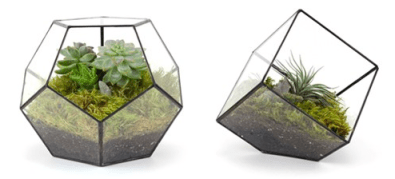
Dodecahedron and Cube Terrariums

Dodecahedron and Cube Terrariums

I love how they stood the cube up on its corner. Did you ever think about how cutting off the corner of a cube creates a little triangle?

Speaking of cutting off corners, that’s called “truncation.” I bet you never realized the soccer ball pattern is a truncated icosahedron. Well it is! And West Elm is selling a pair of really beautiful truncated polyhedra made of Capiz shells. Below are the corner-cut versions of the icosahedron and dodecahedron.

Capiz Shell Truncated Polyhedra

Capiz Shell Truncated Polyhedra

Blue CuboctahedronWhite OctahedronOK, just a couple more. First, I love the blue and white of these two shapes. One correction: the seller calls them an “octahedron”, but they have more than 8 faces. These are actually cuboctahedra. (Can you figure out how many sides they do have?)

Metal Icosidodecahedra

Metal Icosidodecahedra

And lastly, the really cool, metal rhombicosidodecahedron. This is the shape that is used for the Zome construction kit. Check out this video showing a project we did last year. In short, we made a really big version of this out of lots of little ones.

If you end up buying one of these decorative sculptures, let us know. We’d love to see a picture of it in your house.

Finally, this is a really incredible image I found on Pinterest. Can you tell what’s going?

A Platonic solid "multiplication" chart

A Platonic solid “multiplication” chart

It’s set up like a multiplication chart, with the Platonic solids along the top and left edges. In the middle, we get a picture showing how the two shapes might be related to each other. I could (and have) stared at this for hours!

A1

A1

In the A1 position, for example, we have a picture showing that the tetrahedron is the dual of the tetrahedron. That means, when you connect the centers of the faces on the tetrahedron, you get another tetrahedron!

B3

B3

E4

E4

B2

B2

B1

B1

C3

C3

B3 shows that the octhahedron is the dual of the cube. E4 shows that the icosahedron is the dual of the dodecahedron. B2 appears to be a hypercube, and B1 shows the way that a tetrahedron can be made by connecting alternating corners of a cube. It’s a fascinating chart, and I hope you’ll take some time to check it out. Can you figure out what’s going on in C3?

I would love to know where this image came from, but I can’t find anything about it. If you know anything about the origin of the chart, please let us know.

Well that’s it. I hope you found something juicy. Bon appetit!

Jim Loy, Exploding Dots, and an Advent Calendar

Jim Loy

Jim Loy

Welcome to this week’s Math Munch! We’ve got a mathematical advent calendar for you, two new puzzle pages, and a whole course’s worth of videos and problems to think about. Let’s get into it.

Up first, if you like you can read all about Jim Loy (and just about anything else) on his enormous website. The thing I want to share with you are Jim’s puzzle pages. You could pull out some toothpicks or spaghetti and try these matchstick puzzles, or perhaps you want to give his maze a try. Or maybe you just want to learn about the pig pen cipher, a kind of code.

Matchstick Puzzles

Matchstick Puzzles

Jim's Maze

Jim’s Maze

pig pen cipher

Pig Pen Cipher

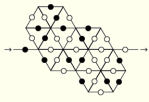
advent calendar 2Up next, some math in the holiday spirit. Plus Magazine has a nice little advent calendar going on again this year. They’re counting down to Christmas by posting their “favourite bits of maths” – a new post each day. On the website you can see preview pictures for each day, which has me pretty excited. What could #7 be? What is going on in 18?! Check out #2. It’s a nice little explanation of a classic math story about Achilles and the tortoise. (Zeno’s Paradox). Plus Magazine is a great website in general, but you have to be prepared to do some reading. According to their about page,

Plus is an internet magazine which aims to introduce readers to the beauty and the practical applications of mathematics. A lot of people don’t have a very clear idea what “real” maths consists of, and often they don’t realise how many things they take for granted only work because of a generous helping of it.”

BONUS:  Take a look at the Plus Mag puzzle page!

Finally, you might remember James Tanton for his partition videos. Well, he just released a really cool series of videos and math activities that’s completely free and online. It’s kind of an entire math course (but it’s unlike any course you’ve  seen before), and it’s called “Exploding Dots.” As James says in the intro video above, this is his favorite topic of all time! The course is broken up into 4 lessons, with a handful of videos in each lesson, and there are some really nice questions to think about. I’ve studied math for many years at this point, but there were lots of things that surprised me.

If you’re ready to dig in, here’s a link to Lesson 1.1 Base Machines.

Have a great week, and bon appetit!