Category Archives: Math Munch

Pi Digit, Pi Patterns, and Pi Day Anthem

pivolant1

Painting by Renée Othot for Simon Plouffe’s birthday.

Welcome to this week’s Math Munch!

It’s here—the Pi Day of the Century happens on Saturday: 3-14-15!

How will you celebrate? You might check to see if there are any festivities happening in your area. There might be an event at a library, museum, school, or university near you.

(Here are some pi day events in NYC, Baltimore, San Francisco, Philadelphia, Houston, and Charlotte.)


John Conway at the pi recitation contest in Princeton.

John Conway at the pi recitation contest in Princeton.

There’s a huge celebration here in Princeton—in part because Pi Day is also Albert Einstein’s birthday, and Albert lived in Princeton for the last 22 years of his life. One event involves kids reciting digits of pi and and is hosted by John Conway and his son, a two-time winner of the contest. I’m looking forward to attending! But as has been noted, memorizing digits of pi isn’t the most mathematical of activities. As Evelyn Lamb relays,

I do feel compelled to point out that besides base 10 being an arbitrary way of representing pi, one of the reasons I’m not fond of digit reciting contests is that, to steal an analogy I read somewhere, memorizing digits of pi is to math as memorizing the order of letters in Robert Frost’s poems is to literature. It’s not an intellectually meaningful activity.

I haven’t memorized very many digits of pi, but I have memorized a digit of pi that no one else has. Ever. In the history of the world. Probably no one has ever even thought about this digit of pi.

And you can have your own secret digit, too—all thanks to Simon Plouffe‘s amazing formula.

plouffe

Simon’s formula shows that pi can be calculated chunk by chunk in base 16 (or hexadecimal). A single digit of pi can be plucked out of the number without calculating the ones that come before it.

Wikipedia observes:

The discovery of this formula came as a surprise. For centuries it had been assumed that there was no way to compute the nth digit of π without calculating all of the preceding n − 1 digits.

Check out some of Simon's math art!

Check out some of Simon’s math art!

Simon is a mathematician who was born in Quebec. In addition to his work on the digits of irrational numbers, he also helped Neil Sloane with his Encyclopedia of Integer Sequences, which soon online and became the OEIS (previously). Simon is currently a Trustee of the OEIS Foundation.

There is a wonderful article by Simon and his colleagues David Bailey, Jonathan Borwein, and Peter Borwein called The Quest for Pi. They describe the history of the computation of digits of pi, as well as a description of the discovery of their digit-plucking formula.

According to the Guinness Book of World Records, the most digits that someone has memorized and recited is 67,890. Unofficial records go up to 100,000 digit. So just to be safe, I’ve used an algorithm by Fabrice Bellard based on Simon’s formula to calculate the 314159th digit of pi. (Details here and here.) No one in the world has this digit of pi memorized except for me.

Ready to hear my secret digit of pi? Lean in and I’ll whisper it to you.

The 314159th digit of pi is…7. But let’s keep that just between you and me!

And just to be sure, I used this website to verify the 314159th digit. You can use the site to try to find any digit sequence in the first 200 million digits of pi.

Aziz and Peter's patterns.

Aziz & Peter’s patterns.

Next up: we met Aziz Inan in last week’s post. This week, in honor of Pi Day, check out some of the numerical coincidences Aziz has discovered in the early digits in pi. Aziz and his colleague Peter Osterberg wrote an article about their findings. By themselves, these observations are nifty little patterns. Maybe you’ll find some more of your own. (This kind of thing reminds me of the Strong Law of Small Numbers.) As Aziz and Peter note at the end of the article, perhaps the study of such little patterns will one day help to show that pi is a normal number.

And last up this week, to get your jam on as Saturday approaches, here’s the brand new Pi Day Anthem by the recently featured John Sims and the inimitable Vi Hart.

Bon appetit!

Sequence Day, Penguins, and a little folding

Welcome to this week’s Math Munch! And… happy Sequence Day!

Sequence day

If you didn’t know that today was Sequence Day, don’t feel bad– I didn’t know until I ran across this article written by Aziz Inan, an electrical engineering professor at the University of Portland. Why is today Sequence Day? Well, because all of the digits in the sequence 0, 1, 2, 3, 4, 5 appear in today’s date– 3-4-2015!

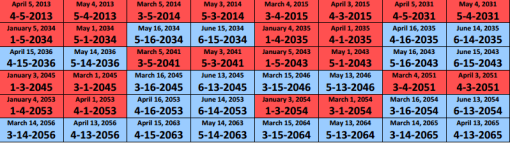
This particular Sequence Day isn’t super special. There will be another one with the exact same sequence on April 3 (4-3-2015). But, according to Aziz, April 3 will be the last Sequence Day of this year– and the last until 2031! Aziz made this chart of all the Sequence Days that will happen this century. There are 48 all together– and if you look carefully at the chart, you may notice some interesting patterns.

Sequences days this century

See how the Sequence Days mostly occur at the beginnings of decades, in the first half of the month, and never later in the year than June? Why do you think that might be? Also, the last Sequence Day of the 21st century is in 2065. That means we’ll have to wait almost 40 years for the next Sequence Day after that– until 2103! But, in the scheme of things, this actually isn’t so bad– there were no Sequence Days at all in the last century. (Why might that be?)

We all know about days like Pi Day (coming up soon on 3-14-15 — and it’s a special one because we’ve got those two additional digits this year!), but, as Aziz likes to show, lots of days can be mathematical holidays– if you just look carefully enough. Maybe you’ll find a mathematical holiday of your own! If you do, let us know. We love any excuse to have a party!

Next up, you think penguins are cute, right? Well, take a look at this:

You may have heard the narrator say, “Something more organized is going on.” Well, several mathematicians wondered what that more organized thing was… and it turns out to be very mathematical!

How many penguins do you see?

Francois Blanchette, a mathematician at the University of California, Merced, had the idea to use math to study how penguins keep warm while watching penguin movies like this one. He studies the math of something called fluid dynamics, which, basically, is how things like water and air flow. Francois and several other mathematicians at the University of Erlangen-Nuremberg in Germany noticed that when one penguin in a huddle moves just a little bit, it triggers a chain reaction in which all of the other penguins move in an organized way to keep warm. Their tiny movements cause the huddle to organize into the best shape for all penguins to keep warm during the cold of winter.

Huddle up, little guy!

Scientists and mathematicians are only now realizing all of the amazing ways that math comes into play in the lives of animals, especially in large groups. It seems that penguins are only the beginning! To learn more about the organization of large groups of animals, I suggest you check out this awesome PBS documentary about animal swarms.

Finally, we haven’t heard from Vi Hart in a while. If you’ve been feeling the need for some math art fun in your life, check out this video I dug up from the archives. Origami meets Pythagorean Theorem– what could be better?

Stay warm, and bon appetit!


SquareRoots, Concave States, and Sea Ice

Welcome to this week’s Math Munch!

The most epic Pi Day of the century will happen in just a few weeks: 3/14/15! I hope you’re getting ready. To help you get into the spirit, check out these quilts.

American Pi.

American Pi.

African American Pi.

African American Pi.

There’s an old joke that “pi is round, not square”—a punchline to the formula for the area of a circle. But in these quilts, we can see that pi really can be square! Each quilt shows the digits of pi in base 3. The quilts are a part of a project called SquareRoots by artist and mathematician John Sims.

John Sims.

John Sims.

There’s lots more to explore and enjoy on John’s website, including a musical interpretation of pi and some fractal trees that he has designed. John studied mathematics as an undergrad at Antioch College and has pursued graduate work at Wesleyan University. He even created a visual math course for artists when he taught at the Ringling College of Art and Design in Florida.

I enjoyed reading several articles (1, 2, 3, 4) about John and his quilts, as well as this interview with John. Here’s one of my favorite quotes from it, in response to “How do you begin a project?”

It can happen in two ways. I usually start with an object, which motivates an idea. That idea connects to other objects and so on, and, at some point, there is a convergence where idea meets form. Or sometimes I am fascinated by an object. Then I will seek to abstract the object into different spatial dimensions.

simstrees

Cellular Forest and Square Root of a Tree, by John Sims.

You can find more of John’s work on his YouTube channel. Check out this video, which features some of John’s music and an art exhibit he curated called Rhythm of Structure.

Next up: Some of our US states are nice and boxy—like Colorado. (Or is it?) Other states have very complicated, very dent-y shapes—way more complicated than the shapes we’re used to seeing in math class.

Which state is the most dent-y? How would you decide?

3fe3acace86442e7a0ddf5c7369f14dc.480x480x351

West Virginia is pretty dent-y. By driving “across” it, you can pass through many other states along the way.

The mathematical term for dent-y is “concave”. One way you might try to measure the concavity of a state is to see how far outside of the state you can get by moving in a straight line from one point in it to another. For example, you can drive straight from one place in West Virginia to another, and along the way pass through four other states. That’s pretty crazy.

But is it craziest? Is another state even more concave? That’s what this study set out to investigate. Click through to find out their results. And remember that this is just one way to measure how concave a state is. A different way of measuring might give a different answer.

Awesome animal kingdom gerrymandering video!

Awesome animal kingdom gerrymandering video!

This puzzle about the concavity of states is silly and fun, but there’s more here, too. Thinking about the denty-ness of geographic regions is very important to our democracy. After all, someone has to decide where to draw the lines. When regions and districts are carved out in a way that’s unfair to the voters and their interests, that’s called gerrymandering.

Karen Saxe

Karen Saxe.

To find out more about the process of creating congressional districts, you can listen to a talk by Karen Saxe, a math professor at Macalester College. Karen was a part of a committee that worked to draw new congressional districts in Minnesota after the 2010 US Census. (Karen speaks about compactness measures starting here.)

Recently I ran across an announcement for a conference—a conference that was all about the math of sea ice! I never grow tired of learning new and exciting ways that math connects with the world. Check out this video featuring Kenneth Golden, a leading mathematician in the study of sea ice who works at the University of Utah. I love the line from the video: “People don’t usually think about mathematics as a daring occupation.” Ken and his team show that math can take you anywhere that you can imagine.

Bon appetit!

Reflection sheet – SquareRoots, Concave States, and Sea Ice