The Penrose Triangle is an “impossible figure” – or so claim many reputable mathematics sources. It’s a triangle made of square beams that all meet a right angles – which does sound pretty impossible. Penrose polygons features in some of M. C. Escher’s most confounding artwork, like this picture:
But, little do these mathematicians know… you can build your own Penrose Triangle out of paper! Check out these instructions and confound your friends.
Want more optical illusions? Check out these awesome ones by scientist Michael Bach.
Mathematicians also seem pretty sure that .99999999…. = 1. Well, trust Vi Hart to show them what’s-what. Here’s a video in which she tells us all that, in fact, .99999999999… is NOT 1.
Finally, did you know that 13×7=28? Well, it does. And here’s the proof:
We’ve had a few posts (like this, this, and this) that included paper folding, but this week we really focus on doing it yourself. Check out Origamiplayer.com, a terrific website that doesn’t just show you origami models. It has an animator that folds them in front of you and waits for you to fold along with it. I really like this origami pentagon, but there’s lots of designs and you can even sort them by type or difficulty. You can change the speed or click around to different steps, so find a model you like and get folding!
Up next, meet the Huang Twins, 14-year old brothers from California. Mike and Cary have been working as a team to design and program all kinds of great web stuff. They actually have their own orgami animator to fold polyhedra. But my favorite thing of theirs is The Scale of the Universe 2, an incredible applet that let’s you compare the sizes of all kinds of things big and small. It uses scientific notation to describe the sizes, so if you’ve never seen that before, you might want to read up. It’s genius.
They’ve also written several excellent games, which we’ve added to our Math Games page. Cube Roll has a familiar format with a twist; The cube has to land on the correct side. I really like that one. No Walking, No Problem is another neat little puzzler. Use the objects to move side to side, because you can’t walk! Lastly, (though the Huangs didn’t write it) we’ve added Morpion Solitaire, a tough little game you can play online or on paper.
Say what? The Euclidean Algorithm is all about our good friend long division and is a great way of finding the greatest common factor of two numbers. It relies on the fact that if a number goes into two other numbers evenly, then it also goes into their difference evenly. For example, 5 goes into both 60 and 85–so it also goes into their difference, 25. Breaking up big objects into smaller common pieces is a big idea in mathematics, and the way this plays out with numbers has lots of awesome aural and visual consequences.
Here’s the link that prompted this post: a cool applet where you can create your own unique rhythms by playing different beats against each other. It’s called “Euclidean Rhythms” and was created by Wouter Hisschemöller, a computer and audio programmer from the Netherlands.
(Something that I like about Wouter’s post is that it’s actually a correction to his original posting of his applet. He explains the mistake he made, gives credit to the person who pointed it out to him, and then gives a thorough account of how he fixed it. That’s a really cool and helpful way that he shared his ideas and experiences. Think about that the next time you’re writing up some math!)
For your listening pleasure, here’s a techno piece that Wouter composed (not using his applet, but with clear influences!)
Here’s an applet that demonstrates the geometry of the Euclidean Algorithm. If you make a rectangle with whole-number length sides and continue to chop off the biggest (non-slanty) square that you can, you’ll eventually finish. The smallest square that you’ll chop will be the greatest common factor of the two original numbers. See it in action in the applet for any number pair from 1 to 100, with thanks to Brown mathematics professor Richard Evan Schwartz, who maintains a great website.
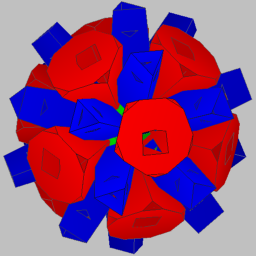
Holyhedron, layer three
One more thing, on an entirely different note: Holyhedron! A polyhedron where every face contains a hole. The story is given briefly here. Pictures and further details can be found on the website of Don Hatch, finder of the smallest known holyhedron. It’s a mathematical discovery less than a decade old–in fact, no one had even asked the question until John Conway did so in the 1990s!