Category Archives: Math Munch

Pi Digits, Pi-oetry, and Anti-Pi

This week’s Math Munch is brought to you by the number pi, because Wednesday (March 14th) is Pi Day!
 

Pi is an irrational number – meaning that it cannot be written as a ratio of integers.  Consequently, it’s decimal expansion goes on and on forever without any repeats.  But, that doesn’t mean people haven’t tried to list as many digits of pi as they can!  This site lists the first million digits of pi.  This site sings many of them – the tune is rather catchy.  And here you can search for strings of numbers in the decimal expansion for pi!  I searched for my birthday, 10/01/87 – it occurs 885,826 digits after the decimal point!

Remember the alphametics puzzle creator, Mike Keith?  Well, he writes poems and short stories in what he calls “Pilish,” in which the lengths of successive words represent successive digits of pi.  Here’s an explanation of the different forms of Pilish.  Mike holds the world record for the longest and second longest texts written in Pilish – they are his book, Not A Wake, and a short story, “Cadaeic Cadenza.”

Finally, as we celebrate pi on Wednesday, we should do so with some skepticism.  In the opinion of some mathematicians, pi is the wrong constant.  Inspired by this article by mathematician Bob Palais, some people have been speaking up in favor of the constant tau, which is double pi.  Here’s our favorite Vi Hart on the issue of pi:

You’ve heard what pi sounds like.  Want to know what tau sounds like?

Bon appetit!

Numberphile, Cube Snakes, and the Hypercube.

Welcome to this week’s Math Munch!

Each one of those pictures takes you to a math video.  Numberphile is a YouTube channel full of fantastic math videos by Brady Haran, each one about a different number.  Is one Googolplex bigger than the universe?  Why does Pac Man end after level 255?  Is 1 a prime number?  Click the numbers to watch the related video.  They also feature James Grime, one of my favorite math people on the internet.

Next up, let’s work on the Saint Ann’s School Problem of the Week.  You can read the fully worded question by following the link, but here it is in short:  If we start in the center, we can snake our way through the 9 small squares of a 3×3 square.  Can we snake our way through the 27 small cubes a 3x3x3 cube?  Can we do it if we start in the middle?

Can we snake our way through the 3x3x3 cube starting in the center?

There’s a new question posted every week (obviously), and if you check the Problem of the Week Archives, you can find more than 4 years of previous questions!  How many do you think we could solve if we did a 24 hour math marathon?

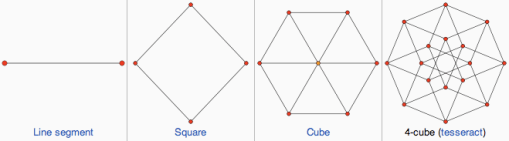
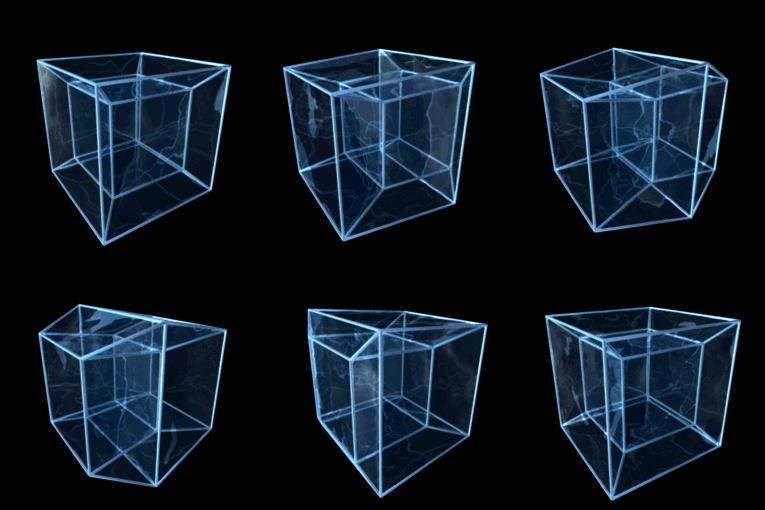
Finally, let’s have a mind-blowing look at higher dimensions.  The problem above is about whether a property of the square (a 2-dimensional object) can be carried over to the cube (its 3D counterpart).  So what is the 4-dimensional version of a cube?  The Hypercube!

The "cube" idea, from 1D to 4D

I’ve heard a lot of people say the 4th dimension is “time” or “duration,” but what would the 5th dimension be?  Well, here’s a video called “Imagining the Tenth Dimension.”  And if you’re hungry for more, there’s a series of 9 math videos called “Dimesions.”  All together it’s 2 amazing hours of math.  You can watch the first chapter online by clicking here.

Bon appetit!

Pentomino Puzzles, Knight’s Tours, and Decimal Maxing

Welcome to this week’s Math Munch!

Have a pentomino tiling problem that’s got you stumped?  Then perhaps the Pentominos Puzzle Solver will be right up your alley! Recently I’ve been thinking a lot about using computer programming and search algorithms to solve mathematical problems, and the Pentomino Puzzle Solver is a great example of the power of coding.  Written by David Eck, a professor of math and computer science at Brandeis University, the solver can find tilings of a variety of shapes.  Watch the application in slow-mo to see how it works; put it into high-gear to see the power of doing mathematics with computers!

Next, here’s a wonderful page about knight’s tours maintained by George Jelliss, a retiree from the UK.  He says on his introductory page, “I have been interested in questions related to the geometry of the knight’s move since the early 1970s.” George has investigated “leapers” or “generalized knights”—pieces that move in other L-shapes than the traditional 2×1—and he even published his own chess puzzle magazine for a number of years.  His webpage includes a great section about the history of knights tours, and I’m a fan of the beautiful catalog of “crosspatch” tours. Great stuff!

Multiplication, addition, division: which gives the biggest result?

Last but not “least”, to the left you’ll find a tiny chunk of a very large table that was constructed and colored by Debra Borkovitz, a math professor at Wheelock College.  Debra describes how, “Students often have poor number sense about multiplication and division with numbers less than one.”  She created an investigation where students decide, for any pair of decimals, which is biggest–multiplying them, adding them, or subtracting them.  For 1.0 and 1.0 the answer is easy–you should add them, so that you get 2.  .5 and 1 is trickier–adding yields 1.5, multiplying gives .5, but dividing 1 by .5 makes 2, since there are two halves in 1. Finding the biggest value possible given some restrictions is called “maximization” in mathematics, and it’s a very popular type of problem with many applications.

This investigation about makes me wonder: what other kinds of tables could I try to make?

Debra mentions that she got the inspiration for this problem from a newsletter put out by the Association of Women in Mathematics.  There’s lots to explore on their website, including an essay contest for middle schoolers, high schoolers, and undergraduates.

I hope you found something here to enjoy.  Bon appetit!