I ran across the most wonderful compendium of slidey and twisty puzzles this past week when sharing the famous 15-puzzle with one of my classes. It’s called Jaap’s Puzzle Page and it’s run by a software engineer from the Netherlands named Jaap Scherphuis. Jaap has been running his Puzzle Page since 1999.
Jaap Scherphuis and some of his many puzzles
Jaap first encountered hands-on mathematical puzzles when he was given a Rubik’s Cube as a present when he was 8 or 9. He now owns over 700 different puzzles!
Jaap’s catalogue of slidey and twisty puzzles is immense and diverse. Each puzzle is accompanied by a picture, a description, a mathematical analysis, and–SPOILER ALERT–an algorithm that you can use to solve it!
On top of this, all of the puzzles in Jaap’s list with asterisks (*) next to them have playable Java applets on…
I was saddened to learn this week of the passing of Solomon Golomb.
Solomon Golomb.
Can you imagine the world without Tetris? What about the world without GPS or cell phones?
Here at Math Munch we are big fans of pentominoes and polyominoes—we’ve written about them often and enjoy sharing them and tinkering with them. While collections of glued-together squares have been around since ancient times, Solomon invented the term “polyominoes” in 1953, investigated them, wrote about them—including this book—and popularized them with puzzle enthusiasts. But one of Solomon’s outstanding qualities as a mathematician is that he pursued a range of projects that blurred the easy and often-used distinction between “pure” and “applied” mathematics. While polyominoes might seem like just a cute plaything, Solomon’s work with discrete structures helped to pave the way for our digital world. Solomon compiled the first book on digital communications and his work led to such technologies as radio telescopes. You can hear him talk about the applications that came from his work and more in this video:
Here is another video, one that surveys Solomon’s work and life. It’s fast-paced and charming and features Solomon in a USC Trojan football uniform! Here is a wonderful short biography of Solomon written by Elwyn Berlekamp. And how about a tutorial on a 16-bit Fibonacci linear feedback shift register—which Solomon mentions as the work he’s most proud of—in Minecraft!
Another kind of mathematical object that Solomon invented is a Golomb ruler. If you think about it, an ordinary 12-inch ruler is kind of inefficient. I mean, do we really need all of those markings? It seems like we could just do away with the 7″ mark, since if we wanted to measure something 7 inches long, we could just measure from the 1″ mark to the 8″ mark. (Or from 2″ to 9″.) So what would happen if we got rid of redundancies of this kind? How many marks do you actually need in order to measure every length from 1″ to 12″?
An optimal Golomb ruler of order 4.
Portrait of Solomon by Ken Knowlton.
I was pleased to find that there’s actually a distributed computing project at distributed.net to help find new Golomb Rulers, just like the GIMPS project to find new Mersenne primes. It’s called OGR for “Optimal Golomb Ruler.” Maybe signing up to participate would be a nice way to honor Solomon’s memory. It’s hard to know what to do when someone passionate and talented and inspiring dies. Impossible, even. We can hope, though, to keep a great person’s memory and spirit alive and to help continue their good work. Maybe this week you’ll share a pentomino puzzle with a friend, or check out the sequences on the OEIS that have Solomon’s name attached to them, or host a Tetris or Blokus party—whatever you’re moved to do.
Thinking about Golomb rulers got me to wondering about what other kinds of nifty rulers might exist. Not long ago, at Gathering for Gardner, Matt Parker spoke about a kind of ruler that foresters use to measure the diameter of tree. Now, that sounds like quite the trick—seeing how the diameter is inside of the tree! But the ruler has a clever work-around: marking things off in multiples of pi! You can read more about this kind of ruler in a blog post by Dave Richeson. I love how Dave got inspired and took this “roundabout ruler” idea to the next level to make rulers that can measure area and volume as well. Generalizing—it’s what mathematicians do!
I was also intrigued by an image that popped up as I was poking around for interesting rulers. It’s called a seam allowance curve ruler. Some patterns for clothing don’t have a little extra material planned out around the edges so that the clothes can be sewn up. (Bummer, right?) To pad the edges of the pattern is easy along straight parts, but what about curved parts like armholes? Wouldn’t it be nice to have a curved ruler? Ta-da!
A seam allowance curve ruler.
David Cohen
Speaking of Gathering for Gardner: it was announced recently that G4G is helping to sponsor an online puzzle challenge called 52 Master Pieces. It’s an “armchair puzzle hunt” created by David Cohen, a physician in Atlanta. It will all happen online and it’s free to participate. There will be lots of puzzle to solve, and each one is built around the theme of a “master” of some occupation, like an architect or a physician. Here are a couple of examples:
Notice that both of these puzzles involve pentominoes!
The official start date to the contest hasn’t been announced yet, but you can get a sneak peek of the site—for a price! What’s the price, you ask? You have to solve a puzzle, of course! Actually, you have your choice of two, and each one is a maze. Which one will you pick to solve? Head on over and give it a go!
Maze A
Maze B
And one last thing before I go: if you’re intrigued by that medicine puzzle, you might really like checking out 100 different ways this shape can be 1/4 shaded. They were designed by David Butler, who teaches in the Maths Learning Centre at the University of Adelaide. Which one do you like best? Can you figure out why each one is a quarter shaded? It’s like art and a puzzle all at once! Can you come up with some quarter-shaded creations of your own? If you do, send them our way! We’d love to see them.
Eight ways to quarter the cross pentomino. 92 more await you!
For this last Thursday of April, we’ll be taking a look at some recent posts from our facebook page. Craig Kaplan writes about “near miss” polyhedra, a Pythagorean gif takes us to an curious math blog, and we find a beautiful portrait of a great mathematician. Let’s go!
Craig Kaplan
First is an article from a wonderful mathematician and mathematical artist by the name of Craig Kaplan. His name has popped up on Math Munch before (1, 2 ,3), in case it sounds familiar. You can check out Craig’s stuff on his website, Isohedral, or download his really great game, “Good Fences,” which I have on my iPhone.
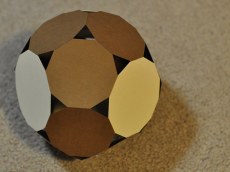
What I really wanted to share, however was Craig’s writing on “A New Near Miss.” This is a polyhedron that almost is… but just isn’t. It looks pretty good, but it can’t be. You’ll have to read to see what I mean.
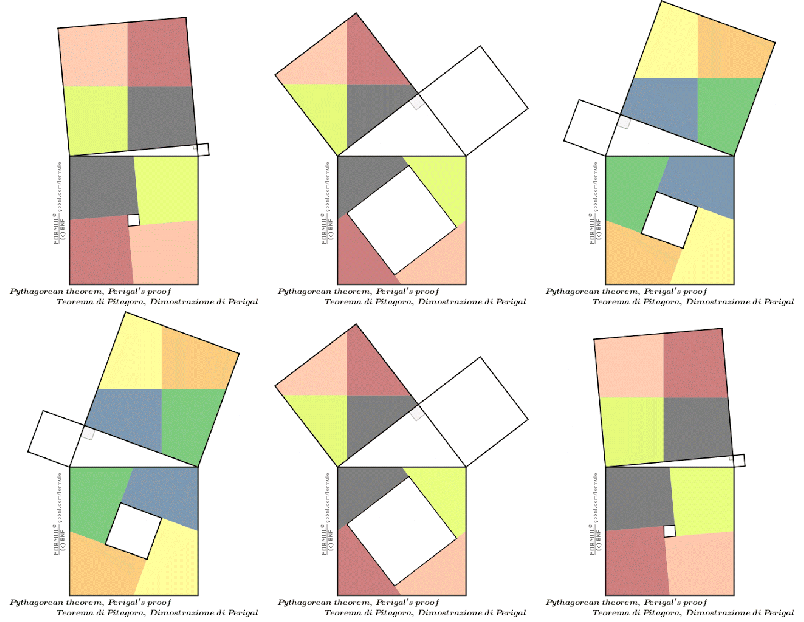
Up next, I found this little gif on our facebook page, and I absolutely loved it. It demonstrates the Pythagorean Theorem which says that as long as that’s a right triangle there, the big square on bottom is exactly as big as the two smaller squares combined. The animation shows you how to chop up the middle-sized square and recombine it with the small one to make the big one. I knew there were demonstrations/proofs like this, but this one opened my eyes to something I didn’t quite know before.
This gif sent me off on a journey through the internet to track down the source, and it led me to a site called Curiosa Mathematica. It’s a math blog featuring lots of random math goodies. There’s lots to see and get into (much like Math Munch). Here’s a quote I found there. I hope you find something you like too.
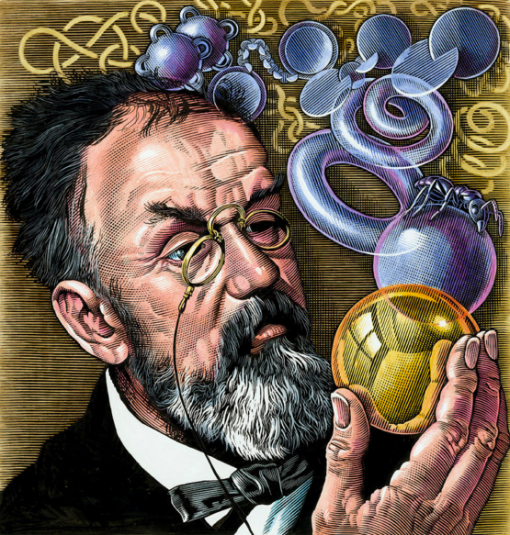
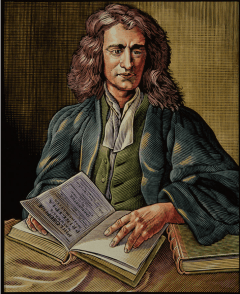
Finally, I was really taken by this piece of art (below). It’s a portrait of French mathematician Henri Poincaré, and it was drawn by Bill Sanderson. I can’t find much info on Bill, but WOW the piece is so cool. I love how he’s surrounded by his mathematical creations. I was hoping he had done more, and I did find a couple more (below), but not all I had hoped for.
French Mathematician Henri Poincaré
Alan Turing
Isaac Newton
Have some illustrative talent? I’d love to see your mathematician’s portrait. Feel free to send us something… anything.
I hope you enjoy your weekend and find something tasty out there in the mathematical interwebs. Bon appetit!



 What I really wanted to share, however was Craig’s writing on “
 Up next, I found this little gif on our facebook page, and I absolutely loved it. It demonstrates the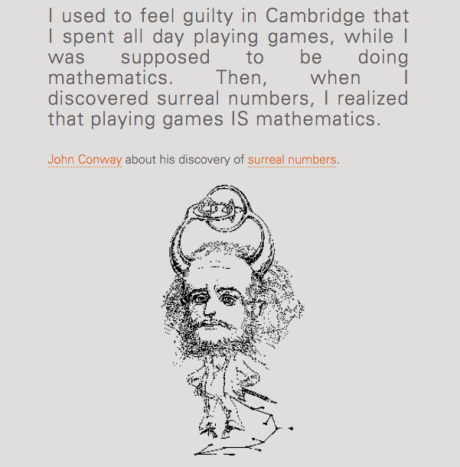

 Math Munch