Tag Archives: applet

A Sweater, Paper Projects, and Math Art Tools

Sondra Eklund and her Prime Factorization Sweater

Welcome to this week’s Math Munch!

Check out Sondra Eklund and her awesome prime factorization sweater! Sondra is a librarian and a writer who writes a blog where she reviews books. She also is a knitter and a lover of math!

Each number from two to one hundred is represented in order on the front of Sondra’s sweater. Each prime number is a square that’s a different color; each composite number has a rectangle for each of the primes in its prime factorization. This number of columns that the numbers are arranged into draws attention to different patterns of color. For instance, you can see a column that has a lot of yellow in it on the front of the sweater–these are all number that contain five as a factor.

You can read more about Sondra and her sweater on her blog. Also, here’s a response and variation to Sondra’s sweater by John Graham-Cumming.

Next up, do you like making origami and other constructions out of paper? Then you’ll love the site made by Laszlo Bardos called CutOutFoldUp.

Laszlo Bardos

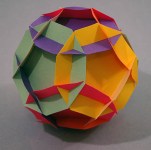
A Rhombic Spirallohedron

A decagon slide-together

Laszlo is a high school math teacher and has enjoyed making mathematical models since he was a kid. On CutOutFoldUp you’ll find gobs of projects to try out, including printable templates. I’ve made some slide-togethers before, but I’m really excited to try making the rhombic spirallohedron pictured above! What is your favorite model on the site?

Last up, Paul recently discovered a great mathematical art applet called Recursive Drawing. The tools are extremely simple. You can make circles and squares. You can stretch these around. But most importantly, you can insert a copy of one of your drawings into itself. And of course then that copy has a copy inside of it, and on and on. With a very simple interface and very simple tools, incredible complexity and beauty can be created.

Recursive Drawing was created by Toby Schachman, an artist and programmer who graduated from MIT and now lives in New York City and attends NYU.  You can watch a demo video below.

Recursive Drawing is one of the first applets on our new Math Art Tools page. We’ll be adding more soon. Any suggestions? Leave them in the comments!

Bon appetit!

Squiggles, Spheres, and Taxes

Welcome to this week’s Math Munch!

Check out this cool doodle animation from the blog of Matt Henderson. Matt studied math at Cambridge as an undergrad and now does research on speech and language technology. His idea for a doodle was to start with an equilateral triangle and then encircle it with squiggles until it eventually turned into a square.

Matt Henderson

Matt Henderson

Matt’s triangle-to-square squiggle

Matt has all kinds of beautiful and intricate mathematical images on his blog, many of them animated using computer code. He made a similar squiggle-doodle that evolves a straight line into a profile of his face; an animation of rolling a ball on a merry-go-round; a million dot generator; and many more!

Along the same “lines” as Matt’s squiggle, Ted Theodosopoulos wrote an article in Peer Points reviewing a research paper by Stanford mathematician Ravi Vakil. The title of Ravi’s paper is “The Mathematics of Doodling.”

Ravi’s doodle

Next up, check out this cool visualization of a sphere.

The title of the video is Spherikal and was created by Ion Lucin, a graphic artist in Spain.

Something neat comes out about Ion’s attitude toward learning and sharing in a comment he makes:

“Thanks for appreciating my work. I was thinking the same, not to reveal my secrets, but then, i to learned from the videos and tutorials of others, i have been working with 3D for a year and a half, and all i know about it i learned it by myself, by seeing tutorials, im from fine arts. In a way a feel i must share , like other did and helped me”

What a great attitude!

Another spherical idea comes from a post on one of my favorite websites: MathOverflow, a question-and-answer site for research-level mathematicians…and anyone else! The question I have in mind was posted by Joe O’Rourke, a mathematician at Smith College and one of my favorite posters on MathOverflow. It’s about a certain kind of random walk on a sphere. Check it out!

For this step distance, it looks like a random walk will fill up the whole sphere. What about other step distances?

Again, such a cool picture is created by translating a mathematical scenario into some computer code!

Since this week is when federal income taxes are due, I’ll leave you with a few links about taxes and the federal budget. First, here’s the IRS’s website for kids. (Yes, for real.)

Next, this infographic lets you examine how President Obama’s 2011 budget proposal divvied up funds to all of the different departments and projects of the federal government. Can you find NASA’s budget?

2011budget

On a more personal scale, this applet called “Where did my tax dollars go?” does just that—when you give it a yearly personal income, it will calculate how much of it will go toward different ends.

Finally, this applet lets you tinker with the existing tax brackets and see the effect on total revenue generated for the federal government. Can you find a flat tax rate that would keep total tax revenue the same?

Whew! That was a lot; I hope you didn’t find it too taxing. Bon appetit!

(Beat, Beat, Beat…)

Welcome to this week’s Math Munch!

What could techno rhythms, square-pieces dissections, and windshield wipers have in common?

Animation in which progressively smaller square tiles are added to cover a rectangle completely.

The Euclidean Algorithm!

Say what?  The Euclidean Algorithm is all about our good friend long division and is a great way of finding the greatest common factor of two numbers. It relies on the fact that if a number goes into two other numbers evenly, then it also goes into their difference evenly.  For example, 5 goes into both 60 and 85–so it also goes into their difference, 25.  Breaking up big objects into smaller common pieces is a big idea in mathematics, and the way this plays out with numbers has lots of awesome aural and visual consequences.

Here’s the link that prompted this post: a cool applet where you can create your own unique rhythms by playing different beats against each other.  It’s called “Euclidean Rhythms” and was created by Wouter Hisschemöller, a computer and audio programmer from the Netherlands.

(Something that I like about Wouter’s post is that it’s actually a correction to his original posting of his applet.  He explains the mistake he made, gives credit to the person who pointed it out to him, and then gives a thorough account of how he fixed it.  That’s a really cool and helpful way that he shared his ideas and experiences.  Think about that the next time you’re writing up some math!)

For your listening pleasure, here’s a techno piece that Wouter composed (not using his applet, but with clear influences!)

Breathing Pavement

Here’s an applet that demonstrates the geometry of the Euclidean Algorithm.  If you make a rectangle with whole-number length sides and continue to chop off the biggest (non-slanty) square that you can, you’ll eventually finish.  The smallest square that you’ll chop will be the greatest common factor of the two original numbers.  See it in action in the applet for any number pair from 1 to 100, with thanks to Brown mathematics professor Richard Evan Schwartz, who maintains a great website.

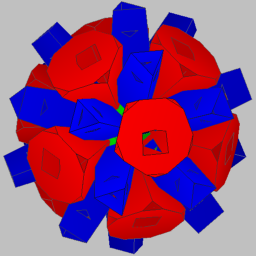
Holyhedron, layer three

One more thing, on an entirely different note: Holyhedron! A polyhedron where every face contains a hole. The story is given briefly here. Pictures and further details can be found on the website of Don Hatch, finder of the smallest known holyhedron.  It’s a mathematical discovery less than a decade old–in fact, no one had even asked the question until John Conway did so in the 1990s!

Have a great week! Bon appétit!