Tag Archives: applet

World’s Oldest Person, Graphing Challenge, and Escher Sketch

265282-jiroemon-kimura-the-world-s-oldest-living-man-celebrated-his-115th-birOn April 19th, Jiroeman Kimura celebrated his 116th birthday. He was – and still is – the world’s oldest person, and the world’s longest living man – ever. (As far as researchers know, that is. There could be a man who has lived longer that the public doesn’t know about.) The world’s longest living woman was Jeanne Calment, who lived to be 122 and a half!

Most people don’t live that long, and, obviously, only one person can hold the title of “Oldest Person in the World” at any given time. So, you may  be wondering… how often is there a new oldest person in the world? (Take a few guesses, if you like. I’ll give you the answer soon!)

stackSome mathematicians were wondering this, too, and they went about answering their question in the way they know best: by sharing their question with other mathematicians around the world! In April, a mathematician who calls himself Gugg, asked this question on the website Mathematics Stack Exchange, a free question-and-answer site that people studying math can use to share their ideas with each other. Math Stack Exchange says that it’s for “people studying math at any level.” If you browse around, you’ll see mathematicians asking for help on all kinds of questions, such as this tricky algebra problem and this problem about finding all the ways to combine coins to get a certain amount of money.  Here’s an entry from a student asking for help on trigonometry homework. You might need some specialized math knowledge to understand some of the questions, but there’s often one that’s both interesting and understandable on the list.

Anyway, Gugg asked on Math Stack Exchange, “How often does the oldest person in the world die?” and the community of mathematicians around the world got to work! Several mathematicians gave ways to calculate how often a new person becomes the oldest person in the world. You can read about how they worked it out on Math Stack Exchange, if you like, or on the Smithsonian blog – it’s a good example of how people use math to model things that happen in the world. Oh, and, in case you were wondering, a new person becomes the world’s oldest about every 0.65 years. (Is that around what you expected? It was definitely more often than I expected!)
advanced 4

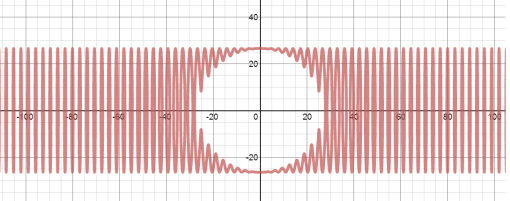
Next, check out this graph! Yes, that’s a graph – there is a single function that you can make so that when you graph it, you get that.  Crazy – and beautiful! This was posted by a New York City math teacher named Michael Pershan to a site called Daily Desmos, and he challenges you to figure out how to make it!  (He challenged me, too. I worked on this for days.)
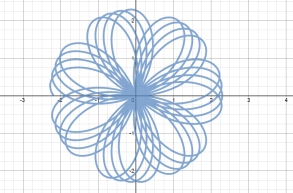
qod0nxgctfMichael made this graph using an awesome free, online graphing program called Desmos. Michael and many other people regularly post graphing challenges on Daily Desmos. Some of them are very difficult (like the one shown above), but some are definitely solvable without causing significant amounts of pain. They’re marked with levels “Basic” and “Advanced.” (See if you can spot contributions from a familiar Math Munch face…)
30a2

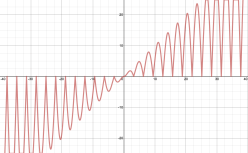
Here are more that I think are particularly beautiful. If you’re feeling more creative than puzzle-solvey, try making a cool graph of your own! You can submit a graphing challenge of your own to Daily Desmos.
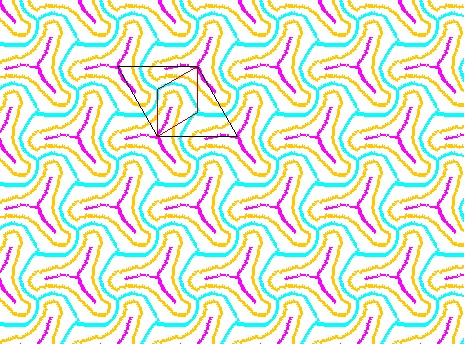
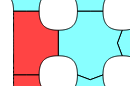
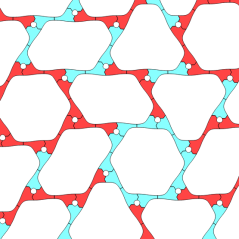
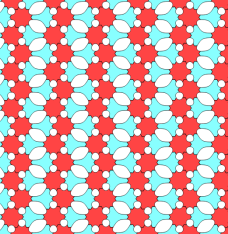
escher 3If you’ve got the creative bug, you could also check out a new MArTH tool that we just found called Escher Web Sketch. This tool was designed by three Swiss mathematicians, and it helps you to make intricate tessellations with interesting symmetries – like the ones made by the mathematical artist M. C. Escher. If you like Symmetry Artist and Kali, you’ll love this applet.

Be healthy and happy! Enjoy graphing and sketching! And, bon appetit!

Circling, Squaring, and Triangulating

Welcome to this week’s Math Munch!

How good are you at drawing circles? To find out, try this circle drawing challenge. There are adorable cat pictures for prizes!

What’s the best score you can get? And hey—what’s the worst score you can get? And how is your score determined? Well, no matter how long the path you draw is, using that length to make a circle would surround the most area. How close your shape gets to that maximum area determines your score.

Do you think this is a good way to measure how circular a shape is? Can you think of a different way?

Dido, Founder and Queen of Carthage.

Dido, Founder and Queen of Carthage.

This idea that a circle is the shape that has the biggest area for a fixed perimeter reminds me of the story of Dido and her famous problem. You can find a retelling of it at Mathematica Ludibunda, a charming website that’s home to all sorts of mathematical stories and puzzles. The whole site is written in the voice of Rapunzel, but there’s a team of authors behind it all. Dido’s story in particular was written by a girl named Christa.

If you have any trouble drawing circles in the applet, you might try using pencil and paper or a chalkboard. I bet if you practice your circling and get good at it, you might even be able to challenge this fellow:

The simple perfect squared square of smallest order.

The simple perfect squared square
of smallest order.

Next up is squaring and the incredible Squaring.Net. The site is run by Stuart Anderson, who works at the Reserve Bank of Australia and lives in Sydney.

The site gathers together all of the research that’s been done about breaking up squares and rectangles into squares. It’s both a gallery and an encyclopedia. I love getting to look at the timelines of discovery—to see the progress that’s been made over time and how new things have been discovered even this year! Just within the last month or so, Stuart and Lorenz Milla used computers to show that there are 20566 simple perfect squared squares of order 30. Squaring.Net also has a wonderful links page that can connect you to more information about the history of squaring, as well as some of the delightful mathematical art that the subject has inspired.

trinity-glass2-small sqBox8 wp4f6b3871_0f

Delaunay triangulationLast up this week is triangulating. There are lots of ways to chop up a shape into triangles, and so I’ll focus on one particular way known as a Delaunay triangulation. To make one, scatter some points on the plane. Then connect them up into triangles so that each triangle fits snugly into a circle that contains none of the scattered points.

Fun Fact #1: Delaunay triangulations are named for the Soviet mathematician Boris Delaunay. What else is named for him? A mountain! That’s because Boris was a world-class mountain climber.

Fun Fact #2: The idea of Delaunay triangulations has been rediscovered many times and is useful in fields as diverse as computer animation and engineering.

Here are two uses of Delaunay triangulations I’d like to share with you. The first comes from the work of Zachary Forest Johnson, a cartographer who shares his work at indiemaps.com. You can check out a Delaunay triangulation applet that he made and read some background about this Delaunay idea here. To see how Zach uses these triangulations in his map-making, you’ve gotta check out the sequence of images on this page. It’s incredible how just a scattering of local temperature measurements can be extended to one of those full-color national temperature maps. So cool!

me

Zachary Forest Johnson

A Delaunay triangulation used to help create a weather map.

A Delaunay triangulation used to help create a weather map.

Finally, take a look at these images that Jonathan Puckey created. Jonathan is a graphic artist who lives in Amsterdam and shares his work on his website. In 2008 he invented a graphical process that uses Delaunay triangulations and color averaging to create abstractions of images. You can see more of Jonathan’s Delaunay images here.

 armandmevis-1  fox

I hope you find something to enjoy in these circles, squares, and triangles. Bon appetit!

Ghost Diagrams, Three New Games, and Scrabble Tiles

Welcome to this week’s Math Munch!

gd0

A ghost diagram composed of two different tiles.

An organism is more than the sum of its organs. When the organs are fitted together, the organism becomes something more. This surprising something more we call “spirit” or “ghost”. Ghost Diagrams finds the ghosts implicit in simple sets of tiles.

So writes Paul Harrison, creator of the amazing Ghost Diagram applet. Paul creates all kinds of free software and has his Ph.D. in Computer Science. I found his Ghost Diagram applet through this huge list of links about generative art.

A '111-' tile connected to a '1aA1' tile.

A ‘111-‘ tile connected to a ‘1aA1’ tile.

Given a collection of tile types, the applet tries to find a way to connect them so that no tile has any loose ends. A tile type is specified through a string of letters, numbers, and dashes. Each of these specifies an edge. You can think of a four-character tile as being a modified square and a six-character tile as being a modified hexagon. Two tiles can connect if they have edges that match. Number edges match with themselves—1 matches with 1—while letter edges match with the same letter with opposite capitalization—a matches with A.

It’s amazing the variety of patterns that can emerge out of a few simple tiles. Here are a couple of ghost diagrams that I created. You can click them to see live versions in the applet. There are many other nice ghost diagrams that Paul has compiled on the site. Also, be sure to check out the random button—it’s a great way to get started on making a pattern of your own. I hope you enjoy tinkering with the ghost diagram applet as much as I have.

gd1 gd3
gd4 gd2

loops-of-zenAnd now for some more fun: three new games! When I ran across Loops of Zen, I had ghost diagrams on my mind. I think they have a similar feel to them. The goal in each level of Loops of Zen is to orient the paths and loops so that they connect up without any loose edges. I feel like this game—like good mathematics—requires both a big-picture, intuitive grasp of the playing field and detailed, logical thinking. Put another way, you need both global strategy  and local tactics. Also, if you like playing Entanglement, then I bet you’ll like Loops of Zen, too.

z-rox

Last week we wrote about Flatland. This book and the movies it inspired describe what it might be like if creatures of different dimensionality were to meet each other. The game Z-Rox puts you in the shoes of a Flatlander. Mystery shapes pass through your field of vision a slice at a time, and it’s up to you to identify what they are. It’s a tricky task that requires a good imagination.

Hat tip to Casual Girl Gamer for both of these great mathy games.

steppin-stones

Steppin’ Stones

Steppin’ Stones is a fun little spatial puzzle game I recently came across. You should definitely check it out. It also provides a nice segue to our last mathy item for the week, because a Steppin’ Stones board looks a lot like a Scrabble board. Scrabble, of course, is a word game. Aside from the arithmetic of keeping score, there isn’t much mathematics involved in playing it. In addition, the universe of Scrabble—the English dictionary—is not particularly elegant from a math standpoint. However, it’s the amazing truth that even in arenas that don’t seem very mathematical, math can often be applied in useful ways.

From a comic about Prime Scrabble on Spiked Math.

From a comic about Prime Scrabble on Spiked Math.

In Re-evaluating the values of the tiles in Scrabble™, the author—who goes by DTC and is a physics graduate student at Cornell—wonders whether the point values assigned to letters in Scrabble are correctly balanced. The basic premise is that the harder a letter is to play, the more it should be worth. DTC does what any good mathematician does—lays out assumptions clearly, reasons from them to make a model, critiques the arguments of others, and of course makes lots of useful calculations. One tool DTC uses is the Monte Carlo method. In the end, DTC finds that the current Scrabble point values are very close to what the model would assign.

MATHI really enjoyed the article, and I hope you will, too. And since Scrabble is a “crossword game”, I think I’ll leave you with a couple of “crossnumber” puzzles. Here are some straightforward ones, while these require a little more thinking.

Have a great week, and bon appetit!

P.S. I can’t resist sharing this video as a bonus: a cellular automaton of rock-paper-scissors! Blue beats green, green beats red, and red beats blue. Hooray for non-transitive swirls!