The Penrose Triangle is an “impossible figure” – or so claim many reputable mathematics sources. It’s a triangle made of square beams that all meet a right angles – which does sound pretty impossible. Penrose polygons features in some of M. C. Escher’s most confounding artwork, like this picture:
But, little do these mathematicians know… you can build your own Penrose Triangle out of paper! Check out these instructions and confound your friends.
Want more optical illusions? Check out these awesome ones by scientist Michael Bach.
Mathematicians also seem pretty sure that .99999999…. = 1. Well, trust Vi Hart to show them what’s-what. Here’s a video in which she tells us all that, in fact, .99999999999… is NOT 1.
Finally, did you know that 13×7=28? Well, it does. And here’s the proof:
Say what? The Euclidean Algorithm is all about our good friend long division and is a great way of finding the greatest common factor of two numbers. It relies on the fact that if a number goes into two other numbers evenly, then it also goes into their difference evenly. For example, 5 goes into both 60 and 85–so it also goes into their difference, 25. Breaking up big objects into smaller common pieces is a big idea in mathematics, and the way this plays out with numbers has lots of awesome aural and visual consequences.
Here’s the link that prompted this post: a cool applet where you can create your own unique rhythms by playing different beats against each other. It’s called “Euclidean Rhythms” and was created by Wouter Hisschemöller, a computer and audio programmer from the Netherlands.
(Something that I like about Wouter’s post is that it’s actually a correction to his original posting of his applet. He explains the mistake he made, gives credit to the person who pointed it out to him, and then gives a thorough account of how he fixed it. That’s a really cool and helpful way that he shared his ideas and experiences. Think about that the next time you’re writing up some math!)
For your listening pleasure, here’s a techno piece that Wouter composed (not using his applet, but with clear influences!)
Here’s an applet that demonstrates the geometry of the Euclidean Algorithm. If you make a rectangle with whole-number length sides and continue to chop off the biggest (non-slanty) square that you can, you’ll eventually finish. The smallest square that you’ll chop will be the greatest common factor of the two original numbers. See it in action in the applet for any number pair from 1 to 100, with thanks to Brown mathematics professor Richard Evan Schwartz, who maintains a great website.
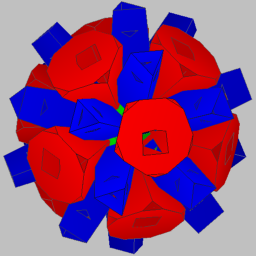
Holyhedron, layer three
One more thing, on an entirely different note: Holyhedron! A polyhedron where every face contains a hole. The story is given briefly here. Pictures and further details can be found on the website of Don Hatch, finder of the smallest known holyhedron. It’s a mathematical discovery less than a decade old–in fact, no one had even asked the question until John Conway did so in the 1990s!
Have a pentomino tiling problem that’s got you stumped? Then perhaps the Pentominos Puzzle Solver will be right up your alley! Recently I’ve been thinking a lot about using computer programming and search algorithms to solve mathematical problems, and the Pentomino Puzzle Solver is a great example of the power of coding. Written by David Eck, a professor of math and computer science at Brandeis University, the solver can find tilings of a variety of shapes. Watch the application in slow-mo to see how it works; put it into high-gear to see the power of doing mathematics with computers!
Next, here’s a wonderful page about knight’s tours maintained by George Jelliss, a retiree from the UK. He says on his introductory page, “I have been interested in questions related to the geometry of the knight’s move since the early 1970s.” George has investigated “leapers” or “generalized knights”—pieces that move in other L-shapes than the traditional 2×1—and he even published his own chess puzzle magazine for a number of years. His webpage includes a great section about the history of knights tours, and I’m a fan of the beautiful catalog of “crosspatch” tours. Great stuff!
Multiplication, addition, division: which gives the biggest result?
Last but not “least”, to the left you’ll find a tiny chunk of a very large table that was constructed and colored by Debra Borkovitz, a math professor at Wheelock College. Debra describes how, “Students often have poor number sense about multiplication and division with numbers less than one.” She created an investigation where students decide, for any pair of decimals, which is biggest–multiplying them, adding them, or subtracting them. For 1.0 and 1.0 the answer is easy–you should add them, so that you get 2. .5 and 1 is trickier–adding yields 1.5, multiplying gives .5, but dividing 1 by .5 makes 2, since there are two halves in 1. Finding the biggest value possible given some restrictions is called “maximization” in mathematics, and it’s a very popular type of problem with many applications.
This investigation about makes me wonder: what other kinds of tables could I try to make?
Debra mentions that she got the inspiration for this problem from a newsletter put out by the Association of Women in Mathematics. There’s lots to explore on their website, including an essay contest for middle schoolers, high schoolers, and undergraduates.
I hope you found something here to enjoy. Bon appetit!




 Math Munch