Tag Archives: games

Visualizations, Inspirations, and the Super Ultimate Graphing Challenge

Welcome to this week’s Math Munch!

Jason Davies

Meet Jason Davies, a freelance mathematician living in the UK. Growing up in Wales (one of the 4 countries of the United Kingdom) his classes were taught in Welsh. This makes Jason one of only about 611,000 people that speak the language, only 21.7% of the population of Wales! Imagine if only 1/5 of France spoke French!! These statistics are from a 2004 study, so the numbers may have changed a bit, but they still say something interesting don’t they?
Prime Seive

Jason is all about what numbers and pictures can tell us.  Since graduating from Cambridge, he’s been doing all sorts of data visualization and computer science on his own for various companies and IT firms. I originally found Jason through a link to his Prime Seive visualization, but take a look at his gallery and you’re bound to find something beautiful, interesting, interactive, and cool. I’ve linked to some of my favorites below.
Interactive Apollonian Gasket

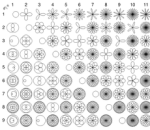
Rhodonea Curves

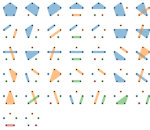
Set Partitions

I asked Jason a few questions about his interest in data visualization and math in general. Here’s a tasty little excerpt:

MM: What’s the most important trait for a mathematician to have? Is there one?

JD: Persistance is always useful in maths! I think the stereotype is to be analytical and logical, but in fact there are many other traits that are highly important, for instance communication skills. Mathematics is passed on from person to person, after all, so being able to communicate ideas effectively is dynamite.

MM: Do you have a message you’d like to give to young mathematicians?

JD: The world needs you!

Read the rest in our Q&A with Jason Davies, and you can see all of our interviews on the Q&A page we’ve just created.

Up next, a beautiful and inspiring video from Spain. The video is actually called Insprations, and it comes to us from Etérea Studios, the online home of animator Cristóbal Vila. In the intro he says, “I looked into that enormous and inexhaustible source of inspiration that is Escher and tried to imagine how it could be his workplace, what things would surround an artist like him, so deeply interested in science in general and mathematics in particular.”

I’d die to have an office like this!

It gets better.  Cristóbal added a page explaining all of the wonderful maths in the video. Click to read about Platonic solids, tilings, tangrams, and various works of art by M.C. Escher.

Finally, a nifty new game that explores the relationship between graphs and different kinds of motion. Super Ultimate Graphing Challenge is a game developed by Physics teacher Matthew Blackman to help his students understand the physics and mathematics of motion. You might not understand it all when you start, but keep playing and see what you can make of it. If you need a bit of help or have something to say, post it in our comments, and we’ll happily reply.

Bon appetit!
Math Cats, Frieze Music, and Numbers

Welcome to this week’s Math Munch!

I just ran across a website that’s chock full of cool math applets, links, and craft ideas – and perfect for fulfilling those summer math cravings!  Math Cats was created by teacher and parent Wendy Petti to, as she says on her site, “promote open-ended and playful explorations of important math concepts.”

Math Cats has a number of pages of interesting mathematical things to do, but my favorite is the Math Cats Explore the World page.  Here you’ll find links to cool math games and explorations made by Wendy, such as…

… the Crossing the River puzzle!  In this puzzle, you have to get a goat, a cabbage, and a wolf across a river without any of your passengers eating each other!  And…

… the Encyclogram!  Make beautiful images called harmonograms, spirographs, and lissajous figures with this cool applet.  Wendy explains some of the mathematics behind these images, too. And, one of my favorites…

Scaredy Cats!  If you’ve ever played the game NIM, this game will be very familiar.  Here you play against the computer to chase cats away – but don’t be left with the last cat, or you’ll lose!

These are only a few of the fun activities to try on Math Cats.  If you happen to be a teacher or parent, I recommend that you look at Wendy’s Idea Bank.  Here Wendy has put together a very comprehensive and impressive list of mathematics lessons, activities, and links contributed by many teachers.

Next, Vi Hart has a new video that showcases one of my favorite things in mathematics – the frieze.  A frieze is a pattern that repeats infinitely in one direction, like the footsteps of the person walking in a straight line above.  All frieze patterns have translation symmetry – or symmetry that slides or hops – but some friezes have additional symmetries.  The footsteps above also have glide reflection symmetry – a symmetry that flips along a horizontal line and then slides.  Frieze patterns frequently appear in architecture.  You can read more about frieze patterns here.

Reading about frieze patterns is all well and good – but what if you could listen to them?  What would a translation sound like?  A glide reflection?  The inverse of a frieze pattern?  Vi sings the sounds of frieze patterns in this video.

[youtube http://www.youtube.com/watch?v=Av_Us6xHkUc&feature=BFa&list=UUOGeU-1Fig3rrDjhm9Zs_wg]

Do you have your own take on frieze music?  Send us your musical compositions at MathMunchTeam@gmail.com .

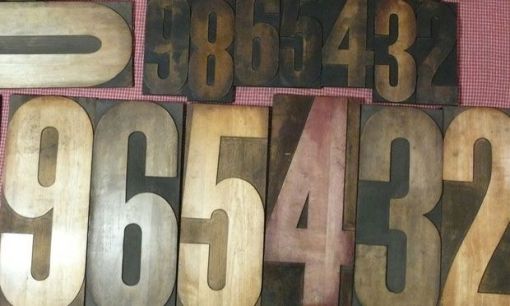
Finally, if I were to ask you to name the number directly in the middle of 1 and 9, I bet you’d say 5.  But not everyone would.  What would these strange people say – and why would they also be correct?  Learn about this and some of the history, philosophy, and psychology of numbers – and hear some great stories – in this podcast from Radiolab.  It’s called Numbers.

Bon appetit!

P.S. – Paul made a new Yoshimoto video!  The Mega-Monster Mesh comes alive!  Ack!

[youtube https://www.youtube.com/watch?v=PMpr8pA5lJw&feature=player_embedded]

P.P.S. – Last week – June 28th, to be exact – was Tau Day.  For more information about Tau Day and tau, check out the last bit of this old Math Munch post.  In honor of the occasion, Vi Hart made this new tau video.  And there’s a remix.

Knots, Torus Games, and Bagels

Welcome to this week’s Math Munch!

The things we have lined up for you this week have to do with a part of math called topology.  Topology is like geometry in many ways, except the shapes you study aren’t rigid.  Instead, you can twist, stretch, squish, and generally deform them in any way you like, so long as you don’t rip any holes or attach things that weren’t already attached.  One of the reasons why topology is interesting is that you get to play with new and fascinating shapes, like…

… knots!  This nifty site, Knot Theory Online, is full of interesting information about the study of mathematical knots and its history and applications.  For some basic information, check out the introduction to knots page.  It talks about what a knot is, mathematically speaking, and some ways that mathematicians answer the most important question in knot theory: is this knot the unknot?  The site also has some fun games in which you can play with transforming one knot into another.  Here’s my favorite: The Hunt for the Elusive Trefoil Knot.

Knots can also be works of art – and this site, Knot Plot, showcases artistic knots at their best.  Here are some images of beautiful decorative knots.

A really cool thing about knot theory is that it is a relatively new area of mathematical research – which means that there are many unsolved knot theory problems that a person without a lot of math training could attempt!  Here’s a page of “approachable open problems in knot theory,” compiled by knot theorist and Williams College professor Colin Adams.

One of a topologist’s favorite objects to study is one that you might encounter at breakfast – the torus, or donut (or bagel).  To get a sense for what makes a torus topologically interesting and for what life might be like if you lived on a torus (instead of a sphere, a topologically different surface), check out Torus Games.  Torus Games was created by mathematician Jeff Weeks.  You can play games that you’d typically play on a plane, in flat space – such as Tic-Tac-Toe, chess, and pool – but on a torus (or a Klein bottle) instead!

A maze – on a torus!

By the way, you can find Torus Games and other cool, free, downloadable math software on our new page – Free Math Software.  You’ll find links to other software that we love to use – such as Scratch and GeoGebra, and another program by Jeff Weeks called Curved Spaces.

All this talk of tori making you hungry?  Go get your own tasty torus (bagel), and try this fun trick to slice your bagel into two linked halves.  This topologically delicious breakfast problem was created by mathematical artist George Hart.

Bon appetit!  (Literally, this time.)