Tag Archives: games

Scott Kim, Puzzles, and Games

Welcome to this week’s Math Munch!

Scott Kim

Meet Scott Kim.  He’s loved puzzles ever since he was a kid, so these days he designs puzzles for a living.  He’s been writing puzzles for Discover Magazine for years in a monthly column called “The Boggler.”  Click that link to look through some of his Boggler archives.  Here’s a cool one he wrote in 2002 about hypercubes and the 4th dimension.

Ambigram

In his 11-minute TED talk, Scott tells the story of his career and shares some of his favorite puzzles, games, and ambigrams.  It’s also completely clear how much he really loves what he does (as do I.)

Knights on Horseback – M.C. Escher

I’ve always loved “figure/ground” images, where the leftover space from one shape creates another recognizable shape.  M.C. Escher created some of the most famous and well-known examples of figure/ground art, but Scott Kim took the idea a step further – making an interactive puzzle game based on the ideas.  Naturally, the game is called “Figure Ground,” and it’s delightfully tricky.  You can even create your own levels.  Scott has a whole page of web games.  Go play!

Symmetrical Alphabet – Ambigram by Scott Kim

Still hungry for more Scott Kim?  He gave a presentation for the Museum of Math‘s lecture series, Math Encounters.  You can watch the full-length video here.  You can also watch an interview he did with Vi Hart by clicking here.

Finally, after you read a Math Munch (or right in the middle) do you ever have a question you wish someone could answer or something you want explained?  Or do you ever wish we could help you find more of something you liked in the post?  Well we can do that!  Just leave a comment on the bottom of the page, and the Math Munch team will be very happy to answer.  We’d love to hear from our readers.

Bon appetit!

Origami, Games, and the Huang Twins

Welcome to this week’s Math Munch!

Origami Whale

We’ve had a few posts (like this, this, and this) that included paper folding, but this week we really focus on doing it yourself.  Check out Origamiplayer.com, a terrific website that doesn’t just show you origami models.  It has an animator that folds them in front of you and waits for you to fold along with it.  I really like this origami pentagon, but there’s lots of designs and you can even sort them by type or difficulty.  You can change the speed or click around to different steps, so find a model you like and get folding!

Up next, meet the Huang Twins, 14-year old brothers from California.  Mike and Cary have been working as a team to design and program all kinds of great web stuff.  They actually have their own orgami animator to fold polyhedra.  But my favorite thing of theirs is The Scale of the Universe 2, an incredible applet that let’s you compare the sizes of all kinds of things big and small.  It uses scientific notation to describe the sizes, so if you’ve never seen that before, you might want to read up.  It’s genius.

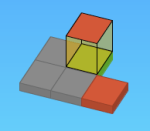
They’ve also written several excellent games, which we’ve added to our Math Games page.  Cube Roll has a familiar format with a twist; The cube has to land on the correct side.  I really like that one.  No Walking, No Problem is another neat little puzzler.  Use the objects to move side to side, because you can’t walk!  Lastly, (though the Huangs didn’t write it) we’ve added Morpion Solitaire, a tough little game you can play online or on paper.

Bon appetit!

Cube Roll

No Walking, No Problem

Morpion Solitaire

Number Gossip, Travels, and Topology

Thanksgiving was great, but I hope you saved room for this week’s Math Munch!

First up, meet Tanya Khovonova, a mathematician and blogger who works at MIT.  Number Gossip is a website of hers where you can find the mysterious facts behind your favorite numbers.  For instance, did you know that the opposite sides of a die add to 7, or that 7 is the only prime number followed by a cube (8=23)? Speaking of 7, I also found this cool test for divisibility by 7 on Tanya’s website.

Tanya Khovonova

Is that divisible by 7? Let's take a walk.

Read about how to use it here, but basically you follow that diagram a certain way, and if you land back at the white dot, then you’re number is divisible by 7. I’m amazed and trying to figure out how it works!

Infographic - Holiday Travel Patterns

Next up, I wanted to share this incredible picture I found today.  It’s an infographic showing travel patterns in the US during the holiday season.  The picture must represent millions of little pieces of data, so I’ve spent a lot of time staring and analyzing it.  Did you notice the bumps in the bottom?  Why is that happening?  Why are the blue lines different from the white lines? There are so many good things to be seen.

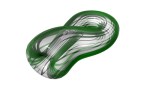
Finally, take a look at these pictures!  They’re from Kenneth Baker’s Sketches of Topology blog.  Kenneth makes images demonstrating ideas in topology, one of the most visually appealing branches of mathematics.  Some of it is tough to understand, but the pictures certainly are fascinating.

On a related point, have you taken a look at the Math Munch page of math games? (You can always find the link at the top of the column to the right.)  I just added a topology game, the Four Color Game, and I’m kind of loving it.  It’s based on a famous math result about only needing 4 colors to nicely color any flat map.  This is called the Four Color Theorem, and it’s a part of topology.

Bon appetit!