Tag Archives: geometry

Fullerenes, Fibonacci Walks, and a Fourier Toy

Welcome to this week’s Math Munch!
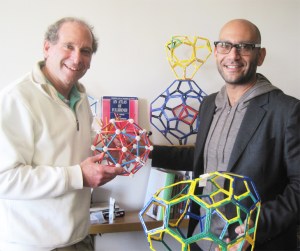
Stan and James

Stan and James

Earlier this month, neuroscientists Stan Schein and James Gayed announced the discovery of a new class of polyhedra. We’ve often posted about Platonic solids here on Math Munch. The shapes that Stan and James found have the same symmetries as the icosahedron and dodecahedron, and they also have all equal edge lengths.

One of Stan and James's shapes, made of equilateral pentagons and hexagons.

One of Stan and James’s shapes, made of equilateral pentagons and hexagons.

These new shapes are examples of fullerenes, a kind of shape named after the geometer, architect, and thinker Buckminster Fuller. In the 1980s, chemists discovered that molecules made of carbon can occur in polyhedral shapes, both in the lab and in nature. Stan and James’s new fullerenes are modifications of some existing shapes first described in 1937 by Michael Goldberg. The faces of Goldberg’s shapes were warped, not flat, and Stan and James showed that flattening can be achieved—thus turning Goldberg’s shapes into true polyhedra—while also having all equal edge lengths. There’s great coverage of Stan and James’s discovery in this article at Science News and a fascinating survey of the media’s coverage of the discovery by Adam Lore on his blog. Adam’s post includes an interview with Stan!

Next up—how much fun is it to find a fractal that’s new to you? That happened to me recently when I ran across the Fibonacci word fractal.
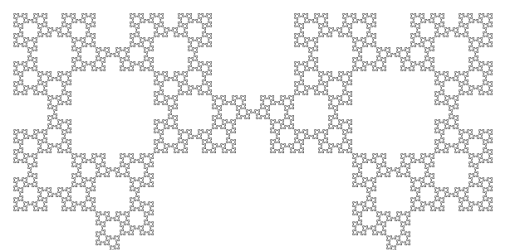
A portion of a Fibonacci word curve.

A portion of a Fibonacci word curve.

Fibonacci “words”—really just strings of 0’s and 1’s—are constructed kind of like the numbers in the Fibonacci sequence. Instead of adding numbers previous numbers to get new ones, we link up—or “concatenate”—previous words. The first few Fibonacci words are 1, 0, 01, 010, 01001, and 01001010. Do you see how new words are made out of the two previous ones?

Here’s a variety of images of Fibonacci word fractals, and you can find more details about the fractal in this article. The infinite Fibonacci word has an entry at the OEIS, and you can find a Fibonacci word necklace on Etsy. Dale Gerdemann, a linguist at the University of Tübingen, has a whole series of videos that show off patterns created out of Fibonacci words. Here is one of my favorites:

Last but not least this week, check out this groovy applet!

Lucas's applet showing the relationship between epicycles and Fourier series

Lucas’s applet showing the relationship between epicycles and Fourier series

A basic layout of Ptolemy's model, including epicycles.

A basic layout of Ptolemy’s model, including epicycles.

Sometime around the year 200 AD, the astronomer Ptolemy proposed a way to describe the motion of the sun, moon, and planets. Here’s a video about his ideas. Ptolemy relied on many years of observations, a new geometrical tool we call “trigonometry”, and a lot of ingenuity. He said that the sun, moon, and planets move around the earth in circles that moved around on other circles—not just cycles, but epicycles. Ptolemy’s model of the universe was incredibly accurate and was state-of-the-art for centuries.
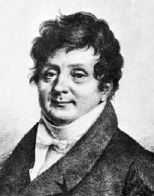
Joseph Fourier

Joseph Fourier

In 1807, Joseph Fourier turned the mathematical world on its head. He showed that periodic functions—curves with a repeated pattern—can be built by adding together a very simple class of curves. Not only this, but he showed that curves created in this way could have breaks and gaps even though they are built out of continuous curves called “sine” and “cosine”. (Sine and cosine are a part of the same trigonometry that Ptolemy helped to found.) Fourier series soon became a powerful tool in mathematics and physics.
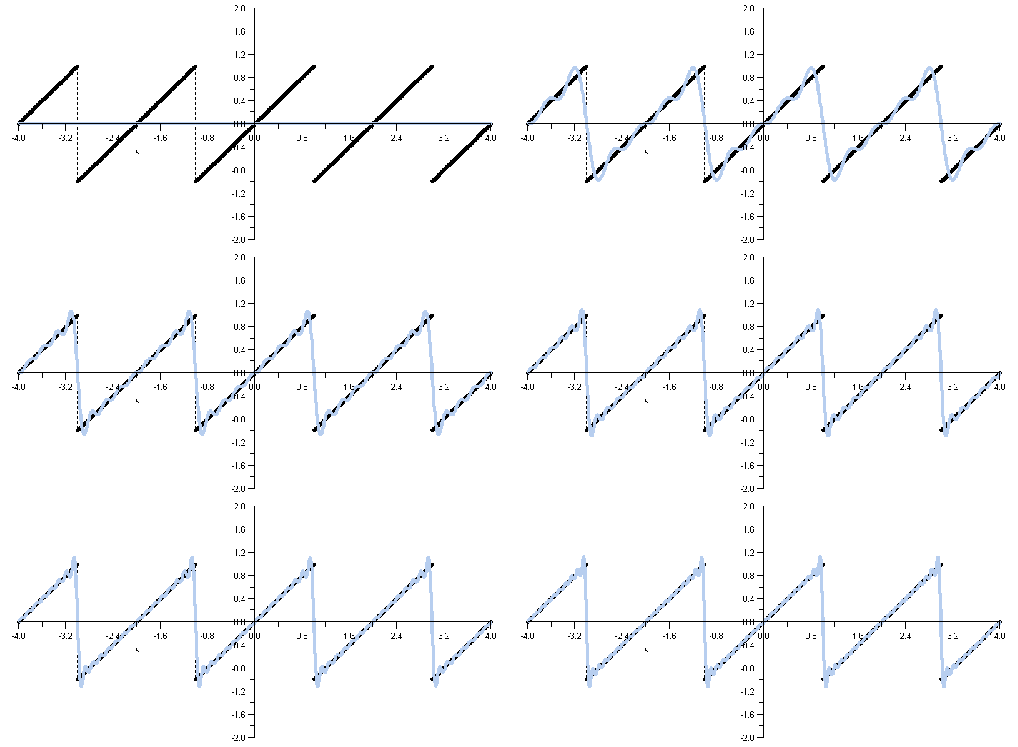
A Fourier series that converges to a discontinuous function.

A Fourier series that converges to a discontinuous function.

And then in the early 21st century Lucas Vieira created an applet that combines and sets side-by-side the ideas of Ptolemy and Fourier. And it’s a toy, so you can play with it! What cool designs can you create? We’ve featured some of Lucas’s work in the past. Here is Lucas’s short post about his Fourier toy, including some details about how to use it.

Bon appetit!

Byrne’s Euclid, Helen Friel, and PolygonJazz

Welcome to this week’s Math Munch! We’ve got geometry galore, starting with a series of historical math diagrams and a color update to Euclid’s Elements. Then it’s onto modern day paper artist Helen Friel, and finally a nifty new app that makes music from polygons. Let’s get into it.

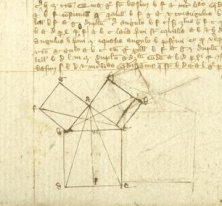
Euclid’s “Elements” was written around 300BC. It was the first great compilation of geometric knowledge, broken into 13 books, and it is one of the most influential books of all time. Euclid’s proof of the Pythagorean Theorem may be his most famous proof from the book (and all of mathematics for that matter), and in the pictures below you can see three diagrams of the proof, spanning seven centuries.

Nasir al-Din al-Tusi's 13th century arabic translation of Euclid's proof.

Persian mathematician Nasir al-Din al-Tusi‘s 13th century arabic translation of Euclid’s proof.

Late 14th century English manuscript

A late 14th century English manuscript of Euclid’s “Elements.”

The idea in each picture is that the area of the top two squares adds up exactly to the area of the bottom square. In the picture below, we see the big square broken up into blue and yellow pieces, whose areas are the same as the squares above them.

Oliver Byrne's 1871 color edition

Oliver Byrne’s 1847 color edition.  Click the image for the full proof of the Pythagorean Theorem as presented by Oliver Byrne in 1847.

This color version comes from Oliver Byrne’s 1847 edition, “The First Six Books of the Elements of Euclid, with Coloured Diagrams and Symbols.” (completely available online). I find the diagrams really beautiful and charming. There’s something extremely modern about them (see De Stijl) though they’re more than 150 years old now. See if you can follow his Oliver Byrne’s version of Euclid’s proof. It’s quite short.

Paper Engineer Helen Friel


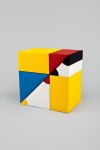
“They’re an absolutely beautiful piece of work and far ahead of their time,” said paper engineer Helen Friel. Helen lives in London, and and as part of a charity project, she designed paper sculptures of Oliver Byrne’s diagrams.

Euclid 2 Euclid 4 Euclid 3 Euclid 1

In an interview, she explained, “It’s a more visual and intriguing way to describe the geometry. I love anything that simplifies. I find it very appealing!” In the interview, Helen also talks a little about her attraction to math. “There’s order in straight lines and geometry. Although my job is creative, I use as much logical progression as possible in my work.”

It’s also cool to see Helen’s work side by side with Oliver Byrne‘s, so click for that.

Screen Shot 2014-02-05 at 11.46.00 PM

Click to send us a pic.  Yes, that is a paper camera Helen made.

Downloadable model

Downloadable model

Perhaps the best part in all of this, though, is that you can download Helen’s Pythagaorean Theorem model and make your own! There are plain white version as well as color. If you end up making one, definitely email us a picture, and we’ll show it off here on Math Munch.

Oh, and here’s a quick video documenting the many versions Helen decided not to use.  So cool.

https://vimeo.com/60412320

Now, on to our final bite.
PolygonJazz Recently, John Miller sent me an email showing off his new iPad app called PolygonJazz. In the app, you control the starting direction for a ball inside a polygon. Once you start it moving, the ball bounces off the walls, making a sound every time it hits a side. Check out the video below. I noticed something about the speed of the ball. Can you spot it? (PolygonJazz is available for $0.99 on the iTunes store.)

Speaking of bouncing around, here‘s a previous Math Munch featuring some billiards, and here‘s another bouncy post that features one of my favorite juggling routines. Michael Moschen built a gigantic equilateral triangle and juggles silicon balls inside and off of it. As with the app, Michael is utilizing the sound and geometry of the collisions to make something beautiful. It’s quite mesmerizing.

Have a bouncy week, and bon appetit!

Light Bulbs, Lanterns, and Lights Out

Welcome to this week’s Math Munch!

thomas-edison

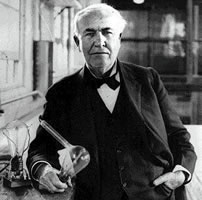
Edison with his light bulb.

On this day in 1880, Thomas Edison was given a patent for his most famous bright idea—the light bulb.

Edison once said, “Genius is one per cent inspiration, ninety-nine per cent perspiration”—a good reminder that putting in some work is important both in math and in life. He also said, “We don’t know a millionth of one percent about anything.” A humbling thought. Also, based on that quote, it sounds like Edison might have had a use for permilles or even permyraids in addition to percents!

Mike's octahedron.

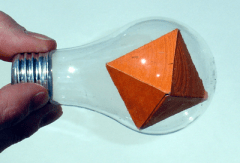
Mike’s octahedron-in-a-light-buld.

In celebration of this illustrious anniversary, I’d like to share some light mathematical fare relating to, well, light bulbs. For starters, J. Mike Rollins of North Carolina has created each of the Platonic solids inside of light bulbs, ship-in-a-bottle style. Getting just the cube to work took him the better part of twelve hours! Talk about perspiration. Mike has also made a number of lovely Escher-inspired woodcuts. Check ’em out!

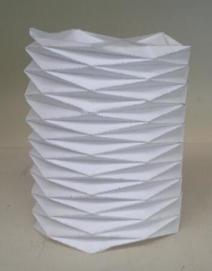
Evelyn's Schwartz lantern.

Evelyn’s Schwartz lantern.

Next up is a far-out example from calculus that’s also a good idea for an art project. It’s called the Schwartz lantern. I found out about this amazing object last fall when Evelyn Lamb tweeted and blogged about it.

The big idea of calculus is that we can find exact answers to tough problems by setting up a pattern of approximations that get better and better and then—zoop! take the process to its logical conclusion at infinity. But there’s a catch: you have to be careful about how you set up your pattern!

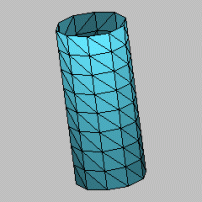
A "nicely" triangulated cylinder.

A “nicely” triangulated cylinder.

For example, if you take a cylinder and approximate its surface with a bunch of triangles carefully, you’ll end up with a surface that matches the cylinder in shape and size. But if you go about the process in a different way, you can end up with a surface that stays right near the cylinder but that has infinite area. That’s the Schwartz lantern, first proposed by Karl Hermann Amandus Schwarz of Cauchy-Schwartz fame. The infinite area happens because of all the crinkles that this devilish pattern creates. For some delightful technical details about the lantern’s construction, check out Evelyn’s post and this article by Conan Wu.

Maybe you’ll try folding a Schwartz lantern of your own. There’s a template and instructions on Conan’s blog to get you started. You’ll be glowing when you finish it up—especially if you submit a photo of it to our Readers’ Gallery. Even better, how about a video? You could make the internet’s first Schwartz lantern short film!

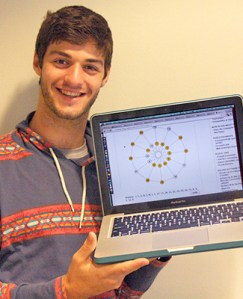
Robert Torrence and his Lights Out puzzle.

Robert and his Lights Out puzzle.

At the MOVES Conference last fall, Bruce Torrence of Randolf-Macon College gave a talk about the math of Lights Out. Lights Out is a puzzle—a close relative of Ray Ray—that’s played on a square grid. When you push one of the buttons in the grid it switches on or off, and its neighbors do, too. Bruce and his son Robert created an extension of this puzzle to some non-grid graphs. Here’s an article about their work and here’s an applet on the New York Times website where you can play Lights Out on the Peterson graph, among others. You can even create a Lights Out puzzle of your own! If it’s more your style, you can try a version of the original game called All Out on Miniclip.

The original Lights Out handheld game from 1995.

The original Lights Out handheld game from 1995.

There’s a huge collection of Lights Out resources on Jaap’s Puzzle Page (previously), including solution strategies, variations, and some great counting problems. Lights Out and Ray Ray are both examples of what’s called a “sigma-plus game” in the mathematical literature. Just as a bonus, there’s this totally other game called Light Up. I haven’t solved a single puzzle yet, but my limitations shouldn’t stop you from trying. Perspiration!

All this great math work might make you hungry, so…bon appetit!